Home > Press > Breaking down the Wiedemann-Franz law: In a study exploring the coupling between heat and particle currents in a gas of strongly interacting atoms, physicists at ETH Zurich find puzzling behaviours
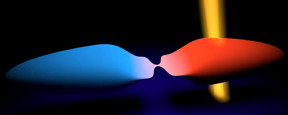 |
| Artistic impression of the two temperature-imbalanced reservoirs of cold atoms connected through a quantum point contact. The temperature balance is induced by a laser beam. CREDIT ETH Zurich/Esslinger group |
Abstract:
From everyday experience we know that metals are good conductors for both electricity and heat -- think inductive cooking or electronic devices warming up upon intense use. That intimate link of heat and electrical transport is no coincidence. In typical metals both sorts of conductivity arise from the flow of 'free' electrons, which move like a gas of independent particles through the material. But when fermionic carriers such as electrons interact with one another, then unexpected phenomena can arise, as Dominik Husmann, Laura Corman and colleagues in the group of Tilman Esslinger in the Department of Physics at ETH Zurich -- in collaboration with Jean-Philippe Brantut at the École Polytechnique Fédérale de Lausanne (EPFL) -- report in a paper published this week in the journal Proceedings of the National Academy of Sciences. Studying heat and particle conduction in a systems of strongly interacting fermionic atoms they found a range of puzzling behaviours that set this system apart from known systems in which the two forms of transport are coupled.
Breaking down the Wiedemann-Franz law: In a study exploring the coupling between heat and particle currents in a gas of strongly interacting atoms, physicists at ETH Zurich find puzzling behaviours
Zurich, Switzerland | Posted on August 10th, 2018In metals, the connection of thermal and electrical conductivity is described by the Wiedemann-Franz law, which has first been formulated in 1853. In its modern form the law states that at a fixed temperature, the ratio between the two types of conductivity is constant. The value of that ratio is quite universal, being the same for a remarkably wide range of metals and conditions. That universality breaks down, however, when the carriers interact with one another. This has been observed in a handful of exotic metals hosting strongly correlated electrons. But Husmann, Corman and their co-workers have now explored the phenomenon in a system in which they had exquisite control over all relevant parameters, enabling them to monitor particle and heat transport in unprecedented detail.
Clean transport
The carriers in their experiments are fermionic lithium atoms, which they cooled to sub-microkelvin temperatures and trapped using laser beams. Initially, they confined a few hundred thousand of these atoms to two independent reservoirs that can be heated individually. Once a temperature difference between the two reservoirs had been established, they opened a tiny restriction between them -- a so-called quantum point contact -- thus initiating transport of particles and heat (see the figure). The transport channel is defined and controlled using laser light as well. The experiment therefore provides an extraordinarily clean platform for studying fermionic transport. For example, in real materials, the lattice through which the electrons flow starts to melt at high temperatures. In contrast, in the cold-atom setup, with the structures defined by light, no such 'lattice heating' occurs, making it possible to focus on the carriers themselves.
Puzzling behaviour
When Husmann et al. determined the ratio between thermal and particle conductivity in their system, they found it to be an order of magnitude below the predictions of the Wiedemann-Franz law. This deviation indicates a separation of the mechanisms responsible for particle and heat currents, in contrast to the situation so universally observed for free carriers. As a result, their system evolved into a state in which heat and particle currents vanished long before an equilibrium between the two reservoirs in terms of temperature and particle number has been reached.
Moreover, another measure for thermoelectric behaviour, the Seebeck coefficient, was found to have a value close to that expected for a non-interacting Fermi gas. This is puzzling, because in some regions of the channel the strongly interacting atoms were in the superfluid regime (in which a gas or liquid flows without viscosity) and in the prototypical superfluid, helium-4, the Seebeck coefficient is zero. This discrepancy signals a different thermoelectric character for the fermionic gas studied by the ETH team.
These findings therefore pose new challenges for microscopic modelling of strongly interacting fermion systems. At the same time, the platform established with these experiments could help to explore novel concepts for thermoelectric devices, such as coolers and engines that are based on interconverting temperature differences into particle flow, and vice versa.
####
For more information, please click here
Contacts:
Andreas Trabesinger
41-791-289-860
Copyright © ETH Zurich Department of Physics
If you have a comment, please Contact us.Issuers of news releases, not 7th Wave, Inc. or Nanotechnology Now, are solely responsible for the accuracy of the content.
Bookmark:


| Related Links |
| Related News Press |
News and information
 Quantum computer improves AI predictions April 17th, 2026
Flexible sensor gains sensitivity under pressure April 17th, 2026
A reusable chip for particulate matter sensing April 17th, 2026
Detecting vibrational quantum beating in the predissociation dynamics of SF6 using time-resolved photoelectron spectroscopy April 17th, 2026
Quantum Physics
Detecting vibrational quantum beating in the predissociation dynamics of SF6 using time-resolved photoelectron spectroscopy April 17th, 2026
Beyond silicon: Electronics at the scale of a single molecule January 30th, 2026
Govt.-Legislation/Regulation/Funding/Policy
Quantum computer improves AI predictions April 17th, 2026
Metasurfaces smooth light to boost magnetic sensing precision January 30th, 2026
New imaging approach transforms study of bacterial biofilms August 8th, 2025
Possible Futures
A fundamentally new therapeutic approach to cystic fibrosis: Nanobody repairs cellular defect April 17th, 2026
UC Irvine physicists discover method to reverse ‘quantum scrambling’ : The work addresses the problem of information loss in quantum computing system April 17th, 2026
Chip Technology
A reusable chip for particulate matter sensing April 17th, 2026
Metasurfaces smooth light to boost magnetic sensing precision January 30th, 2026
Discoveries
Quantum computer improves AI predictions April 17th, 2026
Flexible sensor gains sensitivity under pressure April 17th, 2026
A reusable chip for particulate matter sensing April 17th, 2026
Detecting vibrational quantum beating in the predissociation dynamics of SF6 using time-resolved photoelectron spectroscopy April 17th, 2026
Announcements
A fundamentally new therapeutic approach to cystic fibrosis: Nanobody repairs cellular defect April 17th, 2026
UC Irvine physicists discover method to reverse ‘quantum scrambling’ : The work addresses the problem of information loss in quantum computing system April 17th, 2026
Interviews/Book Reviews/Essays/Reports/Podcasts/Journals/White papers/Posters
A fundamentally new therapeutic approach to cystic fibrosis: Nanobody repairs cellular defect April 17th, 2026
UC Irvine physicists discover method to reverse ‘quantum scrambling’ : The work addresses the problem of information loss in quantum computing system April 17th, 2026
Battery Technology/Capacitors/Generators/Piezoelectrics/Thermoelectrics/Energy storage
Decoding hydrogen‑bond network of electrolyte for cryogenic durable aqueous zinc‑ion batteries January 30th, 2026
COF scaffold membrane with gate‑lane nanostructure for efficient Li+/Mg2+ separation January 30th, 2026
MXene nanomaterials enter a new dimension Multilayer nanomaterial: MXene flakes created at Drexel University show new promise as 1D scrolls January 30th, 2026
Grants/Sponsored Research/Awards/Scholarships/Gifts/Contests/Honors/Records
Quantum computer improves AI predictions April 17th, 2026
Detecting vibrational quantum beating in the predissociation dynamics of SF6 using time-resolved photoelectron spectroscopy April 17th, 2026
Metasurfaces smooth light to boost magnetic sensing precision January 30th, 2026
Photonics/Optics/Lasers
Metasurfaces smooth light to boost magnetic sensing precision January 30th, 2026
From sensors to smart systems: the rise of AI-driven photonic noses January 30th, 2026
Research partnerships
Lab to industry: InSe wafer-scale breakthrough for future electronics August 8th, 2025
HKU physicists uncover hidden order in the quantum world through deconfined quantum critical points April 25th, 2025
Quantum nanoscience
Beyond silicon: Electronics at the scale of a single molecule January 30th, 2026
MXene nanomaterials enter a new dimension Multilayer nanomaterial: MXene flakes created at Drexel University show new promise as 1D scrolls January 30th, 2026
ICFO researchers overcome long-standing bottleneck in single photon detection with twisted 2D materials August 8th, 2025
 |
||
 |
||
| The latest news from around the world, FREE | ||
 |
||
|
|
||
| Premium Products | ||
 |
||
|
Only the news you want to read!
Learn More |
||
 |
||
|
Full-service, expert consulting
Learn More |
||
|
|
||