Home > Press > Scientists verify a way of how to improve resolution of most powerful microscopes: The resolution and intensity of powerful nanoscopes could be enhanced by over 30% via non-spherical particle lenses
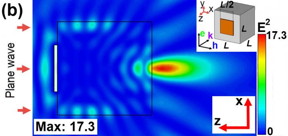 |
| Simulated near-field E 2 field enhancement distribution on xz plane with the amplitude mask apodization. CREDIT Tomsk Polytechnic University |
Abstract:
Researchers from Tomsk Polytechnic University (Russia) and Bangor University (UK) have experimentally verified anomalous amplitude apodization for non-spherical particles for the first time. This phenomenon makes it possible to boost the magnifying power of microscopes and to more effectively record molecules and viruses. The study results were reported in Journal of Infrared, Millimeter, and Terahertz Waves.
Scientists verify a way of how to improve resolution of most powerful microscopes: The resolution and intensity of powerful nanoscopes could be enhanced by over 30% via non-spherical particle lenses
Tomsk, Russia | Posted on May 1st, 2018"If we mask part of an ordinary lens surface with an optical filter, it will increase the magnifying power of the lens. But peak field intensity drops dramatically. The same effect is typical of spherical particle-lenses in nano-scopes or high-definition optical microscopes with a magnifying power of 50 nanometers. If we use non-spherical particles, including cylinders with illuminated butt-ends, as lenses, and if we mask part of the surface, it will simultaneously boost their magnifying power and peak field intensity. This is called the amplitude mask apodization effect," Professor Igor Minin from Tomsk Polytechnic University's faculty of electronic engineering noted.
Non-spherical particles function as super-lenses accumulating evanescent (damp) waves that can form an image with unprecedentedly high definition levels.
In their work, scientists cite experimental data confirming the existence of the amplitude mask apodization effect in the millimeter waveband. During their experiments, cuboid dielectric particles, part of whose surfaces (about 45 percent) are covered with a copper amplitude mask, showed a 36-percent increase in magnifying power, with peak field intensity levels increasing by over 30 percent.
You could say that spherical particle-lenses boost the magnifying power of nano-scopes only through the loss of energy. But when we use non-spherical particles, the magnifying power increases at a rate commensurate with the greater peak field intensity levels," Minin added. The long-term development of this technique will make it possible to obtain images of large biological molecules, viruses and the internal elements of living cells using non-spherical particles.
Experts will no longer have to painstakingly prepare various samples. For example, this is an important aspect of fluorescent microscopy. The amplitude mask apodization effect has a wide range of applications where sub-wavelength focusing is required. These are medicine, non-destructive testing, flaw detection, on chip processing and data transfer systems, etc.
####
For more information, please click here
Contacts:
Kristina Nabokova
7-382-270-5685
Copyright © Tomsk Polytechnic University
If you have a comment, please Contact us.Issuers of news releases, not 7th Wave, Inc. or Nanotechnology Now, are solely responsible for the accuracy of the content.
Bookmark:


| Related Links |
| Related News Press |
News and information
 Quantum computer improves AI predictions April 17th, 2026
Flexible sensor gains sensitivity under pressure April 17th, 2026
A reusable chip for particulate matter sensing April 17th, 2026
Detecting vibrational quantum beating in the predissociation dynamics of SF6 using time-resolved photoelectron spectroscopy April 17th, 2026
Imaging
Simple algorithm paired with standard imaging tool could predict failure in lithium metal batteries August 8th, 2025
Possible Futures
A fundamentally new therapeutic approach to cystic fibrosis: Nanobody repairs cellular defect April 17th, 2026
UC Irvine physicists discover method to reverse ‘quantum scrambling’ : The work addresses the problem of information loss in quantum computing system April 17th, 2026
Discoveries
Quantum computer improves AI predictions April 17th, 2026
Flexible sensor gains sensitivity under pressure April 17th, 2026
A reusable chip for particulate matter sensing April 17th, 2026
Detecting vibrational quantum beating in the predissociation dynamics of SF6 using time-resolved photoelectron spectroscopy April 17th, 2026
Announcements
A fundamentally new therapeutic approach to cystic fibrosis: Nanobody repairs cellular defect April 17th, 2026
UC Irvine physicists discover method to reverse ‘quantum scrambling’ : The work addresses the problem of information loss in quantum computing system April 17th, 2026
Tools
Metasurfaces smooth light to boost magnetic sensing precision January 30th, 2026
From sensors to smart systems: the rise of AI-driven photonic noses January 30th, 2026
Japan launches fully domestically produced quantum computer: Expo visitors to experience quantum computing firsthand August 8th, 2025
 |
||
 |
||
| The latest news from around the world, FREE | ||
 |
||
|
|
||
| Premium Products | ||
 |
||
|
Only the news you want to read!
Learn More |
||
 |
||
|
Full-service, expert consulting
Learn More |
||
|
|
||