Home > Press > Quantum recurrence: Everything goes back to the way it was: At some point, complex systems return almost exactly to their initial state. For the first time, this recurrence theorem has now been demonstrated with complex quantum many-body systems at TU Wien (Vienna)
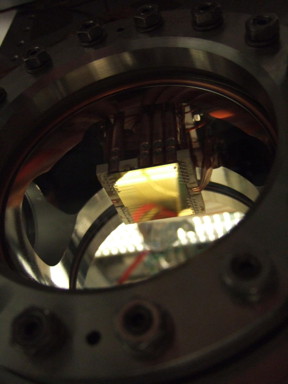 |
| The atom chip, used to control ultra cold atom clouds. CREDIT TU Wien |
Abstract:
It is one of the most astonishing results of physics: when a complex system is left alone, it will return to its initial state with almost perfect precision. Gas particles, for example, chaotically swirling around in a container, will return almost exactly to their starting positions after some time. This "Poincaré Recurrence Theorem" is the foundation of modern chaos theory. For decades, scientists have investigated how this theorem can be applied to the world of quantum physics. Now, researchers at TU Wien (Vienna) have successfully demonstrated a kind of "Poincaré recurrence" in a multi-particle quantum system. The results have been published in the journal Science.
Quantum recurrence: Everything goes back to the way it was: At some point, complex systems return almost exactly to their initial state. For the first time, this recurrence theorem has now been demonstrated with complex quantum many-body systems at TU Wien (Vienna)
Vienna, Austria | Posted on February 26th, 2018An Old Question, Revisited
At the end of the 19th century, the French scientist Henri Poincaré studied systems which cannot be fully analysed with perfect precision - for example solar systems consisting of many planets and asteroids, or gas particles, which keep bumping into each other. His surprising result: every state which is physically possible will be occupied by the system at some point - at least to a very good degree of approximation. If we just wait long enough, at some point all planets will form a straight line, just by coincidence. The gas particles in a box will create interesting patterns, or go back to the state in which they were when the experiment started.
A similar theorem can be proved for quantum systems. There, however, completely different rules apply: "In quantum physics, we have to come up with a completely new way of addressing this problem", says Professor Jörg Schmiedmayer from the Institute for Atomic and Subatomic Physics at TU Wien. "For very fundamental reasons, the state of a large quantum system, consisting of many particles, can never be perfectly measured. Apart from that, the particles cannot be seen as independent objects, we have to take into account that they are quantum mechanically entangled."
There have been attempts to demonstrate the effect of "Poincaré recurrence" in quantum systems, but until now this has only been possible with a very small number of particles, whose state was measured as precisely as possible. This is extremely complicated and the time it takes the system to return to its original state increases dramatically with the number of particles. Jörg Schmiedmayers team at TU Wien, however, chose a different approach: "We are not so much interested in the complete inner state of the system, which cannot be measured anyway", says Bernhard Rauer, first author of the publication. "Instead we want to ask: which quantities can we observe, that tell us something interesting about the system as a whole? And are there times at which these collective quantities return to their initial value?"
The team studied the behaviour of an ultracold gas, consisting of thousands of atoms, which is kept in place by electromagnetic fields on a chip. "There are several different quantities describing the characteristics of such a quantum gas - for example coherence lengths in the gas and correlation functions between different points in space. These parameters tell us, how closely the particles are linked by quantum mechanical effects", says Sebastian Erne, who was responsible for the theoretical calculations necessary for the project. "Our everyday intuition is not used to dealing with these quantities, but for a quantum systems, they are crucial."
Recurrence Discovered - in Collective Quantities
By measuring such quantities, which do not refer to single particles, but characterize the system as a whole, it was indeed possible to observe the long-sought quantum recurrence. And not only that: "With our atom chip, we can even influence the time it takes the system to return to one particular state", says Jörg Schmiedmayer. "By measuring this kind of recurrence, we learn a lot about the collective dynamics of the atoms - for example about the speed of sound in the gas or about scattering phenomena of density waves."
The old question, whether quantum systems show recurrences, can finally be answered: Yes, they do - but the concept of recurrence has to be slightly redefined. Instead of trying to map out the complete inner quantum state of a system, which cannot be measured anyway, it makes more sense to concentrate on quantities which can be measured in quantum experiments. These quantities can be observed to drift away from their initial value - and to return to their initial state eventually.
####
For more information, please click here
Contacts:
Florian Aigner
0043-158-801-41027
Prof. Jörg Schmiedmayer
Institute for Atomic and Subatomic Physics
TU Wien
Stadionallee 2, 1020 Wien
T: +43-1-58801-141801
Copyright © Vienna University of Technology
If you have a comment, please Contact us.Issuers of news releases, not 7th Wave, Inc. or Nanotechnology Now, are solely responsible for the accuracy of the content.
Bookmark:


| Related Links |
| Related News Press |
News and information
 Quantum computer improves AI predictions April 17th, 2026
Flexible sensor gains sensitivity under pressure April 17th, 2026
A reusable chip for particulate matter sensing April 17th, 2026
Detecting vibrational quantum beating in the predissociation dynamics of SF6 using time-resolved photoelectron spectroscopy April 17th, 2026
Quantum Physics
Detecting vibrational quantum beating in the predissociation dynamics of SF6 using time-resolved photoelectron spectroscopy April 17th, 2026
Beyond silicon: Electronics at the scale of a single molecule January 30th, 2026
MXene nanomaterials enter a new dimension Multilayer nanomaterial: MXene flakes created at Drexel University show new promise as 1D scrolls January 30th, 2026
Physics
UC Irvine physicists discover method to reverse ‘quantum scrambling’ : The work addresses the problem of information loss in quantum computing system April 17th, 2026
Possible Futures
A fundamentally new therapeutic approach to cystic fibrosis: Nanobody repairs cellular defect April 17th, 2026
UC Irvine physicists discover method to reverse ‘quantum scrambling’ : The work addresses the problem of information loss in quantum computing system April 17th, 2026
Discoveries
Quantum computer improves AI predictions April 17th, 2026
Flexible sensor gains sensitivity under pressure April 17th, 2026
A reusable chip for particulate matter sensing April 17th, 2026
Detecting vibrational quantum beating in the predissociation dynamics of SF6 using time-resolved photoelectron spectroscopy April 17th, 2026
Announcements
A fundamentally new therapeutic approach to cystic fibrosis: Nanobody repairs cellular defect April 17th, 2026
UC Irvine physicists discover method to reverse ‘quantum scrambling’ : The work addresses the problem of information loss in quantum computing system April 17th, 2026
Interviews/Book Reviews/Essays/Reports/Podcasts/Journals/White papers/Posters
A fundamentally new therapeutic approach to cystic fibrosis: Nanobody repairs cellular defect April 17th, 2026
UC Irvine physicists discover method to reverse ‘quantum scrambling’ : The work addresses the problem of information loss in quantum computing system April 17th, 2026
 |
||
 |
||
| The latest news from around the world, FREE | ||
 |
||
|
|
||
| Premium Products | ||
 |
||
|
Only the news you want to read!
Learn More |
||
 |
||
|
Full-service, expert consulting
Learn More |
||
|
|
||