Home > Press > Atomic structure of ultrasound material not what anyone expected
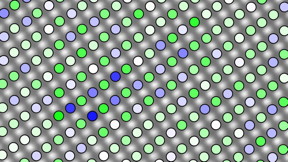 |
| This is an atomic resolution image illustrating the chemical distribution in lead magnesium niobate. Due to mass contrast, columns of atoms rich in magnesium (blue markers) can be discriminated from columns rich in niobium (green markers). CREDIT James LeBeau |
Abstract:
Lead magnesium niobate (PMN) is a prototypical "relaxor" material, used in a wide variety of applications, from ultrasound to sonar. Researchers have now used state-of-the-art microscopy techniques to see exactly how atoms are arranged in PMN - and it's not what anyone expected.
Atomic structure of ultrasound material not what anyone expected
Raleigh, NC | Posted on February 21st, 2018"This work gives us information we can use to better understand how and why PMN behaves the way it does - and possibly other relaxor materials as well," says James LeBeau, an associate professor of materials science and engineering at North Carolina State University and corresponding author of a paper on the work.
"What we've found is that the arrangement of atoms in PMN gradually shift along a gradient, from areas of high order to areas of low order; this happens throughout the material," LeBeau says. "That's substantially different than what conventional wisdom predicted, which was there would be alternating areas of high order and no order, right next to each other."
This information can be fed into computational models to provide new insights into how PMN's atomic structure influences its characteristics.
"This won't happen overnight, but we're optimistic that this may be a step toward the development of processes that create PMN materials with microstructures tailored to emphasize the most desirable characteristics for ultrasound, sonar or other applications," LeBeau says.
"It could also potentially offer insights into the role of atomic structure in other relaxor materials, providing similar long-term benefits for the entire class of materials."
The work was done with support from the Center for Dielectrics and Piezoelectrics, a National Science Foundation-funded center based at NC State that operates under grants IIP-1361571 and IIP-1361503. Additional support came from the Data-Enabled Science and Engineering of Atomic Structure National Science Foundation Research Traineeship, under grant DGE-1633587; and the Office of Naval Research Global, under grant N62909-16-12126.
####
For more information, please click here
Contacts:
Matt Shipman
919-515-6386
Copyright © North Carolina State University
If you have a comment, please Contact us.Issuers of news releases, not 7th Wave, Inc. or Nanotechnology Now, are solely responsible for the accuracy of the content.
Bookmark:


| Related Links |
| Related News Press |
News and information
 Quantum computer improves AI predictions April 17th, 2026
Flexible sensor gains sensitivity under pressure April 17th, 2026
A reusable chip for particulate matter sensing April 17th, 2026
Detecting vibrational quantum beating in the predissociation dynamics of SF6 using time-resolved photoelectron spectroscopy April 17th, 2026
Imaging
Simple algorithm paired with standard imaging tool could predict failure in lithium metal batteries August 8th, 2025
Possible Futures
A fundamentally new therapeutic approach to cystic fibrosis: Nanobody repairs cellular defect April 17th, 2026
UC Irvine physicists discover method to reverse ‘quantum scrambling’ : The work addresses the problem of information loss in quantum computing system April 17th, 2026
Discoveries
Quantum computer improves AI predictions April 17th, 2026
Flexible sensor gains sensitivity under pressure April 17th, 2026
A reusable chip for particulate matter sensing April 17th, 2026
Detecting vibrational quantum beating in the predissociation dynamics of SF6 using time-resolved photoelectron spectroscopy April 17th, 2026
Materials/Metamaterials/Magnetoresistance
First real-time observation of two-dimensional melting process: Researchers at Mainz University unveil new insights into magnetic vortex structures August 8th, 2025
Researchers unveil a groundbreaking clay-based solution to capture carbon dioxide and combat climate change June 6th, 2025
A 1960s idea inspires NBI researchers to study hitherto inaccessible quantum states June 6th, 2025
Institute for Nanoscience hosts annual proposal planning meeting May 16th, 2025
Announcements
A fundamentally new therapeutic approach to cystic fibrosis: Nanobody repairs cellular defect April 17th, 2026
UC Irvine physicists discover method to reverse ‘quantum scrambling’ : The work addresses the problem of information loss in quantum computing system April 17th, 2026
Interviews/Book Reviews/Essays/Reports/Podcasts/Journals/White papers/Posters
A fundamentally new therapeutic approach to cystic fibrosis: Nanobody repairs cellular defect April 17th, 2026
UC Irvine physicists discover method to reverse ‘quantum scrambling’ : The work addresses the problem of information loss in quantum computing system April 17th, 2026
 |
||
 |
||
| The latest news from around the world, FREE | ||
 |
||
|
|
||
| Premium Products | ||
 |
||
|
Only the news you want to read!
Learn More |
||
 |
||
|
Full-service, expert consulting
Learn More |
||
|
|
||