Home > Press > Researchers developed nanoparticle based contrast agent for dual modal imaging of cancer
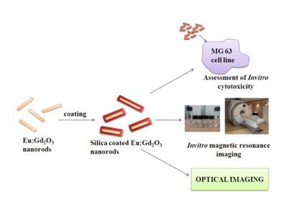 |
| This is a schematic diagram of the europium doped gadolinium oxide nanorods and the silica coating to improve the biocompatibility. Invitro cytotoxicity analysis, invitro magnetic resonance imaging and optical imaging of the prepared samples were carried out. CREDIT NANO Journal |
Abstract:
Researchers from PSG College of Technology, India have developed nano-contrast agents for magnetic resonance imaging (MRI) as well as optical imaging of cancer cells. This report will appear in the forthcoming issue of the journal NANO.
Researchers developed nanoparticle based contrast agent for dual modal imaging of cancer
Singapore | Posted on June 21st, 2017Cancer identification at the early stage remains a challenge to the researchers and clinicians. To diagnose the cancer cells, various imaging modalities are being used. Among these modalities, MRI and optical imaging are combined to develop dual modal imaging. Europium doped gadolinium oxide nanorods were synthesized by co-precipitation technique. Inorder to improve the biocompatibility, the nanoparticles were coated with silica. The invitro cytotoxicity results shows that the developed contrasts are not toxic at the lower concentrations. Invitro MR images reveals that the bright contrasts are produced when the concentration is increased.
According to Dr. R. Arun Kumar, Associate Professor, PSG College of Technology, "The developed nano-contrast serves for both MRI and optical imaging. Therefore, the imaging of cancer with higher sensitivity and spatial resolution is possible. The mortality rate can also be reduced."
One of the authors (Ms. T. Gayathri) is grateful to TEQIP for providing financial assistance. Further research on the optimization of the size, concentration and morphology of the nanorods are being carried out for better results. Additional co-authors of the paper are T. Gayathri from PSG College of Technology, B. S. Panigrahi from Indira Gandhi Centre for Atomic Research, Kalpakkam and B. Devanand from PSG Hospitals.
####
For more information, please click here
Contacts:
Jason Lim
646-65775 x247
Corresponding author for this study is R. Arun Kumar, .
Copyright © World Scientific
If you have a comment, please Contact us.Issuers of news releases, not 7th Wave, Inc. or Nanotechnology Now, are solely responsible for the accuracy of the content.
Bookmark:


| Related Links |
| Related News Press |
News and information
 Quantum computer improves AI predictions April 17th, 2026
Flexible sensor gains sensitivity under pressure April 17th, 2026
A reusable chip for particulate matter sensing April 17th, 2026
Detecting vibrational quantum beating in the predissociation dynamics of SF6 using time-resolved photoelectron spectroscopy April 17th, 2026
Imaging
Simple algorithm paired with standard imaging tool could predict failure in lithium metal batteries August 8th, 2025
First real-time observation of two-dimensional melting process: Researchers at Mainz University unveil new insights into magnetic vortex structures August 8th, 2025
Cancer
New molecular technology targets tumors and simultaneously silences two ‘undruggable’ cancer genes August 8th, 2025
Possible Futures
A fundamentally new therapeutic approach to cystic fibrosis: Nanobody repairs cellular defect April 17th, 2026
UC Irvine physicists discover method to reverse ‘quantum scrambling’ : The work addresses the problem of information loss in quantum computing system April 17th, 2026
Nanomedicine
A fundamentally new therapeutic approach to cystic fibrosis: Nanobody repairs cellular defect April 17th, 2026
New molecular technology targets tumors and simultaneously silences two ‘undruggable’ cancer genes August 8th, 2025
New imaging approach transforms study of bacterial biofilms August 8th, 2025
Electrifying results shed light on graphene foam as a potential material for lab grown cartilage June 6th, 2025
Discoveries
Quantum computer improves AI predictions April 17th, 2026
Flexible sensor gains sensitivity under pressure April 17th, 2026
A reusable chip for particulate matter sensing April 17th, 2026
Detecting vibrational quantum beating in the predissociation dynamics of SF6 using time-resolved photoelectron spectroscopy April 17th, 2026
Announcements
A fundamentally new therapeutic approach to cystic fibrosis: Nanobody repairs cellular defect April 17th, 2026
UC Irvine physicists discover method to reverse ‘quantum scrambling’ : The work addresses the problem of information loss in quantum computing system April 17th, 2026
Tools
Metasurfaces smooth light to boost magnetic sensing precision January 30th, 2026
From sensors to smart systems: the rise of AI-driven photonic noses January 30th, 2026
Japan launches fully domestically produced quantum computer: Expo visitors to experience quantum computing firsthand August 8th, 2025
Nanobiotechnology
A fundamentally new therapeutic approach to cystic fibrosis: Nanobody repairs cellular defect April 17th, 2026
New molecular technology targets tumors and simultaneously silences two ‘undruggable’ cancer genes August 8th, 2025
New imaging approach transforms study of bacterial biofilms August 8th, 2025
Electrifying results shed light on graphene foam as a potential material for lab grown cartilage June 6th, 2025
 |
||
 |
||
| The latest news from around the world, FREE | ||
 |
||
|
|
||
| Premium Products | ||
 |
||
|
Only the news you want to read!
Learn More |
||
 |
||
|
Full-service, expert consulting
Learn More |
||
|
|
||