Home > Press > Ultra-stable perovskite solar cell remains stable for more than a year
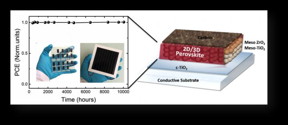 |
| This is a schematic representation of the findings of this study. CREDIT MK Nazeeruddin/EPFL |
Abstract:
Perovskite solar cells promise cheaper and efficient solar energy, with enormous potential for commercialization. But even though they have been shown to achieve over 22% power-conversion efficiency, their operational stability still fails market requirements. Despite a number of proposed solutions in fabrication technology, this issue has continued to undercut whatever incremental increases in efficiency have been achieved. EPFL scientists have now built a low-cost, ultra-stable perovskite solar cell that has operated for more than a year without loss in performance (11.2%). The work is published in Nature Communications.
Ultra-stable perovskite solar cell remains stable for more than a year
Lausanne, Switzerland | Posted on June 1st, 2017The lab of Mohammad Khaja Nazeeruddin at EPFL in collaboration with Michael Grätzel and Solaronix company has engineered what is known as 2D/3D hybrid perovskite solar cell. This combines the enhanced stability of 2D perovskites with 3D forms, which efficiently absorb light across the entire visible spectrum and transport electrical charges. In this way, the scientists were able to fabricate of efficient and ultra-stable solar cells, which is a crucial step for upscaling to a commercial level. The 2D/3D perovskite yields efficiencies of 12.9% (carbon-based architecture), and 14.6% (standard mesoporous solar cells).
The scientists built 10x10 cm2 solar panels using a fully printable industrial-scale process. The resulting solar cells have now delivered a constant 11.2% efficiency for more than 10,000 hours, while showing zero loss in performance as measured under standard conditions.
The breakthrough resolves the problem of perovskite solar-cell stability, and can viably move the technology into the commercial sphere.
###
This work was funded by the Marie Curie Institute, the Horizon 2020 program, the European Union Seventh Framework Programme (FP7/2007-2013) and Solaronix.
####
For more information, please click here
Contacts:
Nik Papageorgiou
41-216-932-105
Copyright © Ecole Polytechnique Fédérale de Lausanne
If you have a comment, please Contact us.Issuers of news releases, not 7th Wave, Inc. or Nanotechnology Now, are solely responsible for the accuracy of the content.
Bookmark:


| Related Links |
| Related News Press |
News and information
 Quantum computer improves AI predictions April 17th, 2026
Flexible sensor gains sensitivity under pressure April 17th, 2026
A reusable chip for particulate matter sensing April 17th, 2026
Detecting vibrational quantum beating in the predissociation dynamics of SF6 using time-resolved photoelectron spectroscopy April 17th, 2026
Perovskites
KAIST researchers introduce new and improved, next-generation perovskite solar cell November 8th, 2024
Efficient and stable hybrid perovskite-organic light-emitting diodes with external quantum efficiency exceeding 40 per cent July 5th, 2024
Possible Futures
A fundamentally new therapeutic approach to cystic fibrosis: Nanobody repairs cellular defect April 17th, 2026
UC Irvine physicists discover method to reverse ‘quantum scrambling’ : The work addresses the problem of information loss in quantum computing system April 17th, 2026
Discoveries
Quantum computer improves AI predictions April 17th, 2026
Flexible sensor gains sensitivity under pressure April 17th, 2026
A reusable chip for particulate matter sensing April 17th, 2026
Detecting vibrational quantum beating in the predissociation dynamics of SF6 using time-resolved photoelectron spectroscopy April 17th, 2026
Materials/Metamaterials/Magnetoresistance
First real-time observation of two-dimensional melting process: Researchers at Mainz University unveil new insights into magnetic vortex structures August 8th, 2025
Researchers unveil a groundbreaking clay-based solution to capture carbon dioxide and combat climate change June 6th, 2025
A 1960s idea inspires NBI researchers to study hitherto inaccessible quantum states June 6th, 2025
Institute for Nanoscience hosts annual proposal planning meeting May 16th, 2025
Announcements
A fundamentally new therapeutic approach to cystic fibrosis: Nanobody repairs cellular defect April 17th, 2026
UC Irvine physicists discover method to reverse ‘quantum scrambling’ : The work addresses the problem of information loss in quantum computing system April 17th, 2026
Interviews/Book Reviews/Essays/Reports/Podcasts/Journals/White papers/Posters
A fundamentally new therapeutic approach to cystic fibrosis: Nanobody repairs cellular defect April 17th, 2026
UC Irvine physicists discover method to reverse ‘quantum scrambling’ : The work addresses the problem of information loss in quantum computing system April 17th, 2026
Energy
Sensors innovations for smart lithium-based batteries: advancements, opportunities, and potential challenges August 8th, 2025
Simple algorithm paired with standard imaging tool could predict failure in lithium metal batteries August 8th, 2025
Solar/Photovoltaic
Spinel-type sulfide semiconductors to operate the next-generation LEDs and solar cells For solar-cell absorbers and green-LED source October 3rd, 2025
KAIST researchers introduce new and improved, next-generation perovskite solar cell November 8th, 2024
Groundbreaking precision in single-molecule optoelectronics August 16th, 2024
Development of zinc oxide nanopagoda array photoelectrode: photoelectrochemical water-splitting hydrogen production January 12th, 2024
 |
||
 |
||
| The latest news from around the world, FREE | ||
 |
||
|
|
||
| Premium Products | ||
 |
||
|
Only the news you want to read!
Learn More |
||
 |
||
|
Full-service, expert consulting
Learn More |
||
|
|
||