Home > Press > Sensors detect disease markers in breath
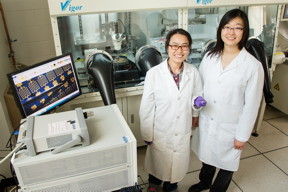 |
| Postdoctoral researcher Fengjiao Zhang and professor Ying Diao developed devices for sensing disease markers in breath. Photo by L. Brian Stauffer |
Abstract:
A small, thin square of an organic plastic that can detect disease markers in breath or toxins in a building’s air could soon be the basis of portable, disposable sensor devices. By riddling the thin plastic films with pores, University of Illinois researchers made the devices sensitive enough to detect at levels that are far too low to smell, yet are important to human health.
Sensors detect disease markers in breath
Champaign, IL | Posted on May 19th, 2017In a new study in the journal Advanced Functional Materials, professor Ying Diao’s research group demonstrated a device that monitors ammonia in breath, a sign of kidney failure.
“In the clinical setting, physicians use bulky instruments, basically the size of a big table, to detect and analyze these compounds. We want to hand out a cheap sensor chip to patients so they can use it and throw it away,” said Diao, a professor of chemical and biomolecular engineering at Illinois.
Other researchers have tried using organic semiconductors for gas sensing, but the materials were not sensitive enough to detect trace levels of disease markers in breath. Diao’s group realized that the reactive sites were not on the surface of the plastic film, but buried inside it.
“We developed this method to directly print tiny pores into the device itself so we can expose these highly reactive sites,” Diao said. “By doing so, we increased the reactivity by ten times and can sense down to one part per billion.”
For their first device demonstration, the researchers focused on ammonia as a marker for kidney failure. Monitoring the change in ammonia concentration could give a patient an early warning sign to call their doctor for a kidney function test, Diao said.
The material they chose is highly reactive to ammonia but not to other compounds in breath, Diao said. But by changing the composition of the sensor, they could create devices that are tuned to other compounds. For example, the researchers have created an ultrasensitive environmental monitor for formaldehyde, a common indoor pollutant in new or refurbished buildings.
The group is working to make sensors with multiple functions to get a more complete picture of a patient’s health.
“We would like to be able to detect multiple compounds at once, like a chemical fingerprint,” Diao said. “It’s useful because in disease conditions, multiple markers will usually change concentration at once. By mapping out the chemical fingerprints and how they change, we can more accurately point to signs of potential health issues.”
Diao’s group collaborated with Purdue University professor Jianguo Mei on this work.
####
Contacts:
Liz Ahlberg Touchstone
Biomedical Sciences
Editor, 217-244-1073
Ying Diao
217-300-3505
Copyright © University of Illinois at Urbana-Champaign
If you have a comment, please Contact us.Issuers of news releases, not 7th Wave, Inc. or Nanotechnology Now, are solely responsible for the accuracy of the content.
Bookmark:


| Related Links |
| Related News Press |
News and information
 Quantum computer improves AI predictions April 17th, 2026
Flexible sensor gains sensitivity under pressure April 17th, 2026
A reusable chip for particulate matter sensing April 17th, 2026
Detecting vibrational quantum beating in the predissociation dynamics of SF6 using time-resolved photoelectron spectroscopy April 17th, 2026
Possible Futures
A fundamentally new therapeutic approach to cystic fibrosis: Nanobody repairs cellular defect April 17th, 2026
UC Irvine physicists discover method to reverse ‘quantum scrambling’ : The work addresses the problem of information loss in quantum computing system April 17th, 2026
Nanomedicine
A fundamentally new therapeutic approach to cystic fibrosis: Nanobody repairs cellular defect April 17th, 2026
New molecular technology targets tumors and simultaneously silences two ‘undruggable’ cancer genes August 8th, 2025
New imaging approach transforms study of bacterial biofilms August 8th, 2025
Electrifying results shed light on graphene foam as a potential material for lab grown cartilage June 6th, 2025
Discoveries
Quantum computer improves AI predictions April 17th, 2026
Flexible sensor gains sensitivity under pressure April 17th, 2026
A reusable chip for particulate matter sensing April 17th, 2026
Detecting vibrational quantum beating in the predissociation dynamics of SF6 using time-resolved photoelectron spectroscopy April 17th, 2026
Announcements
A fundamentally new therapeutic approach to cystic fibrosis: Nanobody repairs cellular defect April 17th, 2026
UC Irvine physicists discover method to reverse ‘quantum scrambling’ : The work addresses the problem of information loss in quantum computing system April 17th, 2026
Interviews/Book Reviews/Essays/Reports/Podcasts/Journals/White papers/Posters
A fundamentally new therapeutic approach to cystic fibrosis: Nanobody repairs cellular defect April 17th, 2026
UC Irvine physicists discover method to reverse ‘quantum scrambling’ : The work addresses the problem of information loss in quantum computing system April 17th, 2026
Nanobiotechnology
A fundamentally new therapeutic approach to cystic fibrosis: Nanobody repairs cellular defect April 17th, 2026
New molecular technology targets tumors and simultaneously silences two ‘undruggable’ cancer genes August 8th, 2025
New imaging approach transforms study of bacterial biofilms August 8th, 2025
Electrifying results shed light on graphene foam as a potential material for lab grown cartilage June 6th, 2025
Research partnerships
Lab to industry: InSe wafer-scale breakthrough for future electronics August 8th, 2025
HKU physicists uncover hidden order in the quantum world through deconfined quantum critical points April 25th, 2025
 |
||
 |
||
| The latest news from around the world, FREE | ||
 |
||
|
|
||
| Premium Products | ||
 |
||
|
Only the news you want to read!
Learn More |
||
 |
||
|
Full-service, expert consulting
Learn More |
||
|
|
||