Home > Press > It's basic: Alternative fuel cell technology reduces cost: Study sets performance targets for metal-free fuel cell membrane
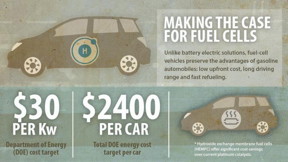 |
| Fuel-cell vehicles offer several advantages over battery-powered cars, but costs have been an obstacle. A new paper shows how an alternative technology could give fuel cells greater traction in the quest for zero-emissions vehicles. CREDIT UNIVERSITY OF DELAWARE/Jeffrey Chase |
Abstract:
The pathway to zero-emission vehicles has taken two forks, one toward battery electric cars like the Tesla and the other toward fuel-cell-powered automobiles like the Toyota Mirai.
It's basic: Alternative fuel cell technology reduces cost: Study sets performance targets for metal-free fuel cell membrane
Newark, DE | Posted on December 13th, 2016The University of Delaware's Yushan Yan believes that fuel-cell vehicles are the way to go, because they best preserve the advantages of gasoline automobiles: low upfront cost, long driving range and fast refueling.
But he also believes that a new fuel-cell technology may be necessary.
For Yan, that approach is a new twist on traditional fuel cells, known as proton exchange membrane fuel cells, or PEMFCs, which rely on costly platinum-based catalysts. Yan and his research team are pursuing an alternative technology, the hydroxide exchange membrane fuel cell (HEMFC), because of its inherent cost advantages.
He sees the rationale for this proposed switch as a matter of very simple arithmetic.
"To make fuel-cell cars a reality, the DOE (Department of Energy) has set a system cost target of $30 per kilowatt, which translates into about $2,400 per car," he says. "Right now, the cost for PEMFCs is $52 per kilowatt, which is a big improvement over where the technology started."
"But the catalyst accounts for only about $12 of that total, leaving $40 worth of other components. So even if we throw in some magic, we can't get the rest of the way down to the target of $30 with PEMFCs."
Yan is co-author on a new paper published in the online version of Nature Nanotechnology that he views as a roadmap to a unified strategy for HEMFC zero-emission cars based on three arguments.
"First, to become a commercial reality, fuel-cell engines have to be at cost parity with their gasoline counterparts," he says, "and moving from an acid platform with the PEMFC to a base system with the HEMFC will enable a collateral benefit in bringing down all of the associated costs.
"Then, if we agree that this is the best approach, we need to get everyone in the HEMFC research community on board. If we want to succeed, we have to work together."
Finally, Yan warns that it is insufficient just to have a lower cost.
"It doesn't work to compare our results today with those from yesterday or the day before," he says. "To succeed commercially with HEMFCs, we have to match or beat the performance of PEMFCs. It's that simple -- we can't succeed without achieving performance parity."
###
Yan is Distinguished Engineering Professor in UD's Department of Chemical and Biomolecular Engineering, Setzler is a postdoctoral researcher in Yan's group, and Wittkopf is a doctoral student advised by Yan.
Zhuang is a professor at Beijing University of Chemical Technology and a former postdoctoral researcher in Yan's group.
####
For more information, please click here
Contacts:
Peter Bothum
302-831-1418
Copyright © University of Delaware
If you have a comment, please Contact us.Issuers of news releases, not 7th Wave, Inc. or Nanotechnology Now, are solely responsible for the accuracy of the content.
Bookmark:


| Related Links |
| Related News Press |
Discoveries
 Quantum computer improves AI predictions April 17th, 2026
Flexible sensor gains sensitivity under pressure April 17th, 2026
A reusable chip for particulate matter sensing April 17th, 2026
Detecting vibrational quantum beating in the predissociation dynamics of SF6 using time-resolved photoelectron spectroscopy April 17th, 2026
Announcements
A fundamentally new therapeutic approach to cystic fibrosis: Nanobody repairs cellular defect April 17th, 2026
UC Irvine physicists discover method to reverse ‘quantum scrambling’ : The work addresses the problem of information loss in quantum computing system April 17th, 2026
Interviews/Book Reviews/Essays/Reports/Podcasts/Journals/White papers/Posters
A fundamentally new therapeutic approach to cystic fibrosis: Nanobody repairs cellular defect April 17th, 2026
UC Irvine physicists discover method to reverse ‘quantum scrambling’ : The work addresses the problem of information loss in quantum computing system April 17th, 2026
Automotive/Transportation
Decoding hydrogen‑bond network of electrolyte for cryogenic durable aqueous zinc‑ion batteries January 30th, 2026
Sensors innovations for smart lithium-based batteries: advancements, opportunities, and potential challenges August 8th, 2025
Simple algorithm paired with standard imaging tool could predict failure in lithium metal batteries August 8th, 2025
Fuel Cells
Deciphering local microstrain-induced optimization of asymmetric Fe single atomic sites for efficient oxygen reduction August 8th, 2025
Current and Future Developments in Nanomaterials and Carbon Nanotubes: Applications of Nanomaterials in Energy Storage and Electronics October 28th, 2022
 |
||
 |
||
| The latest news from around the world, FREE | ||
 |
||
|
|
||
| Premium Products | ||
 |
||
|
Only the news you want to read!
Learn More |
||
 |
||
|
Full-service, expert consulting
Learn More |
||
|
|
||