Home > Press > Long may you wave, borophene: Rice University researchers say 2-D boron may be best for flexible electronics
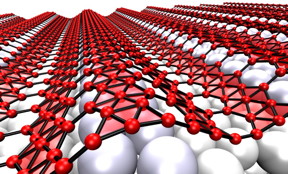 |
| When grown on silver, the two-dimensional form of boron, which is called borophene, takes on corrugations, helped by atomic vacancies in the lattice that make it more flexible. The metallic material may be suitable for use in stretchable, bendable electronics. Credit: Zhuhua Zhang/Rice University |
Abstract:
Though they're touted as ideal for electronics, two-dimensional materials like graphene may be too flat and hard to stretch to serve in flexible, wearable devices. "Wavy" borophene might be better, according to Rice University scientists.
Long may you wave, borophene: Rice University researchers say 2-D boron may be best for flexible electronics
Houston, TX | Posted on October 4th, 2016The Rice lab of theoretical physicist Boris Yakobson and experimental collaborators observed examples of naturally undulating, metallic borophene, an atom-thick layer of boron, and suggested that transferring it onto an elastic surface would preserve the material's stretchability along with its useful electronic properties.
Highly conductive graphene has promise for flexible electronics, Yakobson said, but it is too stiff for devices that also need to stretch, compress or even twist. But borophene deposited on a silver substrate develops nanoscale corrugations. Weakly bound to the silver, it could be moved to a flexible surface for use.
The research appears this month in the American Chemical Society journal Nano Letters.
Rice collaborated with experimentalists at Argonne National Laboratory and Northwestern University to study borophene, which has been made in small quantities. Under the microscope, borophene displays corrugations that demonstrate its wavy nature, meaning it can be highly stretched once removed from the substrate, or reattached to a soft one, Yakobson said.
The Rice group builds computer simulations to analyze the properties of materials from the atoms up. Simulations by first author Zhuhua Zhang, a postdoctoral researcher in Yakobson's group, showed that hexagonal vacancies in borophene help soften the material to facilitate its corrugated form.
"Borophene is metallic in its typical state, with strong electron-phonon coupling to support possible superconductivity, and a rich band structure that contains Dirac cones, as in graphene," Yakobson said.
There is a hitch: Borophene needs the underlying structure to make it wavy. When grown on a featureless surface, its natural form resembles graphene, the flat, chicken-wire arrays of carbon atoms. Zhang said borophene is better seen as a triangular lattice with periodic arrays of hexagonal vacancies.
Borophene prefers to be flat because that's where its energy is lowest, Yakobson said. But surprisingly, when grown on silver, borophene adopts its accordion-like form while silver reconstructs itself to match. The corrugation can be retained by "re-gluing" boron onto another substrate.
"This wavy conformation so far seems unique due to the exceptional structural flexibility and particular interactions of borophene with silver, and may be initially triggered by a slight compression in the layer when a bit too many boron atoms get onto the surface," Zhang said.
Co-authors of the paper are Rice alumnus Zhili Hu, Andrew Jacob Mannix and Brian Kiraly of Argonne National Laboratory and Northwestern; Nathan Guisinger of Argonne National Laboratory and Mark Hersam of Northwestern.
The Department of Energy, the Office of Naval Research and the National Science Foundation (NSF) supported the research. The researchers utilized the XSEDE and NSF-supported DAVinCI supercomputer, both administered by Rice’s Center for Research Computing and procured in a partnership with Rice’s Ken Kennedy Institute for Information Technology.
####
About Rice University
Located on a 300-acre forested campus in Houston, Rice University is consistently ranked among the nation’s top 20 universities by U.S. News & World Report. Rice has highly respected schools of Architecture, Business, Continuing Studies, Engineering, Humanities, Music, Natural Sciences and Social Sciences and is home to the Baker Institute for Public Policy. With 3,910 undergraduates and 2,809 graduate students, Rice’s undergraduate student-to-faculty ratio is 6-to-1. Its residential college system builds close-knit communities and lifelong friendships, just one reason why Rice is ranked No. 1 for happiest students and for lots of race/class interaction by the Princeton Review. Rice is also rated as a best value among private universities by Kiplinger’s Personal Finance. To read “What they’re saying about Rice,” go to tinyurl.com/RiceUniversityoverview.
Follow Rice News and Media Relations via Twitter @RiceUNews
For more information, please click here
Contacts:
David Ruth
713-348-6327
Mike Williams
713-348-6728
Copyright © Rice University
If you have a comment, please Contact us.Issuers of news releases, not 7th Wave, Inc. or Nanotechnology Now, are solely responsible for the accuracy of the content.
Bookmark:


| Related Links |
 Rice Department of Materials Science and NanoEngineering:
George R. Brown School of Engineering:
| Related News Press |
News and information
Quantum computer improves AI predictions April 17th, 2026
Flexible sensor gains sensitivity under pressure April 17th, 2026
A reusable chip for particulate matter sensing April 17th, 2026
Detecting vibrational quantum beating in the predissociation dynamics of SF6 using time-resolved photoelectron spectroscopy April 17th, 2026
2 Dimensional Materials
Flexible sensor gains sensitivity under pressure April 17th, 2026
Flexible Electronics
Flexible sensor gains sensitivity under pressure April 17th, 2026
Govt.-Legislation/Regulation/Funding/Policy
Quantum computer improves AI predictions April 17th, 2026
Metasurfaces smooth light to boost magnetic sensing precision January 30th, 2026
New imaging approach transforms study of bacterial biofilms August 8th, 2025
Possible Futures
A fundamentally new therapeutic approach to cystic fibrosis: Nanobody repairs cellular defect April 17th, 2026
UC Irvine physicists discover method to reverse ‘quantum scrambling’ : The work addresses the problem of information loss in quantum computing system April 17th, 2026
Chip Technology
A reusable chip for particulate matter sensing April 17th, 2026
Metasurfaces smooth light to boost magnetic sensing precision January 30th, 2026
Discoveries
Quantum computer improves AI predictions April 17th, 2026
Flexible sensor gains sensitivity under pressure April 17th, 2026
A reusable chip for particulate matter sensing April 17th, 2026
Detecting vibrational quantum beating in the predissociation dynamics of SF6 using time-resolved photoelectron spectroscopy April 17th, 2026
Announcements
A fundamentally new therapeutic approach to cystic fibrosis: Nanobody repairs cellular defect April 17th, 2026
UC Irvine physicists discover method to reverse ‘quantum scrambling’ : The work addresses the problem of information loss in quantum computing system April 17th, 2026
Interviews/Book Reviews/Essays/Reports/Podcasts/Journals/White papers/Posters
A fundamentally new therapeutic approach to cystic fibrosis: Nanobody repairs cellular defect April 17th, 2026
UC Irvine physicists discover method to reverse ‘quantum scrambling’ : The work addresses the problem of information loss in quantum computing system April 17th, 2026
Military
Quantum engineers ‘squeeze’ laser frequency combs to make more sensitive gas sensors January 17th, 2025
Chainmail-like material could be the future of armor: First 2D mechanically interlocked polymer exhibits exceptional flexibility and strength January 17th, 2025
Single atoms show their true color July 5th, 2024
NRL charters Navy’s quantum inertial navigation path to reduce drift April 5th, 2024
Grants/Sponsored Research/Awards/Scholarships/Gifts/Contests/Honors/Records
Quantum computer improves AI predictions April 17th, 2026
Detecting vibrational quantum beating in the predissociation dynamics of SF6 using time-resolved photoelectron spectroscopy April 17th, 2026
Metasurfaces smooth light to boost magnetic sensing precision January 30th, 2026
 |
||
 |
||
| The latest news from around the world, FREE | ||
 |
||
|
|
||
| Premium Products | ||
 |
||
|
Only the news you want to read!
Learn More |
||
 |
||
|
Full-service, expert consulting
Learn More |
||
|
|
||