Home > Press > Coffee-infused foam removes lead from contaminated water
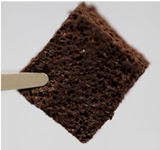 |
| A foam filter made with used coffee grounds removes lead and mercury from contaminated water. Credit: American Chemical Society |
Abstract:
Coffee is one of the most popular drinks in the U.S., which makes for a perky population — but it also creates a lot of used grounds. Scientists now report in the journal ACS Sustainable Chemistry & Engineering an innovative way to reduce this waste and help address another environmental problem. They have incorporated spent coffee grounds in a foam filter that can remove harmful lead and mercury from water.
Coffee-infused foam removes lead from contaminated water
Washington, DC | Posted on September 21st, 2016Restaurants, the beverage industry and people in their homes produce millions of tons of used coffee grounds every year worldwide, according to researcher Despina Fragouli. While much of the used grounds go to landfills, some of them are applied as fertilizer, used as a biodiesel source or mixed into animal feed. Scientists are also studying it as a possible material for water remediation. Experiments so far have shown that powder made from spent coffee grounds can rid water of heavy metal ions, which can cause health problems. But an additional step is needed to separate the powder from the purified water. Fragouli and colleagues wanted to simplify this process.
The researchers fixed spent coffee powder in a bioelastomeric foam, which acted as a filter. In still water, the foam removed up to 99 percent of lead and mercury ions from water over 30 hours. In a more practical test in which lead-contaminated water flowed through the foam, it scrubbed the water of up to 67 percent of the lead ions. Because the coffee is immobilized, it is easy to handle and discard after use without any additional steps, the researchers say.
####
For more information, please click here
Contacts:
Despina Fragouli, Ph.D.
Smart Materials
Nanophysics
Italian Institute of Technology (IIT)
Genova, Italy
Michael Bernstein
202-872-6042
Katie Cottingham, Ph.D.
301-775-8455
Copyright © American Chemical Society
If you have a comment, please Contact us.Issuers of news releases, not 7th Wave, Inc. or Nanotechnology Now, are solely responsible for the accuracy of the content.
Bookmark:


| Related Links |
 "Spent Coffee Bioelastomeric Composite Foams for the Removal of Pb2+ and Hg2+ from Water":
| Related News Press |
News and information
Quantum computer improves AI predictions April 17th, 2026
Flexible sensor gains sensitivity under pressure April 17th, 2026
A reusable chip for particulate matter sensing April 17th, 2026
Detecting vibrational quantum beating in the predissociation dynamics of SF6 using time-resolved photoelectron spectroscopy April 17th, 2026
Possible Futures
A fundamentally new therapeutic approach to cystic fibrosis: Nanobody repairs cellular defect April 17th, 2026
UC Irvine physicists discover method to reverse ‘quantum scrambling’ : The work addresses the problem of information loss in quantum computing system April 17th, 2026
Discoveries
Quantum computer improves AI predictions April 17th, 2026
Flexible sensor gains sensitivity under pressure April 17th, 2026
A reusable chip for particulate matter sensing April 17th, 2026
Detecting vibrational quantum beating in the predissociation dynamics of SF6 using time-resolved photoelectron spectroscopy April 17th, 2026
Materials/Metamaterials/Magnetoresistance
First real-time observation of two-dimensional melting process: Researchers at Mainz University unveil new insights into magnetic vortex structures August 8th, 2025
Researchers unveil a groundbreaking clay-based solution to capture carbon dioxide and combat climate change June 6th, 2025
A 1960s idea inspires NBI researchers to study hitherto inaccessible quantum states June 6th, 2025
Institute for Nanoscience hosts annual proposal planning meeting May 16th, 2025
Announcements
A fundamentally new therapeutic approach to cystic fibrosis: Nanobody repairs cellular defect April 17th, 2026
UC Irvine physicists discover method to reverse ‘quantum scrambling’ : The work addresses the problem of information loss in quantum computing system April 17th, 2026
Interviews/Book Reviews/Essays/Reports/Podcasts/Journals/White papers/Posters
A fundamentally new therapeutic approach to cystic fibrosis: Nanobody repairs cellular defect April 17th, 2026
UC Irvine physicists discover method to reverse ‘quantum scrambling’ : The work addresses the problem of information loss in quantum computing system April 17th, 2026
Environment
A reusable chip for particulate matter sensing April 17th, 2026
Researchers unveil a groundbreaking clay-based solution to capture carbon dioxide and combat climate change June 6th, 2025
 |
||
 |
||
| The latest news from around the world, FREE | ||
 |
||
|
|
||
| Premium Products | ||
 |
||
|
Only the news you want to read!
Learn More |
||
 |
||
|
Full-service, expert consulting
Learn More |
||
|
|
||