Home > Press > Researchers synthesize atomically precise diamond-shaped nanoclusters of silver
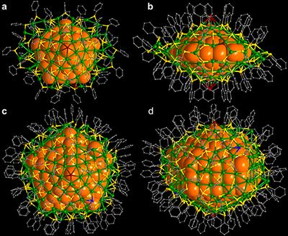 |
| This figure shows: Upper row: (a) top and (b) side view of the 136-atom silver nanocluster. Lower row: (c) top and (d) side view of the 374-atom silver nanocluster. The metal cores of these clusters have a diameter of 2 and 3 nm, respectively. Silver atoms in the metal core are denoted by large orange sphere. The core is protected by a silver-thiol layer (green: silver; yellow: sulfur; carbon: gray). Courtesy of Nanfeng Zheng, Xiamen University. CREDIT: the University of Jyväskylä |
Abstract:
A wide international collaboration involving researchers from four countries - China, Australia, Germany and Finland - have managed to synthesize and characterize two previously unknown, record-large silver nanoclusters of 136 and 374 silver atoms. These diamond-shaped nanoclusters (see Figure), consisting of a silver core of 2 to 3 nanometers and a protecting layer of silver atoms and organic thiol molecules, are the largest ones whose structure is now known to atomic precision. The research (1) was published in Nature Communications on 9 September 2016.
Researchers synthesize atomically precise diamond-shaped nanoclusters of silver
Helsinki, Finland | Posted on September 9th, 2016The nanoclusters where synthesized in Xiamen University in China and characterized by X-ray crystallography and electron microscopy in China, Australia and Germany. Their electronic structure and optical properties were studied computationally in the Nanoscience Center (NSC) of the University of Jyväskylä in Finland.
Gold nanoclusters that are stabilized by a thiol molecular layer have been known for decades, but only during the latest years silver clusters have attracted more interest in the research community. Silver is a desirable material for nanocluster synthesis since it is a cheaper metal than gold and its optical properties are better controllable for applications. However, synthesis recipes that would produce silver clusters that are stable for prolonged times are not so widely known as for gold.
"These largest atomically precise silver nanoclusters known thus far serve as excellent model systems to understand how silver nanoparticles grow," says Professor Nanfeng Zheng whose research group prepared the clusters in Xiamen University in China. "The internal structure of the metal core is a combination of little crystallites of silver that are joined together to form a five-fold symmetric diamond-shape structure."
"From a theoretical point of view these new clusters are very interesting," says Academy Professor Hannu Häkkinen from the NSC in Jyväskylä. "These clusters are already big enough that they have properties similar to silver metal, such as strong absorption of light leading to collective oscillations of the electron cloud known as plasmons, yet small enough that we can study their electronic structure in detail. Much to our surprise, the calculations showed that electrons in the organic molecular layer take part actively in the collective oscillation of the silver electrons. It seems possible to then activate these clusters by light in order to do chemistry at the ligand surface."
###
The other NSC researchers involved in the work were Xi Chen and Lauri Lehtovaara. The computational work was done at the CSC - the Finnish IT Centre for Science. The work at the University of Jyväskylä was supported by the Academy of Finland.
####
For more information, please click here
Contacts:
Hannu Häkkinen
358-400-247-973
Professor Nanfeng Zheng
Xiamen University
China
nfzheng(at)xmu.edu.cn
Academy of Finland Communications
Communications Specialist
Leena Vähäkylä
tel. +358 295 335 139
firstname.lastname(at)aka.fi
Copyright © Academy of Finland
If you have a comment, please Contact us.Issuers of news releases, not 7th Wave, Inc. or Nanotechnology Now, are solely responsible for the accuracy of the content.
Bookmark:


| Related Links |
| Related News Press |
News and information
 Quantum computer improves AI predictions April 17th, 2026
Flexible sensor gains sensitivity under pressure April 17th, 2026
A reusable chip for particulate matter sensing April 17th, 2026
Detecting vibrational quantum beating in the predissociation dynamics of SF6 using time-resolved photoelectron spectroscopy April 17th, 2026
Discoveries
Quantum computer improves AI predictions April 17th, 2026
Flexible sensor gains sensitivity under pressure April 17th, 2026
A reusable chip for particulate matter sensing April 17th, 2026
Detecting vibrational quantum beating in the predissociation dynamics of SF6 using time-resolved photoelectron spectroscopy April 17th, 2026
Materials/Metamaterials/Magnetoresistance
First real-time observation of two-dimensional melting process: Researchers at Mainz University unveil new insights into magnetic vortex structures August 8th, 2025
Researchers unveil a groundbreaking clay-based solution to capture carbon dioxide and combat climate change June 6th, 2025
A 1960s idea inspires NBI researchers to study hitherto inaccessible quantum states June 6th, 2025
Institute for Nanoscience hosts annual proposal planning meeting May 16th, 2025
Announcements
A fundamentally new therapeutic approach to cystic fibrosis: Nanobody repairs cellular defect April 17th, 2026
UC Irvine physicists discover method to reverse ‘quantum scrambling’ : The work addresses the problem of information loss in quantum computing system April 17th, 2026
Interviews/Book Reviews/Essays/Reports/Podcasts/Journals/White papers/Posters
A fundamentally new therapeutic approach to cystic fibrosis: Nanobody repairs cellular defect April 17th, 2026
UC Irvine physicists discover method to reverse ‘quantum scrambling’ : The work addresses the problem of information loss in quantum computing system April 17th, 2026
Research partnerships
Lab to industry: InSe wafer-scale breakthrough for future electronics August 8th, 2025
HKU physicists uncover hidden order in the quantum world through deconfined quantum critical points April 25th, 2025
 |
||
 |
||
| The latest news from around the world, FREE | ||
 |
||
|
|
||
| Premium Products | ||
 |
||
|
Only the news you want to read!
Learn More |
||
 |
||
|
Full-service, expert consulting
Learn More |
||
|
|
||