Home > Press > Putting the pressure on platinum: Hokkaido University researchers have synthesised a uniquely structured platinum-based superconducting material
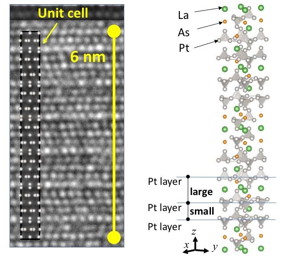 |
| Electron microscopic image(left) and schematic image(right) of LaPt5M/sub>As crystal. CREDIT: Hokkaido University |
Abstract:
Superconductors are materials that, when cooled below a certain temperature, conduct free-flowing electricity without it being impeded by resistance. They are used in magnetic resonance imaging (MRI) machines, magnetic levitation trains and particle accelerators like the Large Hadron Collider. Researchers are constantly on the lookout for materials that can become superconducting at higher-than-currently-possible temperatures and lower costs.
Putting the pressure on platinum: Hokkaido University researchers have synthesised a uniquely structured platinum-based superconducting material
Hokkaido, Japan | Posted on August 6th, 2016A team of researchers from Japan's Hokkaido University along with colleagues at the Kyushu Institute of Technology, NEC Corporation, Keio University and the National Institute for Materials Science have developed a novel superconducting material based on platinum, which was, until recently, thought to be unsuitable as a superconducting material.
The material was developed by mixing lanthanum (La), platinum (Pt) and arsenic (As) powders in a ratio of 1:5:1 and compressing them into pellets. These were then heated to 500°C for ten hours. The resultant material was ground and re-pelletized, then heated at 1000°C for an hour at various pressures. The team found that the final product (LaPt5As ) was non-superconducting at a pressure of five gigapascals (GPa) (equivalent to 50,000 bars of pressure), but became superconducting at 10 GPa, only to return to a non-superconductive state at 15 GPa.
The researchers examined the crystal structure of the superconducting LaPt5As. They revealed that platinum atoms formed multiple layers which piled up as high as 6 nm, the highest among metal superconductor. They also found that lanthanum and arsenic atoms separated platinum layers from each other in a way, they speculate, which weakens the interaction between platinum electrons, allowing them to flow more freely and resulting in the superconducting property.
Future research that determines the detailed crystal structure of the non-superconducting phases of LaPt5sAs will aid in the understanding of the mechanism that causes the material to become superconducting at 10 GPa, the researchers say.
High-pressure synthesis (over 10 GPa) is not a commonly used method in the field of materials science, write the researchers in their study published in the Journal of the American Chemical Society. This research shows there is room for further exploration of unknown phases induced by high pressure in a variety of materials, they say.
####
For more information, please click here
Contacts:
Naoki Namba
81-117-068-034
Copyright © Hokkaido University
If you have a comment, please Contact us.Issuers of news releases, not 7th Wave, Inc. or Nanotechnology Now, are solely responsible for the accuracy of the content.
Bookmark:


| Related Links |
| Related News Press |
News and information
 Quantum computer improves AI predictions April 17th, 2026
Flexible sensor gains sensitivity under pressure April 17th, 2026
A reusable chip for particulate matter sensing April 17th, 2026
Detecting vibrational quantum beating in the predissociation dynamics of SF6 using time-resolved photoelectron spectroscopy April 17th, 2026
Superconductivity
MXene nanomaterials enter a new dimension Multilayer nanomaterial: MXene flakes created at Drexel University show new promise as 1D scrolls January 30th, 2026
Possible Futures
A fundamentally new therapeutic approach to cystic fibrosis: Nanobody repairs cellular defect April 17th, 2026
UC Irvine physicists discover method to reverse ‘quantum scrambling’ : The work addresses the problem of information loss in quantum computing system April 17th, 2026
Discoveries
Quantum computer improves AI predictions April 17th, 2026
Flexible sensor gains sensitivity under pressure April 17th, 2026
A reusable chip for particulate matter sensing April 17th, 2026
Detecting vibrational quantum beating in the predissociation dynamics of SF6 using time-resolved photoelectron spectroscopy April 17th, 2026
Materials/Metamaterials/Magnetoresistance
First real-time observation of two-dimensional melting process: Researchers at Mainz University unveil new insights into magnetic vortex structures August 8th, 2025
Researchers unveil a groundbreaking clay-based solution to capture carbon dioxide and combat climate change June 6th, 2025
A 1960s idea inspires NBI researchers to study hitherto inaccessible quantum states June 6th, 2025
Institute for Nanoscience hosts annual proposal planning meeting May 16th, 2025
Announcements
A fundamentally new therapeutic approach to cystic fibrosis: Nanobody repairs cellular defect April 17th, 2026
UC Irvine physicists discover method to reverse ‘quantum scrambling’ : The work addresses the problem of information loss in quantum computing system April 17th, 2026
Interviews/Book Reviews/Essays/Reports/Podcasts/Journals/White papers/Posters
A fundamentally new therapeutic approach to cystic fibrosis: Nanobody repairs cellular defect April 17th, 2026
UC Irvine physicists discover method to reverse ‘quantum scrambling’ : The work addresses the problem of information loss in quantum computing system April 17th, 2026
 |
||
 |
||
| The latest news from around the world, FREE | ||
 |
||
|
|
||
| Premium Products | ||
 |
||
|
Only the news you want to read!
Learn More |
||
 |
||
|
Full-service, expert consulting
Learn More |
||
|
|
||