Home > Press > Radiation-guided nanoparticles zero in on metastatic cancer
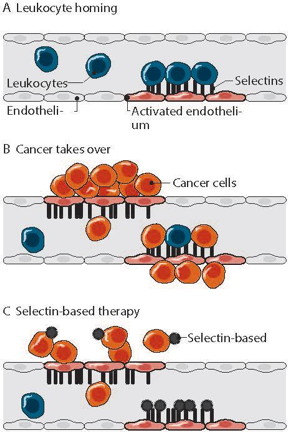 |
| This is a schematic illustration of selectins' role in inflammation (A) and cancer progression (B). This mechanism can be used for selectin-based targeted therapy (C). This material relates to a paper that appeared in the June 29, 2016 issue of Science Translational Medicine, published by AAAS. The paper, by Y. Shamay at Memorial Sloan Kettering Cancer Center in New York, NY, and colleagues was titled, "P-selectin is a nanotherapeutic delivery target in the tumor microenvironment." CREDIT: Kedmi et al., Science Translational Medicine (2016) |
Abstract:
Zap a tumor with radiation to trigger expression of a molecule, then attack that molecule with a drug-loaded nanoparticle. That's the approach researchers working in mice have taken in a new study that aims to make delivery of chemotherapy to metastatic tumors more effective.
Radiation-guided nanoparticles zero in on metastatic cancer
Washington, DC | Posted on July 1st, 2016The researchers say that the radiation-guided nanoparticles may offer a new approach for penetrating the vascular barrier that often thwarts current nanomedicines from reaching metastatic tumors. To spread to distant organs, cancer cells in the bloodstream latch onto adhesion molecules known as P-selectins in the blood vessel walls. Yosi Shamay and colleagues further found that unlike normal tissues, many human cancers--including lung, ovarian, breast, and liver--overexpress P-selectin on tumor cells and in surrounding blood vessels. To exploit this molecule as a therapeutic target, the researchers designed nanoparticle drug carriers composed of fucoidan, a seaweed-derived compound that naturally binds to P-selectin. In a mouse model of lung cancer and metastatic melanoma and breast tumors, all of which express P-selectin, the nanoparticles selectively delivered chemotherapy drugs to the tumors, improving tumor reduction and overall survival better than did the free form of the drugs or drug-loaded nanoparticles not made of fucoidan. For tumors that do not normally express P-selectin, Shamay et al. used radiation, which is known to boost P-selectin expression in tissues, to guide the nanoparticles to the tumor site. When combined with radiation, the nanotherapy effectively shrunk lung tumors lacking P-selectin in mice. In a related Focus, Ranit Kedmi and Dan Peer discuss the promises and challenges of moving the nanotherapy to the clinic. Radiation-guided nanoparticles may offer a new tool for delivering drugs to almost any tumor, they note, but further development would need to address the double-edged sword of radiation's potential to trigger P-selectin expression that might unintentionally promote cancer spread.
####
For more information, please click here
Contacts:
Science Press Package Team
202-326-6440
Copyright © American Association for the Advancement of Science (AAAS)
If you have a comment, please Contact us.Issuers of news releases, not 7th Wave, Inc. or Nanotechnology Now, are solely responsible for the accuracy of the content.
Bookmark:


| Related Links |
| Related News Press |
News and information
 Quantum computer improves AI predictions April 17th, 2026
Flexible sensor gains sensitivity under pressure April 17th, 2026
A reusable chip for particulate matter sensing April 17th, 2026
Detecting vibrational quantum beating in the predissociation dynamics of SF6 using time-resolved photoelectron spectroscopy April 17th, 2026
Cancer
New molecular technology targets tumors and simultaneously silences two ‘undruggable’ cancer genes August 8th, 2025
Ben-Gurion University of the Negev researchers several steps closer to harnessing patient's own T-cells to fight off cancer June 6th, 2025
Self-propelled protein-based nanomotors for enhanced cancer therapy by inducing ferroptosis June 6th, 2025
Possible Futures
A fundamentally new therapeutic approach to cystic fibrosis: Nanobody repairs cellular defect April 17th, 2026
UC Irvine physicists discover method to reverse ‘quantum scrambling’ : The work addresses the problem of information loss in quantum computing system April 17th, 2026
Nanomedicine
A fundamentally new therapeutic approach to cystic fibrosis: Nanobody repairs cellular defect April 17th, 2026
New molecular technology targets tumors and simultaneously silences two ‘undruggable’ cancer genes August 8th, 2025
New imaging approach transforms study of bacterial biofilms August 8th, 2025
Electrifying results shed light on graphene foam as a potential material for lab grown cartilage June 6th, 2025
Discoveries
Quantum computer improves AI predictions April 17th, 2026
Flexible sensor gains sensitivity under pressure April 17th, 2026
A reusable chip for particulate matter sensing April 17th, 2026
Detecting vibrational quantum beating in the predissociation dynamics of SF6 using time-resolved photoelectron spectroscopy April 17th, 2026
Announcements
A fundamentally new therapeutic approach to cystic fibrosis: Nanobody repairs cellular defect April 17th, 2026
UC Irvine physicists discover method to reverse ‘quantum scrambling’ : The work addresses the problem of information loss in quantum computing system April 17th, 2026
Interviews/Book Reviews/Essays/Reports/Podcasts/Journals/White papers/Posters
A fundamentally new therapeutic approach to cystic fibrosis: Nanobody repairs cellular defect April 17th, 2026
UC Irvine physicists discover method to reverse ‘quantum scrambling’ : The work addresses the problem of information loss in quantum computing system April 17th, 2026
Nanobiotechnology
A fundamentally new therapeutic approach to cystic fibrosis: Nanobody repairs cellular defect April 17th, 2026
New molecular technology targets tumors and simultaneously silences two ‘undruggable’ cancer genes August 8th, 2025
New imaging approach transforms study of bacterial biofilms August 8th, 2025
Electrifying results shed light on graphene foam as a potential material for lab grown cartilage June 6th, 2025
 |
||
 |
||
| The latest news from around the world, FREE | ||
 |
||
|
|
||
| Premium Products | ||
 |
||
|
Only the news you want to read!
Learn More |
||
 |
||
|
Full-service, expert consulting
Learn More |
||
|
|
||