Home > Press > New generation of high-efficiency solar thermal absorbers developed
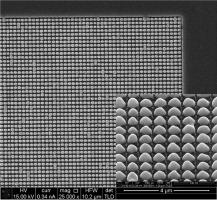 |
| The focused ion beam fabricated trilayer metasurface within the inset shows rounded features in the upper 2-D gold square periodic surface. CREDIT: University of Bristol |
Abstract:
Researchers from the Universities of Bristol and Exeter are one step closer to developing a new generation of low-cost, high-efficiency solar cells. The structure is one of the world's first examples of a tri-layer metasurface absorber using a carbon interlayer.
New generation of high-efficiency solar thermal absorbers developed
Bristol, UK | Posted on June 20th, 2016The system, developed by Chenglong Wang a PhD student in Professor Martin Cryan's research group, uses amorphous carbon as an inter-layer between thin gold films with the upper film patterned with a 2D periodic array using focused ion beam etching.
The trilayer gold-carbon-gold metasurface strongly absorbs light across the solar spectrum but minimises emission of thermal radiation from the structure. The use of gold in the research is a first step towards a high temperature metasurface where gold can be replaced by other refractory metals such as tungsten or chrome.
The cell will be used for solar thermal energy applications and has the potential to reach much higher temperatures than simple black surfaces because it can minimise the emission of thermal radiation.
The metasurface has been developed as part of a joint project, led by Dr Neil Fox, between Bristol's Department of Electrical and Electronic Engineering and Schools of Physics and Chemistry. The aim of this project is to develop diamond-based solar thermionic devices, which use sunlight to get surfaces sufficiently hot that they emit electrons directly into a vacuum. If these electrons are collected at a cooled anode, electrical energy can be produced with maximum efficiencies predicted to be much higher than is achievable using conventional silicon solar cells.
Martin Cryan, Professor of Applied Electromagnetics and Photonics in the Department of Electrical and Electronic Engineering, said: "Integrating diamond within metasurfaces is very challenging, and this paper is a first step in that direction using amorphous carbon. The next stage is to carry out high temperature testing on the structures and to attempt to reach the ~700 degrees celsius required to obtain efficient thermionic emission."
The Bristol team have been working with Professor Tapas Mallick from the University of Exeter to develop the low-cost solar concentrator systems.
####
For more information, please click here
Contacts:
Joanne Fryer
44-011-733-17276
Copyright © University of Bristol
If you have a comment, please Contact us.Issuers of news releases, not 7th Wave, Inc. or Nanotechnology Now, are solely responsible for the accuracy of the content.
Bookmark:


| Related News Press |
News and information
 Quantum computer improves AI predictions April 17th, 2026
Flexible sensor gains sensitivity under pressure April 17th, 2026
A reusable chip for particulate matter sensing April 17th, 2026
Detecting vibrational quantum beating in the predissociation dynamics of SF6 using time-resolved photoelectron spectroscopy April 17th, 2026
2 Dimensional Materials
Flexible sensor gains sensitivity under pressure April 17th, 2026
Possible Futures
A fundamentally new therapeutic approach to cystic fibrosis: Nanobody repairs cellular defect April 17th, 2026
UC Irvine physicists discover method to reverse ‘quantum scrambling’ : The work addresses the problem of information loss in quantum computing system April 17th, 2026
Discoveries
Quantum computer improves AI predictions April 17th, 2026
Flexible sensor gains sensitivity under pressure April 17th, 2026
A reusable chip for particulate matter sensing April 17th, 2026
Detecting vibrational quantum beating in the predissociation dynamics of SF6 using time-resolved photoelectron spectroscopy April 17th, 2026
Materials/Metamaterials/Magnetoresistance
First real-time observation of two-dimensional melting process: Researchers at Mainz University unveil new insights into magnetic vortex structures August 8th, 2025
Researchers unveil a groundbreaking clay-based solution to capture carbon dioxide and combat climate change June 6th, 2025
A 1960s idea inspires NBI researchers to study hitherto inaccessible quantum states June 6th, 2025
Institute for Nanoscience hosts annual proposal planning meeting May 16th, 2025
Announcements
A fundamentally new therapeutic approach to cystic fibrosis: Nanobody repairs cellular defect April 17th, 2026
UC Irvine physicists discover method to reverse ‘quantum scrambling’ : The work addresses the problem of information loss in quantum computing system April 17th, 2026
Interviews/Book Reviews/Essays/Reports/Podcasts/Journals/White papers/Posters
A fundamentally new therapeutic approach to cystic fibrosis: Nanobody repairs cellular defect April 17th, 2026
UC Irvine physicists discover method to reverse ‘quantum scrambling’ : The work addresses the problem of information loss in quantum computing system April 17th, 2026
Energy
Sensors innovations for smart lithium-based batteries: advancements, opportunities, and potential challenges August 8th, 2025
Simple algorithm paired with standard imaging tool could predict failure in lithium metal batteries August 8th, 2025
Research partnerships
Lab to industry: InSe wafer-scale breakthrough for future electronics August 8th, 2025
HKU physicists uncover hidden order in the quantum world through deconfined quantum critical points April 25th, 2025
Solar/Photovoltaic
Spinel-type sulfide semiconductors to operate the next-generation LEDs and solar cells For solar-cell absorbers and green-LED source October 3rd, 2025
KAIST researchers introduce new and improved, next-generation perovskite solar cell November 8th, 2024
Groundbreaking precision in single-molecule optoelectronics August 16th, 2024
Development of zinc oxide nanopagoda array photoelectrode: photoelectrochemical water-splitting hydrogen production January 12th, 2024
 |
||
 |
||
| The latest news from around the world, FREE | ||
 |
||
|
|
||
| Premium Products | ||
 |
||
|
Only the news you want to read!
Learn More |
||
 |
||
|
Full-service, expert consulting
Learn More |
||
|
|
||