Home > Press > Controlling quantum states atom by atom
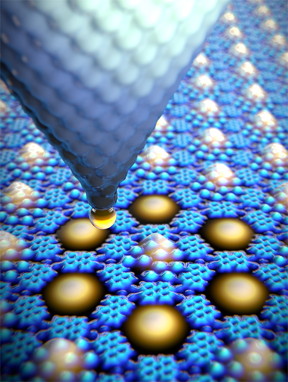 |
| Using the tip of a scanning tunnel microscope, a single xenon atom (yellow) is being moved from a quantum box (blue), thus specifically altering its electronic quantum state. Image: University of Basel, Department of Physics |
Abstract:
An international consortium led by researchers at the University of Basel has developed a method to precisely alter the quantum mechanical states of electrons within an array of quantum boxes. The method can be used to investigate the interactions between various types of atoms and electrons, which is essential for future quantum technologies, as the group reports in the journal Small.
Controlling quantum states atom by atom
Basel, Switzerland | Posted on June 10th, 2016Applications of quantum mechanics are often compromised by the fundamental property of quanta: any measurement inevitably modifies the measured state. Technologies such as quantum computers can be designed only on the basis of known, clearly defined and simple interactions between individual components. The Department of Physics at the University of Basel together with the Swiss Nanoscience Institute has now developed a method that can be used to study these kinds of interactions in a well-defined system.
Similar to a breadboard in electrical engineering
Breadboards are used in electronic measurement technology to design and test prototypes of electronic circuits and for teaching purposes. The procedure developed by the international consortium led by Prof. Thomas Jung of the University of Basel works in a similar way: for the first time, the new method allows researchers to configure a network of quantum boxes in order to form various quantum electronic states. A quantum box is an artificially produced structure that restricts a particle's movements, so that it can move in only two dimensions. This reduces the complexity of a particle interaction and simplifies the process of measurement and analysis.
The research team refined an established method in which atoms are repositioned one after the other using scanning tunneling microscopy, allowing the creation of clearly defined quantum sys-tems. Through the targeted relocating of xenon atoms in quantum boxes, the team succeeded in generating different patterns that correspond to a wide range of quantum states.
Essential tool for quantum technology
The development of quantum technology relies on a detailed understanding of the interdependence between different electronic states; for example, in various atoms. With the physicists' method, quantum states can be accurately reproduced and interactions between various chemical elements and well-defined electronic states examined - an "unlimited playing field for the study of quantum states", as the researchers write in Small.
A range of institutions contributed to the project's success: the theory was outlined by researchers from Linköping (Sweden), the molecules used were synthesized in Heidelberg (Germany), and scientists from San Sebastián (Spain) were responsible for some of the complex measurements of the specific quantum states.
####
For more information, please click here
Contacts:
Olivia Poisson
Copyright © University of Basel
If you have a comment, please Contact us.Issuers of news releases, not 7th Wave, Inc. or Nanotechnology Now, are solely responsible for the accuracy of the content.
Bookmark:


| Related Links |
| Related News Press |
News and information
 Quantum computer improves AI predictions April 17th, 2026
Flexible sensor gains sensitivity under pressure April 17th, 2026
A reusable chip for particulate matter sensing April 17th, 2026
Detecting vibrational quantum beating in the predissociation dynamics of SF6 using time-resolved photoelectron spectroscopy April 17th, 2026
Quantum Physics
Detecting vibrational quantum beating in the predissociation dynamics of SF6 using time-resolved photoelectron spectroscopy April 17th, 2026
Beyond silicon: Electronics at the scale of a single molecule January 30th, 2026
MXene nanomaterials enter a new dimension Multilayer nanomaterial: MXene flakes created at Drexel University show new promise as 1D scrolls January 30th, 2026
ICFO researchers overcome long-standing bottleneck in single photon detection with twisted 2D materials August 8th, 2025
Physics
UC Irvine physicists discover method to reverse ‘quantum scrambling’ : The work addresses the problem of information loss in quantum computing system April 17th, 2026
Quantum computers simulate fundamental physics: shedding light on the building blocks of nature June 6th, 2025
Quantum communication
Next-generation quantum communication October 3rd, 2025
Possible Futures
A fundamentally new therapeutic approach to cystic fibrosis: Nanobody repairs cellular defect April 17th, 2026
UC Irvine physicists discover method to reverse ‘quantum scrambling’ : The work addresses the problem of information loss in quantum computing system April 17th, 2026
Quantum Computing
Quantum computer improves AI predictions April 17th, 2026
UC Irvine physicists discover method to reverse ‘quantum scrambling’ : The work addresses the problem of information loss in quantum computing system April 17th, 2026
Researchers develop molecular qubits that communicate at telecom frequencies October 3rd, 2025
Discoveries
Quantum computer improves AI predictions April 17th, 2026
Flexible sensor gains sensitivity under pressure April 17th, 2026
A reusable chip for particulate matter sensing April 17th, 2026
Detecting vibrational quantum beating in the predissociation dynamics of SF6 using time-resolved photoelectron spectroscopy April 17th, 2026
Announcements
A fundamentally new therapeutic approach to cystic fibrosis: Nanobody repairs cellular defect April 17th, 2026
UC Irvine physicists discover method to reverse ‘quantum scrambling’ : The work addresses the problem of information loss in quantum computing system April 17th, 2026
Interviews/Book Reviews/Essays/Reports/Podcasts/Journals/White papers/Posters
A fundamentally new therapeutic approach to cystic fibrosis: Nanobody repairs cellular defect April 17th, 2026
UC Irvine physicists discover method to reverse ‘quantum scrambling’ : The work addresses the problem of information loss in quantum computing system April 17th, 2026
Tools
Metasurfaces smooth light to boost magnetic sensing precision January 30th, 2026
From sensors to smart systems: the rise of AI-driven photonic noses January 30th, 2026
Japan launches fully domestically produced quantum computer: Expo visitors to experience quantum computing firsthand August 8th, 2025
Research partnerships
Lab to industry: InSe wafer-scale breakthrough for future electronics August 8th, 2025
HKU physicists uncover hidden order in the quantum world through deconfined quantum critical points April 25th, 2025
Quantum nanoscience
Beyond silicon: Electronics at the scale of a single molecule January 30th, 2026
MXene nanomaterials enter a new dimension Multilayer nanomaterial: MXene flakes created at Drexel University show new promise as 1D scrolls January 30th, 2026
ICFO researchers overcome long-standing bottleneck in single photon detection with twisted 2D materials August 8th, 2025
 |
||
 |
||
| The latest news from around the world, FREE | ||
 |
||
|
|
||
| Premium Products | ||
 |
||
|
Only the news you want to read!
Learn More |
||
 |
||
|
Full-service, expert consulting
Learn More |
||
|
|
||