Home > Press > Novel functionalized nanomaterials for CO2 capture
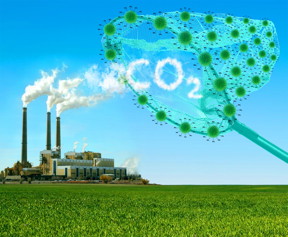 |
| Novel functionalized nanomaterials for CO2 capture.
Copyright Royal Society of Chemistry (RSC). Ref: Polshettiwar et al. Chemical Science, 2012, 3, 2224-2229 |
Abstract:
Climate change due to excessive CO2 levels is one of the most serious problems mankind has ever faced. This has resulted in abrupt weather patterns such as flood and drought, which are extremely disruptive and detrimental to life, as we have been witnessing in India in recent years. Mitigating rising CO2 levels is of prime importance. In a new development, scientists at the Tata Institute of Fundamental Research, Mumbai, have developed a novel design of CO2 sorbents that show superior CO2 capture capacity and stability over conventional materials.
Novel functionalized nanomaterials for CO2 capture
Mumbai, India | Posted on May 10th, 2016The immobilization of functional amines on a porous solid support can result in stable and efficient CO2 sorbent materials compared to similar liquid sorbents. A critical disadvantage however, is a drastic decrease in the textural properties of these supports (i.e., their surface area and pore volume), leading to a decrease in the CO2 capture capability.
To overcome this challenge, scientists at TIFR Mumbai, have designed novel functionalised nanomaterials that allows higher amine loading with a minimal decrease in surface area.
"Our fibrous nanosilica (KCC-1) should be a good candidate for use as a support to design efficient CO2 sorbents that would allow better capture capacity, kinetics and recylability", says Dr Vivek Polshettiwar, the lead scientist of this study. A unique feature of KCC-1 is its high surface area, which originates from its fibrous morphology and not from its mesoporous channels (unlike in other well studied materials like SBA-15 or MCM-41). This study, published recently in the Journal of Materials Chemistry A, demonstrates the usefulness of the fibrous morphology of KCC-1 compared to conventional ordered mesoporous silica. This work is in continuation of the teams efforts to develop sustainable catalysts and sorbents.
The KCC-1-based sorbents showed several advantages over conventional silica-based sorbents, including i) high amine loading, ii) minimum reduction in surface area after functionalization and iii) more accessibility of the amine sites to enhance CO2 capture efficiency (i.e., capture capacity, kinetics and recyclability), due to the fibrous structure and high accessible surface area of KCC-1.
The demand for such efficient sorbents is on the rise since CO2 capture is one of the best solutions to mitigate the rising levels of CO2. Solid sorbents exhibit better efficiency with greater potential to overcome the shortcomings of liquid sorbents. The use of mesoporous silica materials functionalized with various amino groups is well reported. Although materials like SBA-15 and MCM-41, for example, have attracted significant attention because their large pore sizes can accommodate a variety of amine molecules and the high surface area allows for a higher loading of these functional molecules, they suffer from the disadvantages of a decrease in textural properties, thus making KCC-1 a suitable candidate for more efficient CO2 capture.
####
For more information, please click here
Contacts:
Dr. Vivek Polshettiwar
91-222-278-2792
Copyright © Tata Institute of Fundamental Research
If you have a comment, please Contact us.Issuers of news releases, not 7th Wave, Inc. or Nanotechnology Now, are solely responsible for the accuracy of the content.
Bookmark:


| Related Links |
| Related News Press |
News and information
 Quantum computer improves AI predictions April 17th, 2026
Flexible sensor gains sensitivity under pressure April 17th, 2026
A reusable chip for particulate matter sensing April 17th, 2026
Detecting vibrational quantum beating in the predissociation dynamics of SF6 using time-resolved photoelectron spectroscopy April 17th, 2026
Possible Futures
A fundamentally new therapeutic approach to cystic fibrosis: Nanobody repairs cellular defect April 17th, 2026
UC Irvine physicists discover method to reverse ‘quantum scrambling’ : The work addresses the problem of information loss in quantum computing system April 17th, 2026
Discoveries
Quantum computer improves AI predictions April 17th, 2026
Flexible sensor gains sensitivity under pressure April 17th, 2026
A reusable chip for particulate matter sensing April 17th, 2026
Detecting vibrational quantum beating in the predissociation dynamics of SF6 using time-resolved photoelectron spectroscopy April 17th, 2026
Materials/Metamaterials/Magnetoresistance
First real-time observation of two-dimensional melting process: Researchers at Mainz University unveil new insights into magnetic vortex structures August 8th, 2025
Researchers unveil a groundbreaking clay-based solution to capture carbon dioxide and combat climate change June 6th, 2025
A 1960s idea inspires NBI researchers to study hitherto inaccessible quantum states June 6th, 2025
Institute for Nanoscience hosts annual proposal planning meeting May 16th, 2025
Announcements
A fundamentally new therapeutic approach to cystic fibrosis: Nanobody repairs cellular defect April 17th, 2026
UC Irvine physicists discover method to reverse ‘quantum scrambling’ : The work addresses the problem of information loss in quantum computing system April 17th, 2026
Interviews/Book Reviews/Essays/Reports/Podcasts/Journals/White papers/Posters
A fundamentally new therapeutic approach to cystic fibrosis: Nanobody repairs cellular defect April 17th, 2026
UC Irvine physicists discover method to reverse ‘quantum scrambling’ : The work addresses the problem of information loss in quantum computing system April 17th, 2026
Environment
A reusable chip for particulate matter sensing April 17th, 2026
Researchers unveil a groundbreaking clay-based solution to capture carbon dioxide and combat climate change June 6th, 2025
 |
||
 |
||
| The latest news from around the world, FREE | ||
 |
||
|
|
||
| Premium Products | ||
 |
||
|
Only the news you want to read!
Learn More |
||
 |
||
|
Full-service, expert consulting
Learn More |
||
|
|
||