Home > Press > The atom without properties
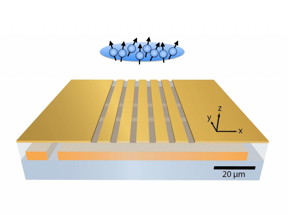 |
| A microchip is used to trap a cloud of ultracold atoms and to entangle the atoms' magnetic moments. CREDIT: Illustration: University of Basel, Department of Physics |
Abstract:
The microscopic world is governed by the rules of quantum mechanics, where the properties of a particle can be completely undetermined and yet strongly correlated with those of other particles. Physicists from the University of Basel have observed these so-called Bell correlations for the first time between hundreds of atoms. Their findings are published in the scientific journal Science.
The atom without properties
Basel, Switzerland | Posted on April 22nd, 2016veryday objects possess properties independently of each other and regardless of whether we observe them or not. Einstein famously asked whether the moon still exists if no one is there to look at it; we answer with a resounding yes. This apparent certainty does not exist in the realm of small particles. The location, speed or magnetic moment of an atom can be entirely indeterminate and yet still depend greatly on the measurements of other distant atoms.
Experimental test of Bell correlations
With the (false) assumption that atoms possess their properties independently of measurements and independently of each other, a so-called Bell inequality can be derived. If it is violated by the results of an experiment, it follows that the properties of the atoms must be interdependent. This is described as Bell correlations between atoms, which also imply that each atom takes on its properties only at the moment of the measurement. Before the measurement, these properties are not only unknown - they do not even exist.
A team of researchers led by professors Nicolas Sangouard and Philipp Treutlein from the University of Basel, along with colleagues from Singapore, have now observed these Bell correlations for the first time in a relatively large system, specifically among 480 atoms in a Bose-Einstein condensate. Earlier experiments showed Bell correlations with a maximum of four light particles or 14 atoms. The results mean that these peculiar quantum effects may also play a role in larger systems.
Large number of interacting particles
In order to observe Bell correlations in systems consisting of many particles, the researchers first had to develop a new method that does not require measuring each particle individually - which would require a level of control beyond what is currently possible. The team succeeded in this task with the help of a Bell inequality that was only recently discovered. The Basel researchers tested their method in the lab with small clouds of ultracold atoms cooled with laser light down to a few billionths of a degree above absolute zero. The atoms in the cloud constantly collide, causing their magnetic moments to become slowly entangled. When this entanglement reaches a certain magnitude, Bell correlations can be detected. Author Roman Schmied explains: "One would expect that random collisions simply cause disorder. Instead, the quantum-mechanical properties become entangled so strongly that they violate classical statistics."
More specifically, each atom is first brought into a quantum superposition of two states. After the atoms have become entangled through collisions, researchers count how many of the atoms are actually in each of the two states. This division varies randomly between trials. If these variations fall below a certain threshold, it appears as if the atoms have 'agreed' on their measurement results; this agreement describes precisely the Bell correlations.
New scientific territory
The work presented, which was funded by the National Centre of Competence in Research Quantum Science and Technology (NCCR QSIT), may open up new possibilities in quantum technology; for example, for generating random numbers or for quantum-secure data transmission. New prospects in basic research open up as well: "Bell correlations in many-particle systems are a largely unexplored field with many open questions - we are entering uncharted territory with our experiments," says Philipp Treutlein.
####
For more information, please click here
Contacts:
Yannik Sprecher
41-612-672-424
Copyright © University of Basel
If you have a comment, please Contact us.Issuers of news releases, not 7th Wave, Inc. or Nanotechnology Now, are solely responsible for the accuracy of the content.
Bookmark:


| Related Links |
| Related News Press |
News and information
 Quantum computer improves AI predictions April 17th, 2026
Flexible sensor gains sensitivity under pressure April 17th, 2026
A reusable chip for particulate matter sensing April 17th, 2026
Detecting vibrational quantum beating in the predissociation dynamics of SF6 using time-resolved photoelectron spectroscopy April 17th, 2026
Quantum Physics
Detecting vibrational quantum beating in the predissociation dynamics of SF6 using time-resolved photoelectron spectroscopy April 17th, 2026
Beyond silicon: Electronics at the scale of a single molecule January 30th, 2026
MXene nanomaterials enter a new dimension Multilayer nanomaterial: MXene flakes created at Drexel University show new promise as 1D scrolls January 30th, 2026
Physics
UC Irvine physicists discover method to reverse ‘quantum scrambling’ : The work addresses the problem of information loss in quantum computing system April 17th, 2026
Possible Futures
A fundamentally new therapeutic approach to cystic fibrosis: Nanobody repairs cellular defect April 17th, 2026
UC Irvine physicists discover method to reverse ‘quantum scrambling’ : The work addresses the problem of information loss in quantum computing system April 17th, 2026
Discoveries
Quantum computer improves AI predictions April 17th, 2026
Flexible sensor gains sensitivity under pressure April 17th, 2026
A reusable chip for particulate matter sensing April 17th, 2026
Detecting vibrational quantum beating in the predissociation dynamics of SF6 using time-resolved photoelectron spectroscopy April 17th, 2026
Announcements
A fundamentally new therapeutic approach to cystic fibrosis: Nanobody repairs cellular defect April 17th, 2026
UC Irvine physicists discover method to reverse ‘quantum scrambling’ : The work addresses the problem of information loss in quantum computing system April 17th, 2026
Interviews/Book Reviews/Essays/Reports/Podcasts/Journals/White papers/Posters
A fundamentally new therapeutic approach to cystic fibrosis: Nanobody repairs cellular defect April 17th, 2026
UC Irvine physicists discover method to reverse ‘quantum scrambling’ : The work addresses the problem of information loss in quantum computing system April 17th, 2026
Quantum nanoscience
Beyond silicon: Electronics at the scale of a single molecule January 30th, 2026
MXene nanomaterials enter a new dimension Multilayer nanomaterial: MXene flakes created at Drexel University show new promise as 1D scrolls January 30th, 2026
ICFO researchers overcome long-standing bottleneck in single photon detection with twisted 2D materials August 8th, 2025
 |
||
 |
||
| The latest news from around the world, FREE | ||
 |
||
|
|
||
| Premium Products | ||
 |
||
|
Only the news you want to read!
Learn More |
||
 |
||
|
Full-service, expert consulting
Learn More |
||
|
|
||