Home > Press > PolyU develops solar cells with highest power conversion efficiency
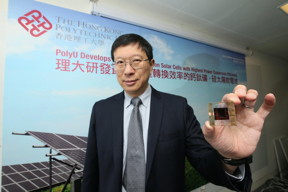 |
| Professor Charles Chee Surya, Clarea Au Endowed Professor in Energy, developed perovskite-silicon tandem solar cells with 25.5% power conversion efficiency. CREDIT: The Hong Kong Polytechnic University |
Abstract:
Perovskite solar cells first appeared in 2009 with an efficiency of just 3.8%. With the outstanding photovoltaic properties, perovskite solar cell has become a subject of vigorous research for sustainable power generation, with researchers around the world finding new ways to increase its energy conversion efficiency. It has currently established itself as one of the most promising solar cell materials.
PolyU develops solar cells with highest power conversion efficiency
Hong Kong, China | Posted on April 13th, 2016The research team in the Department of Electronic and Information Engineering led by Professor Charles Chee Surya, Clarea Au Endowed Professor in Energy, has recently made this world record with innovative means to enhance energy conversion efficiency. With this innovation, it is estimated that solar energy can be generated at cost of HK$2.73/W, compared with HK$3.9/W at present generated by existing silicon solar cells available in the market.
As there are different wavelengths for solar energy, a combination of different materials for making solar cells would work best for energy absorption. For example, methylammonium lead tri-halide perovskite and silicon solar cells can form a complementary pair. With the perovskite solar cell functioning as a top layer, it can harvest the short wavelength photons while the bottom layer coated with silicon is designed to absorb the long wavelength photons. PolyU's research team maximizes efficiency by making use of this feature with three innovative approaches. Firstly, the team discovers a chemical process -- low-temperature annealing process in dry oxygen to reduce the impact made by perovskite defects. Secondly, the team fabricates a tri-layer of molybdenum trioxide / gold / molybdenum trioxide with optimized thickness of each layer, making it highly transparent for light to go into the bottom silicon layer under perovskite layer. Finally, by mimicking the surface morphology of the rose petals, a haze film, developed by Dr Zijian Zheng of PolyU Institute of Textiles and Clothing, has been applied as the top layer of the solar panel to trap more light. All three innovative approaches help enhance energy conversion efficiency. Professor Shen Hui of Sun Yat-sen University and Shun De SYSU Institute for Solar Energy, who excelled in the fabrication high-efficiency silicon cells, was responsible for the design and fabrication of the bottom silicon cell.
PolyU research team will continue to improve the power conversion efficiency as well as the performance of large-scale fabrication of perovskite-silicon solar cells.
####
For more information, please click here
Contacts:
Hailey Lai
852-340-03853
Copyright © The Hong Kong Polytechnic University
If you have a comment, please Contact us.Issuers of news releases, not 7th Wave, Inc. or Nanotechnology Now, are solely responsible for the accuracy of the content.
Bookmark:


| Related News Press |
News and information
 Quantum computer improves AI predictions April 17th, 2026
Flexible sensor gains sensitivity under pressure April 17th, 2026
A reusable chip for particulate matter sensing April 17th, 2026
Detecting vibrational quantum beating in the predissociation dynamics of SF6 using time-resolved photoelectron spectroscopy April 17th, 2026
Possible Futures
A fundamentally new therapeutic approach to cystic fibrosis: Nanobody repairs cellular defect April 17th, 2026
UC Irvine physicists discover method to reverse ‘quantum scrambling’ : The work addresses the problem of information loss in quantum computing system April 17th, 2026
Discoveries
Quantum computer improves AI predictions April 17th, 2026
Flexible sensor gains sensitivity under pressure April 17th, 2026
A reusable chip for particulate matter sensing April 17th, 2026
Detecting vibrational quantum beating in the predissociation dynamics of SF6 using time-resolved photoelectron spectroscopy April 17th, 2026
Materials/Metamaterials/Magnetoresistance
First real-time observation of two-dimensional melting process: Researchers at Mainz University unveil new insights into magnetic vortex structures August 8th, 2025
Researchers unveil a groundbreaking clay-based solution to capture carbon dioxide and combat climate change June 6th, 2025
A 1960s idea inspires NBI researchers to study hitherto inaccessible quantum states June 6th, 2025
Institute for Nanoscience hosts annual proposal planning meeting May 16th, 2025
Announcements
A fundamentally new therapeutic approach to cystic fibrosis: Nanobody repairs cellular defect April 17th, 2026
UC Irvine physicists discover method to reverse ‘quantum scrambling’ : The work addresses the problem of information loss in quantum computing system April 17th, 2026
Interviews/Book Reviews/Essays/Reports/Podcasts/Journals/White papers/Posters
A fundamentally new therapeutic approach to cystic fibrosis: Nanobody repairs cellular defect April 17th, 2026
UC Irvine physicists discover method to reverse ‘quantum scrambling’ : The work addresses the problem of information loss in quantum computing system April 17th, 2026
Energy
Sensors innovations for smart lithium-based batteries: advancements, opportunities, and potential challenges August 8th, 2025
Simple algorithm paired with standard imaging tool could predict failure in lithium metal batteries August 8th, 2025
Solar/Photovoltaic
Spinel-type sulfide semiconductors to operate the next-generation LEDs and solar cells For solar-cell absorbers and green-LED source October 3rd, 2025
KAIST researchers introduce new and improved, next-generation perovskite solar cell November 8th, 2024
Groundbreaking precision in single-molecule optoelectronics August 16th, 2024
Development of zinc oxide nanopagoda array photoelectrode: photoelectrochemical water-splitting hydrogen production January 12th, 2024
 |
||
 |
||
| The latest news from around the world, FREE | ||
 |
||
|
|
||
| Premium Products | ||
 |
||
|
Only the news you want to read!
Learn More |
||
 |
||
|
Full-service, expert consulting
Learn More |
||
|
|
||