Home > Press > From IT to black holes: Nano-control of light pioneers new paths: Breakthrough chip for nano-manipulation of light paves way for next generation optical technologies and enables deeper understanding of black holes
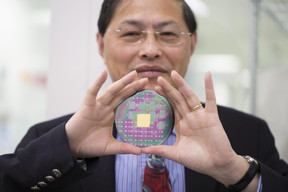 |
| RMIT University's Professor Min Gu with the breakthrough nanophotonic chip that can harness the angular momentum of light. CREDIT: RMIT University |
Abstract:
An Australian research team has created a breakthrough chip for the nano-manipulation of light, paving the way for next gen optical technologies and enabling deeper understanding of black holes.
From IT to black holes: Nano-control of light pioneers new paths: Breakthrough chip for nano-manipulation of light paves way for next generation optical technologies and enables deeper understanding of black holes
Melbourne, Australia | Posted on April 9th, 2016Led by Professor Min Gu at RMIT University in Melbourne, Australia, the team designed an integrated nanophotonic chip that can achieve unparalleled levels of control over the angular momentum (AM) of light.
The pioneering work opens new opportunities for using AM at a chip-scale for the generation, transmission, processing and recording of information, and could also be used to help scientists better understand the evolution and nature of black holes.
While traveling approximately in a straight line, a beam of light also spins and twists around its optical axis. The AM of light, which measures the amount of that dynamic rotation, has attracted tremendous research interest in recent decades.
A key focus is the potential of using AM to enable the mass expansion of the available capacity of optical fibres through the use of parallel light channels - an approach known as "multiplexing".
But realising AM multiplexing on a chip scale has remained a major challenge, as there is no material in nature capable of sensing twisted light.
"By designing a series of elaborate nano-apertures and nano-grooves on the photonic chip, our team has enabled the on-chip manipulation of twisted light for the first time," Gu said.
"The design removes the need for any other bulky interference-based optics to detect the AM signals.
"Our discovery could open up truly compact on-chip AM applications such as ultra-high definition display, ultra-high capacity optical communication and ultra-secure optical encryption.
"It could also be extended to characterize the AM properties of gravitational waves, to help us gain more information on how black holes interact with each other in the universe."
The team devised nano-grooves to couple AM-carrying beams into different plasmonic AM fields, with the nano-apertures subsequently sorting and transmitting the different plasmonic AM signals.
Lead author Haoran Ren, a PhD candidate at Swinburne University of Technology, said: "If you send an optical data signal to a photonic chip it is critical to know where the data is going, otherwise information will be lost.
"Our specially-designed nanophotonic chip can precisely guide AM data signals so they are transmitted from different mode-sorting nano-ring slits without losing any information."
As well as laying the foundation for the future ultra-broadband big data industry and providing a new platform for the next industry revolution, the research offers a precise new method for improving scientific knowledge of black holes.
Gu, Associate Deputy Vice-Chancellor for Research Innovation and Entrepreneurship at RMIT, and Node Director of the Australian Research Council's Centre for Ultrahigh-bandwidth Devices for Optical Systems (CUDOS), said the work offered the possibility of full control over twisted light, including both spin angular momentum (SAM) and orbital angular momentum (OAM).
"Due to the fact that rotating black holes can impart OAM associated with gravitational waves, an unambiguous measuring of the OAM through the sky could lead to a more profound understanding of the evolution and nature of black holes in the universe," he said.
###
The research, "On-chip Non-interference Angular-momentum Multiplexing of Broadband Light", will be published online by the journal Science on Thursday, 7 April 2016 (EDT).
####
For more information, please click here
Contacts:
Min Gu
61-399-252-128
Copyright © RMIT University
If you have a comment, please Contact us.Issuers of news releases, not 7th Wave, Inc. or Nanotechnology Now, are solely responsible for the accuracy of the content.
Bookmark:


| Related News Press |
News and information
 Quantum computer improves AI predictions April 17th, 2026
Flexible sensor gains sensitivity under pressure April 17th, 2026
A reusable chip for particulate matter sensing April 17th, 2026
Detecting vibrational quantum beating in the predissociation dynamics of SF6 using time-resolved photoelectron spectroscopy April 17th, 2026
Announcements
A fundamentally new therapeutic approach to cystic fibrosis: Nanobody repairs cellular defect April 17th, 2026
UC Irvine physicists discover method to reverse ‘quantum scrambling’ : The work addresses the problem of information loss in quantum computing system April 17th, 2026
Interviews/Book Reviews/Essays/Reports/Podcasts/Journals/White papers/Posters
A fundamentally new therapeutic approach to cystic fibrosis: Nanobody repairs cellular defect April 17th, 2026
UC Irvine physicists discover method to reverse ‘quantum scrambling’ : The work addresses the problem of information loss in quantum computing system April 17th, 2026
Aerospace/Space
Decoding hydrogen‑bond network of electrolyte for cryogenic durable aqueous zinc‑ion batteries January 30th, 2026
ICFO researchers overcome long-standing bottleneck in single photon detection with twisted 2D materials August 8th, 2025
Onion-like nanoparticles found in aircraft exhaust May 14th, 2025
Photonics/Optics/Lasers
Metasurfaces smooth light to boost magnetic sensing precision January 30th, 2026
From sensors to smart systems: the rise of AI-driven photonic noses January 30th, 2026
 |
||
 |
||
| The latest news from around the world, FREE | ||
 |
||
|
|
||
| Premium Products | ||
 |
||
|
Only the news you want to read!
Learn More |
||
 |
||
|
Full-service, expert consulting
Learn More |
||
|
|
||