Home > Press > Changing the color of single photons in a diamond quantum memory
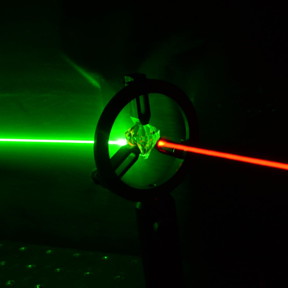 |
| This is an artist's impression of quantum frequency conversion in a diamond quantum memory.
Researchers from the Institute for Quantum Computing at the University of Waterloo and the National Research Council of Canada (NRC) have, for the first time, converted the colour and bandwidth of ultrafast single photons using a room-temperature quantum memory in diamond. CREDIT: Dr. Khabat Heshami, National Research Council Canada |
Abstract:
Researchers from the Institute for Quantum Computing at the University of Waterloo and the National Research Council of Canada (NRC) have, for the first time, converted the colour and bandwidth of ultrafast single photons using a room-temperature quantum memory in diamond.
Changing the color of single photons in a diamond quantum memory
Waterloo, Canada | Posted on April 7th, 2016Shifting the colour of a photon, or changing its frequency, is necessary to optimally link components in a quantum network. For example, in optical quantum communication, the best transmission through an optical fibre is near infrared, but many of the sensors that measure them work much better for visible light, which is a higher frequency. Being able to shift the colour of the photon between the fibre and the sensor enables higher performance operation, including bigger data rates.
The research, published in Nature Communications, demonstrated small frequency shifts that are useful for a communication protocol known as wavelength division multiplexing. This is used today when a sender needs to transmit large amounts of information through a transmission so the signal is broken into smaller packets of slightly different frequencies and sent through together. The information is then organized at the other end based on those frequencies.
In the experiments conducted at NRC, the researchers demonstrated the conversion of both the frequency and bandwidth of single photons using a room-temperature diamond quantum memory.
"Originally there was this thought that you just stop the photon, store it for a little while and get it back out. The fact that we can manipulate it at the same time is exciting," said Kent Fisher a PhD student at the Institute for Quantum Computing and with the Department of Physics and Astronomy at Waterloo. "These findings could open the door for other uses of quantum memory as well."
The diamond quantum memory works by converting the photon into a particular vibration of the carbon atoms in the diamond, called a phonon. This conversion works for many different colours of light allowing for the manipulation of a broad spectrum of light. The energy structure of diamond allows for this to occur at room temperature with very low noise. Researchers used strong laser pulses to store and retrieve the photon. By controlling the colours of these laser pulses, researchers controlled the colour of the retrieved photon.
"The fragility of quantum systems means that you are always working against the clock," remarked Duncan England, researcher at NRC. "The interesting step that we've shown here is that by using extremely short pulses of light, we are able to beat the clock and maintain quantum performance."
The integrated platform for photon storage and spectral conversion could be used for frequency multiplexing in quantum communication, as well as build up a very large entangled state - something called a cluster state. Researchers are interested in exploiting cluster states as the resource for quantum computing driven entirely by measurements.
"Canada is a power-house in quantum research and technology. This work is another example of what partners across the country can achieve when leveraging their joint expertise to build next-generation technologies," noted Ben Sussman, program leader for NRC's Quantum Photonics program.
####
About University of Waterloo
University of Waterloo is Canada's top innovation university. With more than 36,000 students we are home to the world's largest co-operative education system of its kind. Our unmatched entrepreneurial culture, combined with an intensive focus on research, powers one of the top innovation hubs in the world.
For more information, please click here
Contacts:
Nick Manning
226-929-7627
Copyright © University of Waterloo
If you have a comment, please Contact us.Issuers of news releases, not 7th Wave, Inc. or Nanotechnology Now, are solely responsible for the accuracy of the content.
Bookmark:


| Related Links |
| Related News Press |
News and information
 Quantum computer improves AI predictions April 17th, 2026
Flexible sensor gains sensitivity under pressure April 17th, 2026
A reusable chip for particulate matter sensing April 17th, 2026
Detecting vibrational quantum beating in the predissociation dynamics of SF6 using time-resolved photoelectron spectroscopy April 17th, 2026
Quantum Physics
Detecting vibrational quantum beating in the predissociation dynamics of SF6 using time-resolved photoelectron spectroscopy April 17th, 2026
Beyond silicon: Electronics at the scale of a single molecule January 30th, 2026
MXene nanomaterials enter a new dimension Multilayer nanomaterial: MXene flakes created at Drexel University show new promise as 1D scrolls January 30th, 2026
Physics
UC Irvine physicists discover method to reverse ‘quantum scrambling’ : The work addresses the problem of information loss in quantum computing system April 17th, 2026
Chip Technology
A reusable chip for particulate matter sensing April 17th, 2026
Metasurfaces smooth light to boost magnetic sensing precision January 30th, 2026
Quantum Computing
Quantum computer improves AI predictions April 17th, 2026
UC Irvine physicists discover method to reverse ‘quantum scrambling’ : The work addresses the problem of information loss in quantum computing system April 17th, 2026
Researchers develop molecular qubits that communicate at telecom frequencies October 3rd, 2025
Discoveries
Quantum computer improves AI predictions April 17th, 2026
Flexible sensor gains sensitivity under pressure April 17th, 2026
A reusable chip for particulate matter sensing April 17th, 2026
Detecting vibrational quantum beating in the predissociation dynamics of SF6 using time-resolved photoelectron spectroscopy April 17th, 2026
Announcements
A fundamentally new therapeutic approach to cystic fibrosis: Nanobody repairs cellular defect April 17th, 2026
UC Irvine physicists discover method to reverse ‘quantum scrambling’ : The work addresses the problem of information loss in quantum computing system April 17th, 2026
Interviews/Book Reviews/Essays/Reports/Podcasts/Journals/White papers/Posters
A fundamentally new therapeutic approach to cystic fibrosis: Nanobody repairs cellular defect April 17th, 2026
UC Irvine physicists discover method to reverse ‘quantum scrambling’ : The work addresses the problem of information loss in quantum computing system April 17th, 2026
Photonics/Optics/Lasers
Metasurfaces smooth light to boost magnetic sensing precision January 30th, 2026
From sensors to smart systems: the rise of AI-driven photonic noses January 30th, 2026
Quantum nanoscience
Beyond silicon: Electronics at the scale of a single molecule January 30th, 2026
MXene nanomaterials enter a new dimension Multilayer nanomaterial: MXene flakes created at Drexel University show new promise as 1D scrolls January 30th, 2026
ICFO researchers overcome long-standing bottleneck in single photon detection with twisted 2D materials August 8th, 2025
 |
||
 |
||
| The latest news from around the world, FREE | ||
 |
||
|
|
||
| Premium Products | ||
 |
||
|
Only the news you want to read!
Learn More |
||
 |
||
|
Full-service, expert consulting
Learn More |
||
|
|
||