Home > Press > Second quantum revolution a reality with chip-based atomic physics
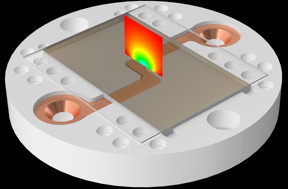 |
| The colormap on the surface shows the electric field amplitude. CREDIT: University of Oklahoma |
Abstract:
A University of Oklahoma-led team of physicists believes chip-based atomic physics holds promise to make the second quantum revolution--the engineering of quantum matter with arbitrary precision--a reality. With recent technological advances in fabrication and trapping, hybrid quantum systems are emerging as ideal platforms for a diverse range of studies in quantum control, quantum simulation and computing.
Second quantum revolution a reality with chip-based atomic physics
Norman, OK | Posted on March 31st, 2016James P. Shaffer, professor in the Homer L. Dodge Department of Physics and Astronomy, OU College of Arts and Sciences; Jon Sedlacek, OU graduate student; and a team from the University of Nevada, Western Washington University, The United States Naval Academy, Sandia National Laboratories and Harvard-Smithsonian Center for Astrophysics, have published research important for integrating Rydberg atoms into hybrid quantum systems and the fundamental study of atom-surface interactions, as well as applications for electrons bound to a 2D surface.
"A convenient surface for application in hybrid quantum systems is quartz because of its extensive use in the semiconductor and optics industries," Sedlacek said. "The surface has been the subject of recent interest as a result of it stability and low surface energy. Mitigating electric fields near 'trapping' surfaces is the holy grail for realizing hybrid quantum systems," added Hossein Sadeghpour, director of the Institute for Theoretical Atomic Molecular and Optical Physics, Harvard-Smithsonian Center for Astrophysics.
In this work, Shaffer finds ionized electrons from Rydberg atoms excited near the quartz surface form a 2D layer of electrons above the surface, canceling the electric field produced by rubidium surface adsorbates. The system is similar to electron trapping in a 2D gas on superfluid liquid helium. The binding of electrons to the surface substantially reduces the electric field above the surface.
"Our results show that binding is due to the image potential of the electron inside the quartz," said Shaffer. "The electron can't diffuse into the quartz because the rubidium adsorbates make the surface have a negative electron affinity. The approach is a promising pathway for coupling Rydberg atoms to surfaces as well as for using surfaces close to atomic and ionic samples."
###
A paper on this research was published in the American Physics Society's Physical Review Letters. The OU part of this work was supported by the Defense Advanced Research Projects Agency Quasar program by a grant through the Army Research Office, the Air Force Office of Scientific Research and the National Science Foundation.
####
For more information, please click here
Contacts:
Jana Smith
405-325-1322
Copyright © University of Oklahoma
If you have a comment, please Contact us.Issuers of news releases, not 7th Wave, Inc. or Nanotechnology Now, are solely responsible for the accuracy of the content.
Bookmark:


| Related News Press |
News and information
 Quantum computer improves AI predictions April 17th, 2026
Flexible sensor gains sensitivity under pressure April 17th, 2026
A reusable chip for particulate matter sensing April 17th, 2026
Detecting vibrational quantum beating in the predissociation dynamics of SF6 using time-resolved photoelectron spectroscopy April 17th, 2026
Quantum Physics
Detecting vibrational quantum beating in the predissociation dynamics of SF6 using time-resolved photoelectron spectroscopy April 17th, 2026
Beyond silicon: Electronics at the scale of a single molecule January 30th, 2026
MXene nanomaterials enter a new dimension Multilayer nanomaterial: MXene flakes created at Drexel University show new promise as 1D scrolls January 30th, 2026
Physics
UC Irvine physicists discover method to reverse ‘quantum scrambling’ : The work addresses the problem of information loss in quantum computing system April 17th, 2026
Govt.-Legislation/Regulation/Funding/Policy
Quantum computer improves AI predictions April 17th, 2026
Metasurfaces smooth light to boost magnetic sensing precision January 30th, 2026
New imaging approach transforms study of bacterial biofilms August 8th, 2025
Possible Futures
A fundamentally new therapeutic approach to cystic fibrosis: Nanobody repairs cellular defect April 17th, 2026
UC Irvine physicists discover method to reverse ‘quantum scrambling’ : The work addresses the problem of information loss in quantum computing system April 17th, 2026
Chip Technology
A reusable chip for particulate matter sensing April 17th, 2026
Metasurfaces smooth light to boost magnetic sensing precision January 30th, 2026
Quantum Computing
Quantum computer improves AI predictions April 17th, 2026
UC Irvine physicists discover method to reverse ‘quantum scrambling’ : The work addresses the problem of information loss in quantum computing system April 17th, 2026
Researchers develop molecular qubits that communicate at telecom frequencies October 3rd, 2025
Discoveries
Quantum computer improves AI predictions April 17th, 2026
Flexible sensor gains sensitivity under pressure April 17th, 2026
A reusable chip for particulate matter sensing April 17th, 2026
Detecting vibrational quantum beating in the predissociation dynamics of SF6 using time-resolved photoelectron spectroscopy April 17th, 2026
Announcements
A fundamentally new therapeutic approach to cystic fibrosis: Nanobody repairs cellular defect April 17th, 2026
UC Irvine physicists discover method to reverse ‘quantum scrambling’ : The work addresses the problem of information loss in quantum computing system April 17th, 2026
Interviews/Book Reviews/Essays/Reports/Podcasts/Journals/White papers/Posters
A fundamentally new therapeutic approach to cystic fibrosis: Nanobody repairs cellular defect April 17th, 2026
UC Irvine physicists discover method to reverse ‘quantum scrambling’ : The work addresses the problem of information loss in quantum computing system April 17th, 2026
Military
Quantum engineers ‘squeeze’ laser frequency combs to make more sensitive gas sensors January 17th, 2025
Chainmail-like material could be the future of armor: First 2D mechanically interlocked polymer exhibits exceptional flexibility and strength January 17th, 2025
Single atoms show their true color July 5th, 2024
NRL charters Navy’s quantum inertial navigation path to reduce drift April 5th, 2024
Quantum nanoscience
Beyond silicon: Electronics at the scale of a single molecule January 30th, 2026
MXene nanomaterials enter a new dimension Multilayer nanomaterial: MXene flakes created at Drexel University show new promise as 1D scrolls January 30th, 2026
ICFO researchers overcome long-standing bottleneck in single photon detection with twisted 2D materials August 8th, 2025
 |
||
 |
||
| The latest news from around the world, FREE | ||
 |
||
|
|
||
| Premium Products | ||
 |
||
|
Only the news you want to read!
Learn More |
||
 |
||
|
Full-service, expert consulting
Learn More |
||
|
|
||