Home > Press > Special topic: New unconventional superconductors and Weyl semimetal
 |
Abstract:
Unconventional superconductivity and topological quantum phenomena are two frontier research directions of condensed matter physics. A special topic published in 2016(5) issue of Science China Physics, Mechanics & Astronomy collected several works covering important progress in these two directions. Superconductivity was discovered in Hg in 1911 by the group of Kamerling Onnes in Leiden (Holland). The mystery of superconductivity was, however, not uncovered until 1957 when Bardeen-Cooper-Schrieffer (BCS) proposed the electron-phonon coupling picture. In the BCS picture, two electrons near the Fermi surface with opposite momenta and spins will form a bound state by exchanging phonons. Such charge carriers are called as Cooper pairs. Cooper pairs will condense into a low-energy state, which exhibits macroscopic phase coherence with, of course, the presence of a superfluid. The validity of this theory is, however, quite limited, and it cannot explain superconductivity in many unconventional superconductors, such as cuprates, iron pnictides, and iron selenides.
Special topic: New unconventional superconductors and Weyl semimetal
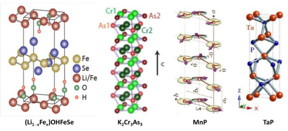
Beijing, China | Posted on March 28th, 2016On the topic of unconventional superconductivity, four works were presented in this special collection. The first work [1] concerns the effect of impurity scattering on superconductivity in K2Cr3As3, an unconventional superconductor discovered in 2015 by the same group here. This superconductor may contain a one-dimensional superfluid channel and possess the rarely reported triplet superconductivity. The report by the group of Prof. Guang-Han Cao from Zhejiang University deals with the effect of impurity resulting from dopants, which may reveal the fundamental feature of the pairing manner. They found the suppression of superconductivity by non-magnetic impurities, which is consistent with a possible novel pairing gap with, for example, gap nodes. The second work [2] by the group of Prof. JianLin Luo of the Institute of Physics, Chinese Academy of Sciences, involves NMR studies of the recently discovered superconductor MnP under pressure. Superconductivity was discovered by the same group in MnP under pressure. The chiral magnetic state seems to be essential to the superconductivity in that system. Here, the authors put new efforts into this issue. The third work [3] is by Prof. Hai-Hu Wen's group from Nanjing University. Since the discovery of the superconductor (Li1?xFex)OHFeSe, the question remains as to whether the superconductivity is robust and has a full volume. Clearly, the authors report robust superconductivity and anisotropy of the newly discovered superconductor (Li1?xFex)OHFeSe. Using well-documented data and analysis, they concluded a full volume of superconductivity in this new superconductor. The fourth work [4] is by the group of Prof. ShiYan Li from Fudan University. They use elegant thermal transport measurements at very low temperatures to detect the superconducting gap structure of the new superconductor Ca10(Pt4??As8)((Fe1?xPtx)2As2)5 (Tc=22 K). They find strong evidence of a fully gapped feature, the gap structure of which is common with many other iron-based superconductors.
Finally, the special topic collected one paper [5] by the group of Prof. MingHu Fang from Zhejiang University on the transport properties of the theoretically predicted Weyl semimetal TaP. Weyl semimetal is a very hot topic involving interesting physics. The detailed and careful transport measurements reveal not only the features of a semimetal but also some evidence of the chiral feature of the electrons, such as the huge positive and negative magnetoresistance. This discovery will trigger further studies on the Weyl semimetal state.
####
For more information, please click here
Contacts:
Wang Wei
Copyright © Science China Press
If you have a comment, please Contact us.Issuers of news releases, not 7th Wave, Inc. or Nanotechnology Now, are solely responsible for the accuracy of the content.
Bookmark:


| Related Links |
 1. Effect of impurity scattering on superconductivity in K2Cr3As3
2. 31P NMR study of magnetic phase transitions of MnP single crystal under 2 GPa pressure
3. Robust superconductivity and transport properties in (Li1-xFex)OHFeSe single crystals
5. Large unsaturated positive and negative magnetoresistance in Weyl semimetal TaP
| Related News Press |
News and information
Quantum computer improves AI predictions April 17th, 2026
Flexible sensor gains sensitivity under pressure April 17th, 2026
A reusable chip for particulate matter sensing April 17th, 2026
Detecting vibrational quantum beating in the predissociation dynamics of SF6 using time-resolved photoelectron spectroscopy April 17th, 2026
Superconductivity
MXene nanomaterials enter a new dimension Multilayer nanomaterial: MXene flakes created at Drexel University show new promise as 1D scrolls January 30th, 2026
Magnetism/Magnons
Metasurfaces smooth light to boost magnetic sensing precision January 30th, 2026
Researchers develop molecular qubits that communicate at telecom frequencies October 3rd, 2025
Possible Futures
A fundamentally new therapeutic approach to cystic fibrosis: Nanobody repairs cellular defect April 17th, 2026
UC Irvine physicists discover method to reverse ‘quantum scrambling’ : The work addresses the problem of information loss in quantum computing system April 17th, 2026
Discoveries
Quantum computer improves AI predictions April 17th, 2026
Flexible sensor gains sensitivity under pressure April 17th, 2026
A reusable chip for particulate matter sensing April 17th, 2026
Detecting vibrational quantum beating in the predissociation dynamics of SF6 using time-resolved photoelectron spectroscopy April 17th, 2026
Materials/Metamaterials/Magnetoresistance
First real-time observation of two-dimensional melting process: Researchers at Mainz University unveil new insights into magnetic vortex structures August 8th, 2025
Researchers unveil a groundbreaking clay-based solution to capture carbon dioxide and combat climate change June 6th, 2025
A 1960s idea inspires NBI researchers to study hitherto inaccessible quantum states June 6th, 2025
Institute for Nanoscience hosts annual proposal planning meeting May 16th, 2025
Announcements
A fundamentally new therapeutic approach to cystic fibrosis: Nanobody repairs cellular defect April 17th, 2026
UC Irvine physicists discover method to reverse ‘quantum scrambling’ : The work addresses the problem of information loss in quantum computing system April 17th, 2026
Interviews/Book Reviews/Essays/Reports/Podcasts/Journals/White papers/Posters
A fundamentally new therapeutic approach to cystic fibrosis: Nanobody repairs cellular defect April 17th, 2026
UC Irvine physicists discover method to reverse ‘quantum scrambling’ : The work addresses the problem of information loss in quantum computing system April 17th, 2026
 |
||
 |
||
| The latest news from around the world, FREE | ||
 |
||
|
|
||
| Premium Products | ||
 |
||
|
Only the news you want to read!
Learn More |
||
 |
||
|
Full-service, expert consulting
Learn More |
||
|
|
||