Home > Press > UGA researchers find potential treatment for prostate cancer
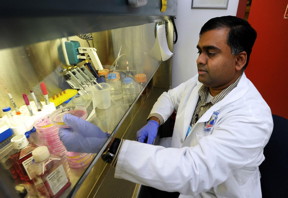 |
| Somanath Shenoy is an associate professor of Clinical and Experimental Therapeutics in the University of Georgia College of Pharmacy. CREDIT: University of Georgia |
Abstract:
Researchers at the University of Georgia have created a new therapeutic for prostate cancer that has shown great efficacy in mouse models of the disease. They published their findings recently in the journal Nanomedicine: Nanotechnology, Biology and Medicine.
UGA researchers find potential treatment for prostate cancer
Athens, GA | Posted on March 21st, 2016The treatment is designed to inhibit the activity of a protein called PAK-1, which contributes to the development of highly invasive prostate cancer cells.
Aside from non-melanoma skin cancer, prostate cancer is the most common cancer among men in the U.S., according to the Centers for Disease Control and Prevention. It is also one of the leading causes of cancer death among men of all races.
"PAK-1 is kind of like an on/off switch," said study co-author Somanath Shenoy, an associate professor in UGA's College of Pharmacy. "When it turns on, it makes cancerous cells turn into metastatic cells that spread throughout the body."
With the help of Brian Cummings, an associate professor in UGA's College of Pharmacy, the researchers developed a way to package and administer a small molecule called IPA-3, which limits the activity of PAK-1 proteins.
They enveloped the IPA-3 molecule in a bubble-like structure called a liposome and injected it intravenously. The liposome shell surrounding IPA-3 ensures that it is not metabolized by the body too quickly, allowing the inhibitor enough time to disrupt the PAK-1 protein.
The researchers found that this molecule significantly slowed the progression of cancer in mice, and it also forced the cancerous cells to undergo apoptosis--a kind of programmed cell death.
"When we first began these experiments, we injected IPA-3 directly into the bloodstream, but it was absorbed so quickly that we had to administer the treatment seven days a week for it to be effective," Shenoy said. "But the liposome that Dr. Cummings created makes the IPA-3 much more stable, and it reduced the treatment regimen to only twice a week."
The preliminary results suggest that IPA-3 might be a viable treatment for prostate cancer in humans, but Shenoy cautions that much work must be done before human clinical trials can begin.
"The results of our experiments are promising, and we hope to move toward clinical trials soon," he said, "but we must figure out what side effects this treatment may have before we can think about using it in humans."
Funds for this study were provided by the National Institutes of Health under grant number R01HL103952, the UGA College of Pharmacy, UGA Research Foundation and the American Legion, National Institutes of Health under grant number R01EB0116100 and a College Scientists Foundation Award.
####
For more information, please click here
Contacts:
Stephanie Schupska
706-542-6927
Copyright © University of Georgia
If you have a comment, please Contact us.Issuers of news releases, not 7th Wave, Inc. or Nanotechnology Now, are solely responsible for the accuracy of the content.
Bookmark:


| Related Links |
| Related News Press |
News and information
 Quantum computer improves AI predictions April 17th, 2026
Flexible sensor gains sensitivity under pressure April 17th, 2026
A reusable chip for particulate matter sensing April 17th, 2026
Detecting vibrational quantum beating in the predissociation dynamics of SF6 using time-resolved photoelectron spectroscopy April 17th, 2026
Cancer
New molecular technology targets tumors and simultaneously silences two ‘undruggable’ cancer genes August 8th, 2025
Ben-Gurion University of the Negev researchers several steps closer to harnessing patient's own T-cells to fight off cancer June 6th, 2025
Self-propelled protein-based nanomotors for enhanced cancer therapy by inducing ferroptosis June 6th, 2025
Govt.-Legislation/Regulation/Funding/Policy
Quantum computer improves AI predictions April 17th, 2026
Metasurfaces smooth light to boost magnetic sensing precision January 30th, 2026
New imaging approach transforms study of bacterial biofilms August 8th, 2025
Possible Futures
A fundamentally new therapeutic approach to cystic fibrosis: Nanobody repairs cellular defect April 17th, 2026
UC Irvine physicists discover method to reverse ‘quantum scrambling’ : The work addresses the problem of information loss in quantum computing system April 17th, 2026
Nanomedicine
A fundamentally new therapeutic approach to cystic fibrosis: Nanobody repairs cellular defect April 17th, 2026
New molecular technology targets tumors and simultaneously silences two ‘undruggable’ cancer genes August 8th, 2025
New imaging approach transforms study of bacterial biofilms August 8th, 2025
Electrifying results shed light on graphene foam as a potential material for lab grown cartilage June 6th, 2025
Discoveries
Quantum computer improves AI predictions April 17th, 2026
Flexible sensor gains sensitivity under pressure April 17th, 2026
A reusable chip for particulate matter sensing April 17th, 2026
Detecting vibrational quantum beating in the predissociation dynamics of SF6 using time-resolved photoelectron spectroscopy April 17th, 2026
Announcements
A fundamentally new therapeutic approach to cystic fibrosis: Nanobody repairs cellular defect April 17th, 2026
UC Irvine physicists discover method to reverse ‘quantum scrambling’ : The work addresses the problem of information loss in quantum computing system April 17th, 2026
Interviews/Book Reviews/Essays/Reports/Podcasts/Journals/White papers/Posters
A fundamentally new therapeutic approach to cystic fibrosis: Nanobody repairs cellular defect April 17th, 2026
UC Irvine physicists discover method to reverse ‘quantum scrambling’ : The work addresses the problem of information loss in quantum computing system April 17th, 2026
Grants/Sponsored Research/Awards/Scholarships/Gifts/Contests/Honors/Records
Quantum computer improves AI predictions April 17th, 2026
Detecting vibrational quantum beating in the predissociation dynamics of SF6 using time-resolved photoelectron spectroscopy April 17th, 2026
Metasurfaces smooth light to boost magnetic sensing precision January 30th, 2026
Nanobiotechnology
A fundamentally new therapeutic approach to cystic fibrosis: Nanobody repairs cellular defect April 17th, 2026
New molecular technology targets tumors and simultaneously silences two ‘undruggable’ cancer genes August 8th, 2025
New imaging approach transforms study of bacterial biofilms August 8th, 2025
Electrifying results shed light on graphene foam as a potential material for lab grown cartilage June 6th, 2025
 |
||
 |
||
| The latest news from around the world, FREE | ||
 |
||
|
|
||
| Premium Products | ||
 |
||
|
Only the news you want to read!
Learn More |
||
 |
||
|
Full-service, expert consulting
Learn More |
||
|
|
||