Home > Press > Making electronics safer with perovskites: Scientists in Japan are developing methods to manufacture safer ceramic capacitors
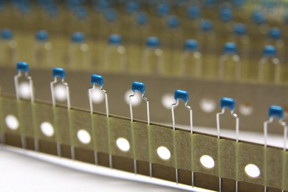 |
| A team of scientists from Hokkaido University and the multinational electronics company TDK Corporation in Japan has developed a method to improve the insulating properties of the oxynitride perovskite SrTaO2N for potential use as a ceramic capacitor. CREDIT: Tanusin Phunya/ 123rf |
Abstract:
Ceramic capacitors are used in a wide variety of electronics, ranging from computers and mobile phones to telecommunications transmitter stations and high voltage laser power supplies. Capacitors act, in a way, like batteries. They are "dielectric" - they act as an electronic insulator in which an electric field can be sustained with minimum loss of power. Their dielectric properties allow them to store electricity and then release it. One of the most widely used ceramics in capacitors is lead zirconate titanate, but it is hazardous to the health and the environment once it's disposed. Scientists are trying to find other less hazardous ceramic materials for use in capacitors.
Making electronics safer with perovskites: Scientists in Japan are developing methods to manufacture safer ceramic capacitors
Hokkaido, Japan | Posted on March 17th, 2016Perovskite oxynitrides - cheap and easily fabricated materials with a distinctive crystalline structure - are particularly promising. But ceramics manufactured from these materials need to be made denser to improve their insulating properties. This is usually done by applying intense heat; a process called "sintering". However, sintering the material can lead to a change in its chemical composition, turning it from an insulator to an electrical conductor.
The researchers sintered the perovskite powder SrTaO2N at a temperature of 1723 Kelvin (1450° Celsius) for three hours. They then "annealed" the material by heating it with flowing ammonia at 1223 Kelvin (950° Celsius) for 12 hours and then allowing it to slowly cool.
They found that the surface of the material after this process (but not its interior) displayed an important dielectric property called "ferroelectricity". This was the first time that a ferroelectric response has been observed on oxynitride perovskite ceramics, they say, making it promising as a new dielectric material for multi-layered ceramic capacitors.
####
For more information, please click here
Contacts:
Shinichi Kikkawa
Copyright © Hokkaido University
If you have a comment, please Contact us.Issuers of news releases, not 7th Wave, Inc. or Nanotechnology Now, are solely responsible for the accuracy of the content.
Bookmark:


| Related Links |
| Related News Press |
News and information
 Quantum computer improves AI predictions April 17th, 2026
Flexible sensor gains sensitivity under pressure April 17th, 2026
A reusable chip for particulate matter sensing April 17th, 2026
Detecting vibrational quantum beating in the predissociation dynamics of SF6 using time-resolved photoelectron spectroscopy April 17th, 2026
Possible Futures
A fundamentally new therapeutic approach to cystic fibrosis: Nanobody repairs cellular defect April 17th, 2026
UC Irvine physicists discover method to reverse ‘quantum scrambling’ : The work addresses the problem of information loss in quantum computing system April 17th, 2026
Discoveries
Quantum computer improves AI predictions April 17th, 2026
Flexible sensor gains sensitivity under pressure April 17th, 2026
A reusable chip for particulate matter sensing April 17th, 2026
Detecting vibrational quantum beating in the predissociation dynamics of SF6 using time-resolved photoelectron spectroscopy April 17th, 2026
Announcements
A fundamentally new therapeutic approach to cystic fibrosis: Nanobody repairs cellular defect April 17th, 2026
UC Irvine physicists discover method to reverse ‘quantum scrambling’ : The work addresses the problem of information loss in quantum computing system April 17th, 2026
Interviews/Book Reviews/Essays/Reports/Podcasts/Journals/White papers/Posters
A fundamentally new therapeutic approach to cystic fibrosis: Nanobody repairs cellular defect April 17th, 2026
UC Irvine physicists discover method to reverse ‘quantum scrambling’ : The work addresses the problem of information loss in quantum computing system April 17th, 2026
Environment
A reusable chip for particulate matter sensing April 17th, 2026
Researchers unveil a groundbreaking clay-based solution to capture carbon dioxide and combat climate change June 6th, 2025
Battery Technology/Capacitors/Generators/Piezoelectrics/Thermoelectrics/Energy storage
Decoding hydrogen‑bond network of electrolyte for cryogenic durable aqueous zinc‑ion batteries January 30th, 2026
COF scaffold membrane with gate‑lane nanostructure for efficient Li+/Mg2+ separation January 30th, 2026
MXene nanomaterials enter a new dimension Multilayer nanomaterial: MXene flakes created at Drexel University show new promise as 1D scrolls January 30th, 2026
 |
||
 |
||
| The latest news from around the world, FREE | ||
 |
||
|
|
||
| Premium Products | ||
 |
||
|
Only the news you want to read!
Learn More |
||
 |
||
|
Full-service, expert consulting
Learn More |
||
|
|
||