Home > Press > Theoretical physics discovery to set the research field buzzing
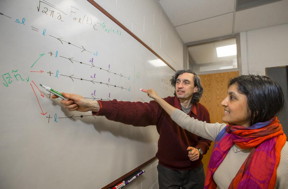 |
| Nayana Shah, a University of Cincinnati assistant professor of physics, and Carlos Bolech, a UC associate professor of physics, will be among researchers from around the world presenting groundbreaking research at the March meeting of the American Physical Society. CREDIT: Joseph Fuqua II |
Abstract:
Bazinga! University of Cincinnati theoretical physicists are about to report on a controversial discovery that they say contradicts the work of researchers over the decades. The discovery concerns the conventional approach toward bosonization-debosonization. For folks outside the physics lab and the whiteboard, this could affect calculations regarding the future of quantum computers as well as your electronic devices as they become smaller, faster and more advanced. Nayana Shah, a University of Cincinnati assistant professor of physics, and Carlos Bolech, a UC associate professor of physics, will be among researchers from around the world presenting groundbreaking research at the March meeting of the American Physical Society, which takes place March 14-18 in Baltimore.
Theoretical physics discovery to set the research field buzzing
Cincinnati, OH | Posted on March 15th, 2016The discovery involves how to solve problems when there are strong interactions between particles that need to work in harmony with each other - bosons or fermions. An example of a fermion is an electron and an example of a boson is a light particle (photon).
To get these particles to interact with each other and therefore power the high-tech devices of the future, theoretical physicists do calculations, a sort of alchemy, to transform fermions into bosons, called bosonization, or in reverse apply formulas for debosonization. "This 'refermionization' is like magic, because it can turn originally intractable problems into exactly solvable ones," explains Shah.
The researchers, however say they found that certain solutions with and without bosonization were not matching, despite the fact that the two were supposed to be exact. Shah and Bolech report that the issue involved violation of certain conservation laws in the bosonization-based procedure.
"An innovative reworking allowed us to incorporate some of the missing pieces into the steps of bosonization and debosonization and restore the magic," says Bolech. The researchers applied their new consistent formalism toward what's called the Nonequilibrium Kondo Problem in the physics world, a problem which can be applied to interacting electrons at the nano-scale - the very tiniest scale possible for electronics.
"What are the implications for the large body of past work that has used bosonization since the 1990s and earlier? Many results will have to be reworked," says Bolech.
"The good news is that the consistent formalism gives a general recipe for how to proceed," adds Shah.
Two papers reporting the research, Consistent bosonization-debosonization I and II, were recently published in the American Physical Society's Condensed Matter Physics journal, Physical Review B.
The American Physical Society is a non-profit membership organization dedicated to advancing the knowledge of physics through its research journals, scientific meetings, education, outreach, advocacy and international activities. APS represents more than 51,000 members, including physicists in academia, national laboratories, and industry in the United States and throughout the world.
Condensed matter being the largest subfield in physics, the APS March meeting draws nearly 10,000 physicists, scientists, and students from all over the world to share research from industry, universities, and major labs.
The University of Cincinnati was the first institution west of the Appalachian Mountains to offer a PhD in Physics. The UC Physics Department is housed in the McMicken College of Arts and Sciences.
####
For more information, please click here
Contacts:
Dawn Fuller
513-556-1823
Copyright © University of Cincinnati
If you have a comment, please Contact us.Issuers of news releases, not 7th Wave, Inc. or Nanotechnology Now, are solely responsible for the accuracy of the content.
Bookmark:


| Related News Press |
News and information
 Quantum computer improves AI predictions April 17th, 2026
Flexible sensor gains sensitivity under pressure April 17th, 2026
A reusable chip for particulate matter sensing April 17th, 2026
Detecting vibrational quantum beating in the predissociation dynamics of SF6 using time-resolved photoelectron spectroscopy April 17th, 2026
Quantum Physics
Detecting vibrational quantum beating in the predissociation dynamics of SF6 using time-resolved photoelectron spectroscopy April 17th, 2026
Beyond silicon: Electronics at the scale of a single molecule January 30th, 2026
MXene nanomaterials enter a new dimension Multilayer nanomaterial: MXene flakes created at Drexel University show new promise as 1D scrolls January 30th, 2026
Physics
UC Irvine physicists discover method to reverse ‘quantum scrambling’ : The work addresses the problem of information loss in quantum computing system April 17th, 2026
Quantum Computing
Quantum computer improves AI predictions April 17th, 2026
UC Irvine physicists discover method to reverse ‘quantum scrambling’ : The work addresses the problem of information loss in quantum computing system April 17th, 2026
Researchers develop molecular qubits that communicate at telecom frequencies October 3rd, 2025
Discoveries
Quantum computer improves AI predictions April 17th, 2026
Flexible sensor gains sensitivity under pressure April 17th, 2026
A reusable chip for particulate matter sensing April 17th, 2026
Detecting vibrational quantum beating in the predissociation dynamics of SF6 using time-resolved photoelectron spectroscopy April 17th, 2026
Announcements
A fundamentally new therapeutic approach to cystic fibrosis: Nanobody repairs cellular defect April 17th, 2026
UC Irvine physicists discover method to reverse ‘quantum scrambling’ : The work addresses the problem of information loss in quantum computing system April 17th, 2026
Interviews/Book Reviews/Essays/Reports/Podcasts/Journals/White papers/Posters
A fundamentally new therapeutic approach to cystic fibrosis: Nanobody repairs cellular defect April 17th, 2026
UC Irvine physicists discover method to reverse ‘quantum scrambling’ : The work addresses the problem of information loss in quantum computing system April 17th, 2026
 |
||
 |
||
| The latest news from around the world, FREE | ||
 |
||
|
|
||
| Premium Products | ||
 |
||
|
Only the news you want to read!
Learn More |
||
 |
||
|
Full-service, expert consulting
Learn More |
||
|
|
||