Home > Press > Soap bubbles for treating stenosed blood vessels
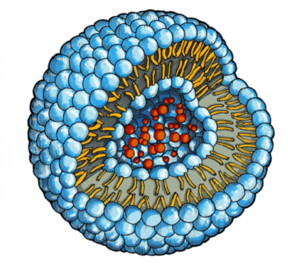 |
| The drug molecules (red) are embedded in a water-filled cavity inside of the phospholipid vesicle. CREDIT: University of Basel/University of Fribourg |
Abstract:
Liposomes are currently used as drug delivery vehicles but recognized by the immune system. Scientists from the universities of Basel and Fribourg have shown that special artificial liposomes do not elicit any reaction in human and porcine sera as well as pigs. The study was published in the Journal Nanomedicine: Nanotechnology, Biology, and Medicine.
Soap bubbles for treating stenosed blood vessels
Basel, Switzerland | Posted on March 13th, 2016Liposomes are soap-bubble-like nanocontainers made of a double phospholipid membrane that shields off an inner aqueous compartment. In a lenticular form, as developed by Professor Andreas Zumbühl's team at the Department of Chemistry at the University of Fribourg, they are promising candidates for drug delivery to constricted coronary arteries. Here, the blood flows through the stenosed artery segments with high velocity and is subjected to enhanced shear forces. Under these conditions, the liposomes open and release their content.
Unfortunately, the immune system does recognize these liposomes as foreign bodies. The activation of the immune system may lead to a pseudo-allergy. Earlier studies have shown that negative effects are found in up to 30 percent of the cases. Even using clinically approved liposomal dugs it is possible to find anaphylactic shocks, which can be highly toxic for the treated patient.
No Reaction in Pig Studies
A team of researchers led by Prof. Bert Müller from the Biomaterials Science Center of the University of Basel and Prof. Andreas Zumbühl from the Department of Chemistry at the University of Fribourg has tested artificial phospholipid vesicles (Pad-PC-Pad vesicles) for their potential as drug delivery nanocontainers. Surprisingly, these liposomes did not spur any reaction neither in blood serum of pigs nor humans.
In a next step, the vesicles were tested in living organisms. The researchers injected three Yorkshire pigs with Pad-PC-Pad suspensions and monitored the heart rate, the electrocardiogram and the blood pressures. Even at high doses the pigs showed no or negligible reactions. The biopsies of pig tissues showed no toxic changes in kidneys, lungs, heart, and liver. "The study shows that Pad-PC-Pad liposomes are not inducing direct or indirect anaphylactic reactions, even at high dosages", says Professor Bert Müller of the University of Basel. "These are highly unexpected results could have a high impact of future treatments of atherosclerosis."
According to the World Health Organization WHO coronary artery diseases are responsible for 30 % of deaths worldwide. In the case of constricted coronary arteries the conditions often gets worse during the transport of the patient to the hospital, showing the need for medication that efficiently covers the pre-hospital segment. Pad-PC-Pad vesicles therefore show high potential because, in contrast to existing liposomes, they do not elicit a significant immune response.
####
For more information, please click here
Contacts:
Yannik Sprecher
41-612-672-424
Copyright © University of Basel
If you have a comment, please Contact us.Issuers of news releases, not 7th Wave, Inc. or Nanotechnology Now, are solely responsible for the accuracy of the content.
Bookmark:


| Related Links |
| Related News Press |
News and information
 Quantum computer improves AI predictions April 17th, 2026
Flexible sensor gains sensitivity under pressure April 17th, 2026
A reusable chip for particulate matter sensing April 17th, 2026
Detecting vibrational quantum beating in the predissociation dynamics of SF6 using time-resolved photoelectron spectroscopy April 17th, 2026
Possible Futures
A fundamentally new therapeutic approach to cystic fibrosis: Nanobody repairs cellular defect April 17th, 2026
UC Irvine physicists discover method to reverse ‘quantum scrambling’ : The work addresses the problem of information loss in quantum computing system April 17th, 2026
Nanomedicine
A fundamentally new therapeutic approach to cystic fibrosis: Nanobody repairs cellular defect April 17th, 2026
New molecular technology targets tumors and simultaneously silences two ‘undruggable’ cancer genes August 8th, 2025
New imaging approach transforms study of bacterial biofilms August 8th, 2025
Electrifying results shed light on graphene foam as a potential material for lab grown cartilage June 6th, 2025
Discoveries
Quantum computer improves AI predictions April 17th, 2026
Flexible sensor gains sensitivity under pressure April 17th, 2026
A reusable chip for particulate matter sensing April 17th, 2026
Detecting vibrational quantum beating in the predissociation dynamics of SF6 using time-resolved photoelectron spectroscopy April 17th, 2026
Announcements
A fundamentally new therapeutic approach to cystic fibrosis: Nanobody repairs cellular defect April 17th, 2026
UC Irvine physicists discover method to reverse ‘quantum scrambling’ : The work addresses the problem of information loss in quantum computing system April 17th, 2026
Interviews/Book Reviews/Essays/Reports/Podcasts/Journals/White papers/Posters
A fundamentally new therapeutic approach to cystic fibrosis: Nanobody repairs cellular defect April 17th, 2026
UC Irvine physicists discover method to reverse ‘quantum scrambling’ : The work addresses the problem of information loss in quantum computing system April 17th, 2026
Nanobiotechnology
A fundamentally new therapeutic approach to cystic fibrosis: Nanobody repairs cellular defect April 17th, 2026
New molecular technology targets tumors and simultaneously silences two ‘undruggable’ cancer genes August 8th, 2025
New imaging approach transforms study of bacterial biofilms August 8th, 2025
Electrifying results shed light on graphene foam as a potential material for lab grown cartilage June 6th, 2025
 |
||
 |
||
| The latest news from around the world, FREE | ||
 |
||
|
|
||
| Premium Products | ||
 |
||
|
Only the news you want to read!
Learn More |
||
 |
||
|
Full-service, expert consulting
Learn More |
||
|
|
||