Home > Press > Hepatitis virus-like particles as potential cancer treatment
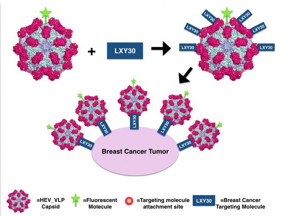 |
| Hepatitis E virus capsids can resist passing through the digestive system. These virus-like particles could be used to carry vaccines or drugs into the body through the oral route. By modifying the capsid proteins, UC Davis researchers show that they can attach molecules to the particle surface that target breast cancer cells. CREDIT: Marie Stark/UC Davis |
Abstract:
UC Davis researchers have developed a way to use the empty shell of a Hepatitis E virus to carry vaccines or drugs into the body. The technique has been tested in rodents as a way to target breast cancer, and is available for commercial licensing through UC Davis Office of Research.
Hepatitis virus-like particles as potential cancer treatment
Davis, CA | Posted on February 5th, 2016Hepatitis E virus is feco-orally transmitted, so it can survive passing through the digestive system, said Marie Stark, a graduate student working with Professor Holland Cheng in the UC Davis Department of Molecular and Cell Biology.
Cheng, Stark and colleagues prepared virus-like particles based on Hepatitis E proteins. The particles do not contain any virus DNA, so they can't multiply and spread and cause infections.
Such particles could be used as vaccines that are delivered through food or drink. The idea is that you would drink the vaccine, and after passing through the stomach the virus-like particles would get absorbed in the intestine and deliver vaccines to the body.
But the particles could also be used to attack cancer. Stark and Cheng did some tinkering with the proteins, so that they carry sticky cysteine amino acids on the outside. They could then chemically link other molecules to these cysteine groups.
They worked with a molecule called LXY-30, developed by researchers at the UC Davis Comprehensive Cancer Center, which is known to stick to breast cancer cells. By using a fluorescent marker, they could show that virus-like particles carrying LXY-30 could home in on breast cancer cells both in a laboratory dish and in a mouse model of breast cancer.
Results of the study are published in the journal Nanomedicine. Information about licensing the technology can be found at: https://techtransfer.universityofcalifornia.edu/NCD/24218.html .
So perhaps one day, cancer patients might drink their medicine and UC Davis-designed virus-like particles carrying anticancer drugs will home in on their target.
####
For more information, please click here
Contacts:
Andy Fell
530-752-4533
Copyright © University of California, Davis
If you have a comment, please Contact us.Issuers of news releases, not 7th Wave, Inc. or Nanotechnology Now, are solely responsible for the accuracy of the content.
Bookmark:


| Related Links |
| Related News Press |
News and information
 Quantum computer improves AI predictions April 17th, 2026
Flexible sensor gains sensitivity under pressure April 17th, 2026
A reusable chip for particulate matter sensing April 17th, 2026
Detecting vibrational quantum beating in the predissociation dynamics of SF6 using time-resolved photoelectron spectroscopy April 17th, 2026
Cancer
New molecular technology targets tumors and simultaneously silences two ‘undruggable’ cancer genes August 8th, 2025
Ben-Gurion University of the Negev researchers several steps closer to harnessing patient's own T-cells to fight off cancer June 6th, 2025
Self-propelled protein-based nanomotors for enhanced cancer therapy by inducing ferroptosis June 6th, 2025
Govt.-Legislation/Regulation/Funding/Policy
Quantum computer improves AI predictions April 17th, 2026
Metasurfaces smooth light to boost magnetic sensing precision January 30th, 2026
New imaging approach transforms study of bacterial biofilms August 8th, 2025
Possible Futures
A fundamentally new therapeutic approach to cystic fibrosis: Nanobody repairs cellular defect April 17th, 2026
UC Irvine physicists discover method to reverse ‘quantum scrambling’ : The work addresses the problem of information loss in quantum computing system April 17th, 2026
Nanomedicine
A fundamentally new therapeutic approach to cystic fibrosis: Nanobody repairs cellular defect April 17th, 2026
New molecular technology targets tumors and simultaneously silences two ‘undruggable’ cancer genes August 8th, 2025
New imaging approach transforms study of bacterial biofilms August 8th, 2025
Electrifying results shed light on graphene foam as a potential material for lab grown cartilage June 6th, 2025
Discoveries
Quantum computer improves AI predictions April 17th, 2026
Flexible sensor gains sensitivity under pressure April 17th, 2026
A reusable chip for particulate matter sensing April 17th, 2026
Detecting vibrational quantum beating in the predissociation dynamics of SF6 using time-resolved photoelectron spectroscopy April 17th, 2026
Materials/Metamaterials/Magnetoresistance
First real-time observation of two-dimensional melting process: Researchers at Mainz University unveil new insights into magnetic vortex structures August 8th, 2025
Researchers unveil a groundbreaking clay-based solution to capture carbon dioxide and combat climate change June 6th, 2025
A 1960s idea inspires NBI researchers to study hitherto inaccessible quantum states June 6th, 2025
Institute for Nanoscience hosts annual proposal planning meeting May 16th, 2025
Announcements
A fundamentally new therapeutic approach to cystic fibrosis: Nanobody repairs cellular defect April 17th, 2026
UC Irvine physicists discover method to reverse ‘quantum scrambling’ : The work addresses the problem of information loss in quantum computing system April 17th, 2026
Interviews/Book Reviews/Essays/Reports/Podcasts/Journals/White papers/Posters
A fundamentally new therapeutic approach to cystic fibrosis: Nanobody repairs cellular defect April 17th, 2026
UC Irvine physicists discover method to reverse ‘quantum scrambling’ : The work addresses the problem of information loss in quantum computing system April 17th, 2026
Grants/Sponsored Research/Awards/Scholarships/Gifts/Contests/Honors/Records
Quantum computer improves AI predictions April 17th, 2026
Detecting vibrational quantum beating in the predissociation dynamics of SF6 using time-resolved photoelectron spectroscopy April 17th, 2026
Metasurfaces smooth light to boost magnetic sensing precision January 30th, 2026
Nanobiotechnology
A fundamentally new therapeutic approach to cystic fibrosis: Nanobody repairs cellular defect April 17th, 2026
New molecular technology targets tumors and simultaneously silences two ‘undruggable’ cancer genes August 8th, 2025
New imaging approach transforms study of bacterial biofilms August 8th, 2025
Electrifying results shed light on graphene foam as a potential material for lab grown cartilage June 6th, 2025
 |
||
 |
||
| The latest news from around the world, FREE | ||
 |
||
|
|
||
| Premium Products | ||
 |
||
|
Only the news you want to read!
Learn More |
||
 |
||
|
Full-service, expert consulting
Learn More |
||
|
|
||