Home > Press > Clarifying the role of magnetism in high-temperature superconductors
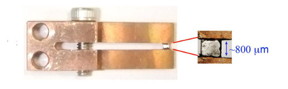 |
| The sample was gently squeezed in a copper holder to insure a uniform alignment at low temperature. |
Abstract:
A collaboration of scientists from the RIKEN SPring-8 Center, Osaka University, the Japan Atomic Energy Agency, and the Japan Synchrotron Radiation Research Institute have published research clarifying the role of magnetism in a new type of high-temperature superconductor. The research, just published as a Rapid Communication in Physical Review B, gives us a better understanding of the atomic-scale behavior of these materials. Physicists hope that, by understanding how these materials superconduct at relatively high temperature, they can eventually learn enough to make materials that superconduct close to room temperature.
Clarifying the role of magnetism in high-temperature superconductors
Wako, Japan | Posted on January 26th, 2016It is known that the phenomenon of superconductivity -- where materials conduct electricity without resistance -- arises when pairs of electrons become coupled together or "paired". With traditional superconductors, this pairing arises due to vibrations of the ions in the structure. But this is not always the case: there are other types of materials, such as cuprate superconductors and a relatively new class of superconductor iron-pnictide superconductors, that was discovered by a group led by Hideo Hosono at the Tokyo Institute of Technology, where magnetism may be the paring mechanism.
According to Alfred Baron, the leader of the Materials Dynamics Lab at RIKEN SPring-8 Center, "The question we addressed was how the atomic vibrations in the iron pnictides are affected by magnetism. This was especially interesting because atomic vibrations are understood to be driving force of the older type of low-temperature superconductors, while magnetism is considered to be the probable driving mechanism of the new, high-temperature, superconductivity. Thus, it was in some sense, an overlap of the old with the new."
Using a technique called inelastic x-ray scattering on two beamlines of the powerful SPring-8 synchrotron facility in Harima, Japan, the group was able to measure the dynamics in specially prepared single-domain samples. Comparing their measurements to calculations then suggested that magnetic fluctuations play an important role in the atomic vibrations. Naoki Murai, the graduate student spearheading the measurement explains, "By very gently pressing the material in the correct direction we were able to observe effects due to the onset of magnetic order". Says Baron, "One of the nice things about this work is that it provides a basis for describing atomic vibrations in this whole class of materials--do calculations with magnetism and then add fluctuations".
Baron says the collaboration will continue to investigate the properties of these fascinating materials, and also, more generally, the interaction of magnetism and atomic vibrations.
####
For more information, please click here
Contacts:
Jens Wilkinson
81-484-621-225
Copyright © RIKEN
If you have a comment, please Contact us.Issuers of news releases, not 7th Wave, Inc. or Nanotechnology Now, are solely responsible for the accuracy of the content.
Bookmark:


| Related Links |
| Related News Press |
News and information
 Quantum computer improves AI predictions April 17th, 2026
Flexible sensor gains sensitivity under pressure April 17th, 2026
A reusable chip for particulate matter sensing April 17th, 2026
Detecting vibrational quantum beating in the predissociation dynamics of SF6 using time-resolved photoelectron spectroscopy April 17th, 2026
Superconductivity
MXene nanomaterials enter a new dimension Multilayer nanomaterial: MXene flakes created at Drexel University show new promise as 1D scrolls January 30th, 2026
Discoveries
Quantum computer improves AI predictions April 17th, 2026
Flexible sensor gains sensitivity under pressure April 17th, 2026
A reusable chip for particulate matter sensing April 17th, 2026
Detecting vibrational quantum beating in the predissociation dynamics of SF6 using time-resolved photoelectron spectroscopy April 17th, 2026
Materials/Metamaterials/Magnetoresistance
First real-time observation of two-dimensional melting process: Researchers at Mainz University unveil new insights into magnetic vortex structures August 8th, 2025
Researchers unveil a groundbreaking clay-based solution to capture carbon dioxide and combat climate change June 6th, 2025
A 1960s idea inspires NBI researchers to study hitherto inaccessible quantum states June 6th, 2025
Institute for Nanoscience hosts annual proposal planning meeting May 16th, 2025
Announcements
A fundamentally new therapeutic approach to cystic fibrosis: Nanobody repairs cellular defect April 17th, 2026
UC Irvine physicists discover method to reverse ‘quantum scrambling’ : The work addresses the problem of information loss in quantum computing system April 17th, 2026
Interviews/Book Reviews/Essays/Reports/Podcasts/Journals/White papers/Posters
A fundamentally new therapeutic approach to cystic fibrosis: Nanobody repairs cellular defect April 17th, 2026
UC Irvine physicists discover method to reverse ‘quantum scrambling’ : The work addresses the problem of information loss in quantum computing system April 17th, 2026
 |
||
 |
||
| The latest news from around the world, FREE | ||
 |
||
|
|
||
| Premium Products | ||
 |
||
|
Only the news you want to read!
Learn More |
||
 |
||
|
Full-service, expert consulting
Learn More |
||
|
|
||