Home > Press > Optimum band gap for hybrid silicon/perovskite tandem solar cell
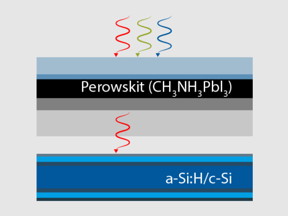 |
| Sketch of the tandem cell. Credit: H. Cords/HZB |
Abstract:
Tandem solar cells based on silicon and perovskites have raised high hopes for future high efficiency solar modules. A tandem solar cell works by absorbing the high energy photons (visible light) in a top cell which generates a high voltage, and the lower energy photons (Infra red) in a rear cell, which generates a lower voltage. This increases the theoretical maximum efficiency by about 50% in comparison to a standalone silicon cell.
Optimum band gap for hybrid silicon/perovskite tandem solar cell
Berlin, Germany | Posted on January 11th, 2016To maximise efficiency, the amount of light absorbed in top cell has to precisely match the light absorbed in the rear cell. However, the band gap of ~1.6eV of the standard perovskite material is too small to fully exploit the efficiency potential of this technology.
A team led by perovskite solar cell pioneer Prof. Henry Snaith FRS at the University of Oxford, in collaboration with silicon solar cell experts Prof. Bernd Rech and Dr. Lars Korte of the Helmholtz-Zentrum Berlin, have shown that an ultimate efficiency of 30% should be attainable with such tandem cells.
They conceived together a tandem cell, in a configuration where the perovskite and the silicon cell are mechanically stacked and contacted separately. The HZB team contributed the silicon cell. The Oxford group did vary systematically the chemical composition of the perovskite layer, and with a precise cocktail of ions discovered a structurally stable perovsksite with its band gap tuned to an optimum value of 1.75 electron volts, maintaining a high electronic quality of the layer. At the same time, they increased the chemical and thermal stability of the material significantly.
####
For more information, please click here
Contacts:
Antonia Roetger
49-308-062-43733
Copyright © Helmholtz-Zentrum Berlin für Materialien und Energie
If you have a comment, please Contact us.Issuers of news releases, not 7th Wave, Inc. or Nanotechnology Now, are solely responsible for the accuracy of the content.
Bookmark:


| Related Links |
 Science 8 January 2016: Vol. 351 no. 6269 pp. 151-155
| Related News Press |
News and information
Quantum computer improves AI predictions April 17th, 2026
Flexible sensor gains sensitivity under pressure April 17th, 2026
A reusable chip for particulate matter sensing April 17th, 2026
Detecting vibrational quantum beating in the predissociation dynamics of SF6 using time-resolved photoelectron spectroscopy April 17th, 2026
Discoveries
Quantum computer improves AI predictions April 17th, 2026
Flexible sensor gains sensitivity under pressure April 17th, 2026
A reusable chip for particulate matter sensing April 17th, 2026
Detecting vibrational quantum beating in the predissociation dynamics of SF6 using time-resolved photoelectron spectroscopy April 17th, 2026
Announcements
A fundamentally new therapeutic approach to cystic fibrosis: Nanobody repairs cellular defect April 17th, 2026
UC Irvine physicists discover method to reverse ‘quantum scrambling’ : The work addresses the problem of information loss in quantum computing system April 17th, 2026
Interviews/Book Reviews/Essays/Reports/Podcasts/Journals/White papers/Posters
A fundamentally new therapeutic approach to cystic fibrosis: Nanobody repairs cellular defect April 17th, 2026
UC Irvine physicists discover method to reverse ‘quantum scrambling’ : The work addresses the problem of information loss in quantum computing system April 17th, 2026
Energy
Sensors innovations for smart lithium-based batteries: advancements, opportunities, and potential challenges August 8th, 2025
Simple algorithm paired with standard imaging tool could predict failure in lithium metal batteries August 8th, 2025
Solar/Photovoltaic
Spinel-type sulfide semiconductors to operate the next-generation LEDs and solar cells For solar-cell absorbers and green-LED source October 3rd, 2025
KAIST researchers introduce new and improved, next-generation perovskite solar cell November 8th, 2024
Groundbreaking precision in single-molecule optoelectronics August 16th, 2024
Development of zinc oxide nanopagoda array photoelectrode: photoelectrochemical water-splitting hydrogen production January 12th, 2024
 |
||
 |
||
| The latest news from around the world, FREE | ||
 |
||
|
|
||
| Premium Products | ||
 |
||
|
Only the news you want to read!
Learn More |
||
 |
||
|
Full-service, expert consulting
Learn More |
||
|
|
||