Home > Press > Researchers demonstrate tracking of individual catalyst nanoparticles during heating
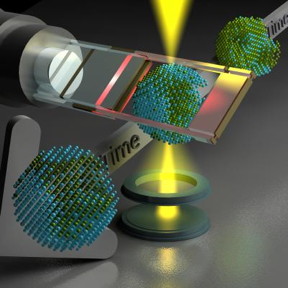 |
| McMaster researchers have taken atomic-level images of individual nanoparticles during heating that could lead to improved fuel-cell technologies at lower cost, reduce dependence on imported oil and minimize greenhouse gas emissions. CREDIT: McMaster University |
Abstract:
Researchers from McMaster University in Hamilton, Ont., have taken atomic-level images of individual nanoparticles during heating that could lead to improved fuel-cell technologies at lower cost, reduce dependence on imported oil and minimize greenhouse gas emissions.
Researchers demonstrate tracking of individual catalyst nanoparticles during heating
Hamilton, Canada | Posted on December 21st, 2015Heating nanoparticles and atomic-level tracking allows for the development of other less expensive catalysts, such as platinum-iron nanoparticles. Typically, pricey platinum nanoparticles are used.
Using advanced electron microscopic techniques the team was able to track the atomic-rearrangement process of an individual Platinum-Iron nanoparticle - as it got annealed inside the microscope.
"Our work is pioneering in the application of advanced electron microscopy techniques to study the structural and compositional transformation of individual nanometer-sized particles during heating," said Gianluigi Botton, Professor of Materials Science and Engineering at McMaster University.
The researchers' work on nanoparticles, which are as small as 1/50,000th of the diameter of a human hair, could have far-reaching impact on the automotive industry.
With the depletion of fossil fuel reserves, there has been a surge of interest in developing alternative energy sources, particularly in the area of fuel cell technology. Fuel cell devices can power vehicles by converting chemical energy into electrical energy in a far more efficient and environmentally-friendly way than the conventional combustion technologies. However, they rely on catalysts to operate and reducing catalyst-cost is crucial for commercialization.
McMaster's research team comprising of Sagar Prabhudev (Materials Science and Engineering PhD Student), Dr. Matthieu Bugnet (Post-doctoral researcher) and Botton carried out their work in collaboration with Dr. Christina Bock (NRC, Ottawa) and Dr. Guozhen Zhu (Shanghai Jiao Tong University, China).
"Imagine that you placed millions of nanoparticles on a pan and started heating," said Prabhudev. "During the course of heating, you select one of the particles. And, with the help of a powerful microscope, watch the atoms move. That is the equivalent to what we have done."
A Titan 80-300 cubed microscope at McMaster's Canadian Center for Electron Microscopy (CCEM) was used for the research.
"In terms of capability, Titan electron microscope is similar to the Hubble Telescope. The difference is that the Titan allows us to explore atomic structure of materials, instead of stars and galaxies," said Botton, also the Scientific Director of CCEM. "This includes identifying atoms, measuring their chemical state and even probing the electrons that bind atoms together."
The researchers point out that the insights obtained were previously inaccessible with traditional analytical methods.
###
The work was carried out with financial support from NSERC (Discovery and Strategic grants), Automotive Partnership Canada (APC) (Carpe-FC grant) and McMaster University.
####
For more information, please click here
Contacts:
Monique Beech
905-525-9140 x27082
Copyright © McMaster University
If you have a comment, please Contact us.Issuers of news releases, not 7th Wave, Inc. or Nanotechnology Now, are solely responsible for the accuracy of the content.
Bookmark:


| Related News Press |
News and information
 Quantum computer improves AI predictions April 17th, 2026
Flexible sensor gains sensitivity under pressure April 17th, 2026
A reusable chip for particulate matter sensing April 17th, 2026
Detecting vibrational quantum beating in the predissociation dynamics of SF6 using time-resolved photoelectron spectroscopy April 17th, 2026
Discoveries
Quantum computer improves AI predictions April 17th, 2026
Flexible sensor gains sensitivity under pressure April 17th, 2026
A reusable chip for particulate matter sensing April 17th, 2026
Detecting vibrational quantum beating in the predissociation dynamics of SF6 using time-resolved photoelectron spectroscopy April 17th, 2026
Announcements
A fundamentally new therapeutic approach to cystic fibrosis: Nanobody repairs cellular defect April 17th, 2026
UC Irvine physicists discover method to reverse ‘quantum scrambling’ : The work addresses the problem of information loss in quantum computing system April 17th, 2026
Interviews/Book Reviews/Essays/Reports/Podcasts/Journals/White papers/Posters
A fundamentally new therapeutic approach to cystic fibrosis: Nanobody repairs cellular defect April 17th, 2026
UC Irvine physicists discover method to reverse ‘quantum scrambling’ : The work addresses the problem of information loss in quantum computing system April 17th, 2026
Environment
A reusable chip for particulate matter sensing April 17th, 2026
Researchers unveil a groundbreaking clay-based solution to capture carbon dioxide and combat climate change June 6th, 2025
Energy
Sensors innovations for smart lithium-based batteries: advancements, opportunities, and potential challenges August 8th, 2025
Simple algorithm paired with standard imaging tool could predict failure in lithium metal batteries August 8th, 2025
Automotive/Transportation
Decoding hydrogen‑bond network of electrolyte for cryogenic durable aqueous zinc‑ion batteries January 30th, 2026
Sensors innovations for smart lithium-based batteries: advancements, opportunities, and potential challenges August 8th, 2025
Simple algorithm paired with standard imaging tool could predict failure in lithium metal batteries August 8th, 2025
Fuel Cells
Deciphering local microstrain-induced optimization of asymmetric Fe single atomic sites for efficient oxygen reduction August 8th, 2025
Current and Future Developments in Nanomaterials and Carbon Nanotubes: Applications of Nanomaterials in Energy Storage and Electronics October 28th, 2022
 |
||
 |
||
| The latest news from around the world, FREE | ||
 |
||
|
|
||
| Premium Products | ||
 |
||
|
Only the news you want to read!
Learn More |
||
 |
||
|
Full-service, expert consulting
Learn More |
||
|
|
||