Home > Press > Unveiling distribution of defects in proton conductors: A new strategy to open a practical use of IT-SOFCs
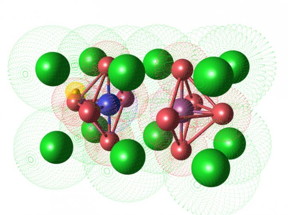 |
| This figure shows the crystal structure of Sc-doped BaZrO3 to be used as an electrolyte material in intermediate temperature solid oxide fuel cells (IT-SOFCs). By using a nuclear magnetic resonance (NMR) technique, the distribution of proton and oxygen vacancy in Sc-doped BaZrO3 was clarified. Green, blue, purple and red spheres represent Ba, Zr, Sc cations and oxide ions in the Sc-doped BaZrO3, respectively. In this material, a proton (gold sphere) having one positive charge is known to be trapped around the Sc cation (purple sphere) since the Sc site possesses one negative charge; the trapped proton is the cause of low proton conductivity at the intermediate temperature range. Meanwhile, when an oxide ion (red sphere) is vacant (center position in this case), the pair of the vacancy and Sc now possesses one positive charge. The positive charge works to liberate the trapped proton from nearby Sc to nearby Zr (blue sphere). This change in proton distribution is believed to improve the proton conductivity of Sc-doped BaZrO3. CREDIT: Hitoshi Takamura |
Abstract:
Solid oxide fuel cells (SOFC), recently used as a power source for households in Japan, have several drawbacks such as high-cost, material degradation and long start-up time derived from high operating temperatures up to 750°C.
Unveiling distribution of defects in proton conductors: A new strategy to open a practical use of IT-SOFCs
Sendai, Japan | Posted on October 21st, 2015Lowering the operating temperature to an "intermediate" range of 300-500°C would, in effect, enable the use of low-cost materials and allow for a quicker start-up which, in turn, could lead to wider commercial use and application to a mobile power source.
A team of researchers at Tohoku University in Japan has developed a new idea to improve proton conductivity in rare-earth doped BaZrO3 perovskite-type proton conductors. Rare-earth doped BaZrO3 is a promising candidate material for intermediate temperature SOFCs. However, further improvement of proton conductivity is required for practical use.
In the journal Chemistry of Materials, from ACS publications, the researchers suggest a strategy to improve the mobility of protons by controlling oxygen vacancies as well as protons. Protons are known to be "trapped" around a rare-earth element in the doped BaZrO3 which lowers the proton conductivity. This proton trapping is originated from the electrostatic attractive interaction between a negatively charged rare-earth element and a positively charged proton.
However, when the pairing of a rare-earth element and an oxygen vacancy is created in the material, this pair possesses a positive net charge and therefore, inhibits the trapping of protons due to the electrostatic repulsive interaction.
In developing this idea, the team clarified the distribution of protons and oxygen vacancies in Sc-doped BaZrO3 by combining nuclear magnetic resonance spectroscopy and thermogravimetric analysis. When a certain amount of oxygen vacancies (4 mol%) exists in the material, the proton concentration around Zr is higher than that around the rare-earth element which indicates protons with less influence from the trapping effects of the rare-earth element (Fig. 1).
"Because the attractive interaction between the rare-earth element and protons causes the proton trapping, introducing another defect having positive charges - that is to say, oxygen vacancy - appears to liberate the trapped protons," said Hitoshi Takamura who led the research at Tohoku University. He and his colleagues have clarified that the interaction between the rare-earth element and oxygen vacancy does prevent the proton trapping.
"This idea can be applied not only to the development of ionic conductors but also other materials, such as fluorescent and catalyst materials, since the interaction of defects plays an important role in these materials," said Takamura. "If the distribution of defects becomes controllable, we can design a variety of functional materials. That is our goal for this research."
###
Publication Information:
Authors: Itaru Oikawa and Hitoshi Takamura
Title: Correlation among Oxygen Vacancies, Protonic Defects, and the Acceptor Dopant in Sc-Doped BaZrO3 Studied by 45Sc Nuclear Magnetic Resonance
Journal: Chemistry of Materials
####
For more information, please click here
Contacts:
Hitoshi Takamura
81-227-953-938
Copyright © Tohoku University
If you have a comment, please Contact us.Issuers of news releases, not 7th Wave, Inc. or Nanotechnology Now, are solely responsible for the accuracy of the content.
Bookmark:


| Related News Press |
News and information
 Quantum computer improves AI predictions April 17th, 2026
Flexible sensor gains sensitivity under pressure April 17th, 2026
A reusable chip for particulate matter sensing April 17th, 2026
Detecting vibrational quantum beating in the predissociation dynamics of SF6 using time-resolved photoelectron spectroscopy April 17th, 2026
Discoveries
Quantum computer improves AI predictions April 17th, 2026
Flexible sensor gains sensitivity under pressure April 17th, 2026
A reusable chip for particulate matter sensing April 17th, 2026
Detecting vibrational quantum beating in the predissociation dynamics of SF6 using time-resolved photoelectron spectroscopy April 17th, 2026
Announcements
A fundamentally new therapeutic approach to cystic fibrosis: Nanobody repairs cellular defect April 17th, 2026
UC Irvine physicists discover method to reverse ‘quantum scrambling’ : The work addresses the problem of information loss in quantum computing system April 17th, 2026
Interviews/Book Reviews/Essays/Reports/Podcasts/Journals/White papers/Posters
A fundamentally new therapeutic approach to cystic fibrosis: Nanobody repairs cellular defect April 17th, 2026
UC Irvine physicists discover method to reverse ‘quantum scrambling’ : The work addresses the problem of information loss in quantum computing system April 17th, 2026
Energy
Sensors innovations for smart lithium-based batteries: advancements, opportunities, and potential challenges August 8th, 2025
Simple algorithm paired with standard imaging tool could predict failure in lithium metal batteries August 8th, 2025
Automotive/Transportation
Decoding hydrogen‑bond network of electrolyte for cryogenic durable aqueous zinc‑ion batteries January 30th, 2026
Sensors innovations for smart lithium-based batteries: advancements, opportunities, and potential challenges August 8th, 2025
Simple algorithm paired with standard imaging tool could predict failure in lithium metal batteries August 8th, 2025
Fuel Cells
Deciphering local microstrain-induced optimization of asymmetric Fe single atomic sites for efficient oxygen reduction August 8th, 2025
Current and Future Developments in Nanomaterials and Carbon Nanotubes: Applications of Nanomaterials in Energy Storage and Electronics October 28th, 2022
 |
||
 |
||
| The latest news from around the world, FREE | ||
 |
||
|
|
||
| Premium Products | ||
 |
||
|
Only the news you want to read!
Learn More |
||
 |
||
|
Full-service, expert consulting
Learn More |
||
|
|
||