Home > Press > DNA-based nanodevices for molecular medicine: Self-assembled DNA nanostructures can be used in molecular-scale diagnostics and as smart drug-delivery vehicles.
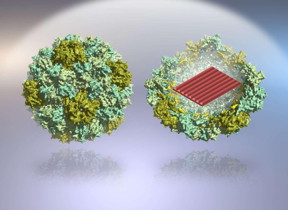 |
| Virus-protein-coated DNA origami nanostructures. With the help of protein encapsulation, DNA origamis can be transported into human cells much more efficiently. CREDIT Image: Veikko Linko and Mauri Kostiainen. |
Abstract:
Researchers from Aalto University have published an article in the recent Trends in Biotechnology journal. The article discusses how DNA molecules can be assembled into tailored and complex nanostructures, and further, how these structures can find uses in therapeutics and bionanotechnological applications. In the review article, the researchers outline the superior properties of DNA nanostructures, and how these features enable the development of efficient biological DNA-nanomachines. Moreover, these DNA nanostructures provide new applications in molecular medicine, such as novel approaches in tackling cancer. Tailored DNA structures could find targeted cells and release their molecular payload (drugs or antibodies) selectively into these cells.
DNA-based nanodevices for molecular medicine: Self-assembled DNA nanostructures can be used in molecular-scale diagnostics and as smart drug-delivery vehicles.
Helsinki, Finland | Posted on September 25th, 2015"Nowadays, software and techniques to design and simulate DNA nanostructures are extremely powerful and user-friendly, and thus, researchers can easily construct their own DNA-objects for various uses. The big boom in the field of structural DNA nanotechnology happened in 2006, when Paul Rothemund introduced a technique dubbed 'DNA origami'. This method is the starting point for practically all other straightforward design approaches available today", describes Veikko Linko, an Academy of Finland postdoctoral researcher from Biohybrid Materials Group.
Versatile DNA nanostructures
The most important feature of a DNA-based nanostructure is its modularity. DNA structures can be fabricated with nanometer-precision, and most importantly, other molecules such as RNA, proteins, peptides and drugs can be anchored to them with the same resolution. Such a high accuracy can be exploited in creating nanosized optical devices as well as molecular platforms and barcodes for various imaging techniques and analytics. Furthermore, the researchers from Aalto University and University of Jyväskylä have recently shown how DNA origamis can be used in efficient fabrication of custom-shaped metal nanoparticles that could be used in various fields of material sciences.
For molecular medicine, tiny DNA-based devices could be utilized not only in detecting single molecules but also in modulating cell signaling. In the near future, highly sophisticated DNA-robots could be even used in creating artificial immune systems. A system based on tailored DNA-devices could help to avoid unnecessary drug treatments, since programmed DNA-nanorobots could detect various agents from the blood stream, and immediately start the battle against disease.
Groundbreaking approach to create nanomaterials
The research group lead by Professor Mauri Kostiainen works extensively with DNA nanostructures, and the group has just recently published two research articles regarding DNA-based applications in biotechnology and molecular medicine. The researchers have coated DNA nanostructures with virus capsid proteins in order to significantly improve their transport to human cells; this could find uses for example in enhanced drug delivery. In addition, the group has designed a modular DNA-based enzymatic nanoreactor that can be exploited in diagnostics at the molecular scale level.
####
About Aalto University
Aalto University. Towards a better world.?Aalto University is a community of bold thinkers in the fields of technology, business, art and design. The university has 6 schools with altogether 20 000 students and 5 000 employees, nearly 400 of which are professors. Our vision is to rank among the top universities in the world. The Aalto University campuses are located in Espoo and Helsinki, Finland.
For more information, please click here
Contacts:
Veikko Linko
358-504-081-810
Mauri A. Kostiainen
Professor, Leader of the Biohybrid Materials Group
Aalto University
School of Chemical Technology
Tel: + 358 50 362 7070
Copyright © Aalto University
If you have a comment, please Contact us.Issuers of news releases, not 7th Wave, Inc. or Nanotechnology Now, are solely responsible for the accuracy of the content.
Bookmark:


| Related Links |
 Web page of the research group:
| Related News Press |
News and information
Quantum computer improves AI predictions April 17th, 2026
Flexible sensor gains sensitivity under pressure April 17th, 2026
A reusable chip for particulate matter sensing April 17th, 2026
Detecting vibrational quantum beating in the predissociation dynamics of SF6 using time-resolved photoelectron spectroscopy April 17th, 2026
Nanomedicine
A fundamentally new therapeutic approach to cystic fibrosis: Nanobody repairs cellular defect April 17th, 2026
New molecular technology targets tumors and simultaneously silences two ‘undruggable’ cancer genes August 8th, 2025
New imaging approach transforms study of bacterial biofilms August 8th, 2025
Electrifying results shed light on graphene foam as a potential material for lab grown cartilage June 6th, 2025
Discoveries
Quantum computer improves AI predictions April 17th, 2026
Flexible sensor gains sensitivity under pressure April 17th, 2026
A reusable chip for particulate matter sensing April 17th, 2026
Detecting vibrational quantum beating in the predissociation dynamics of SF6 using time-resolved photoelectron spectroscopy April 17th, 2026
Announcements
A fundamentally new therapeutic approach to cystic fibrosis: Nanobody repairs cellular defect April 17th, 2026
UC Irvine physicists discover method to reverse ‘quantum scrambling’ : The work addresses the problem of information loss in quantum computing system April 17th, 2026
Interviews/Book Reviews/Essays/Reports/Podcasts/Journals/White papers/Posters
A fundamentally new therapeutic approach to cystic fibrosis: Nanobody repairs cellular defect April 17th, 2026
UC Irvine physicists discover method to reverse ‘quantum scrambling’ : The work addresses the problem of information loss in quantum computing system April 17th, 2026
Nanobiotechnology
A fundamentally new therapeutic approach to cystic fibrosis: Nanobody repairs cellular defect April 17th, 2026
New molecular technology targets tumors and simultaneously silences two ‘undruggable’ cancer genes August 8th, 2025
New imaging approach transforms study of bacterial biofilms August 8th, 2025
Electrifying results shed light on graphene foam as a potential material for lab grown cartilage June 6th, 2025
 |
||
 |
||
| The latest news from around the world, FREE | ||
 |
||
|
|
||
| Premium Products | ||
 |
||
|
Only the news you want to read!
Learn More |
||
 |
||
|
Full-service, expert consulting
Learn More |
||
|
|
||