Home > Press > New approach to mammograms could improve reliability
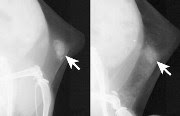 |
| A new mammography technique detects microcalcifications in both normal mice (left) and those with dense mammary tissue (right). Credit: American Chemical Society |
Abstract:
Detecting breast cancer in women with dense mammary tissues could become more reliable with a new mammogram procedure that researchers have now tested in pre-clinical studies of mice. In their report in the journal ACS Nano, they describe injecting gold nanoparticles in mammary tissue to enhance the imaging of early signs of breast cancer.
New approach to mammograms could improve reliability
Washington, DC | Posted on September 16th, 2015Mammography remains the clinical gold standard of screening tests for detecting breast cancer. However, a recognized limitation of this X-ray procedure is that dense breast tissue shows up as white masses and fibers on an image, which can obscure the presence of microcalcifications -- potential signs of early cancer development. Other imaging methods including ultrasound, magnetic resonance imaging and molecular breast imaging can also find abnormalities, but each has its own limitation, such as high cost or poor resolution. Lisa Cole, Tracy Vargo-Gogola and Ryan K. Roeder wanted to improve patients' options.
The researchers boosted the contrast of mammography X-rays by modifying gold nanoparticles with molecules that bind specifically to microcalcifications. They injected a low dose of these nanoparticles into the mammary glands of mice with dense tissue. The engineered particles made the microcalcifications brighter on the X-rays -- and therefore, easier to distinguish. The mice showed no obvious side effects. Although further research would be required, the scientists say the technique could eventually translate into more reliable breast cancer detection for women with dense mammary tissue.
###
The authors acknowledge funding from the St. Joseph Regional Medical Center, the Walther Cancer Foundation and the National Science Foundation.
####
About American Chemical Society
The American Chemical Society is a nonprofit organization chartered by the U.S. Congress. With more than 158,000 members, ACS is the world's largest scientific society and a global leader in providing access to chemistry-related research through its multiple databases, peer-reviewed journals and scientific conferences. Its main offices are in Washington, D.C., and Columbus, Ohio.
For more information, please click here
Contacts:
Michael Bernstein
202-872-6042
Ryan K. Roeder, Ph.D.
Department of Aerospace and Mechanical Engineering
University of Notre Dame
Notre Dame, IN 46556
Phone: 574-631-7003
Copyright © American Chemical Society
If you have a comment, please Contact us.Issuers of news releases, not 7th Wave, Inc. or Nanotechnology Now, are solely responsible for the accuracy of the content.
Bookmark:


| Related Links |
| Related News Press |
News and information
 Quantum computer improves AI predictions April 17th, 2026
Flexible sensor gains sensitivity under pressure April 17th, 2026
A reusable chip for particulate matter sensing April 17th, 2026
Detecting vibrational quantum beating in the predissociation dynamics of SF6 using time-resolved photoelectron spectroscopy April 17th, 2026
Imaging
Simple algorithm paired with standard imaging tool could predict failure in lithium metal batteries August 8th, 2025
Cancer
New molecular technology targets tumors and simultaneously silences two ‘undruggable’ cancer genes August 8th, 2025
Govt.-Legislation/Regulation/Funding/Policy
Quantum computer improves AI predictions April 17th, 2026
Metasurfaces smooth light to boost magnetic sensing precision January 30th, 2026
New imaging approach transforms study of bacterial biofilms August 8th, 2025
Nanomedicine
A fundamentally new therapeutic approach to cystic fibrosis: Nanobody repairs cellular defect April 17th, 2026
New molecular technology targets tumors and simultaneously silences two ‘undruggable’ cancer genes August 8th, 2025
New imaging approach transforms study of bacterial biofilms August 8th, 2025
Electrifying results shed light on graphene foam as a potential material for lab grown cartilage June 6th, 2025
Discoveries
Quantum computer improves AI predictions April 17th, 2026
Flexible sensor gains sensitivity under pressure April 17th, 2026
A reusable chip for particulate matter sensing April 17th, 2026
Detecting vibrational quantum beating in the predissociation dynamics of SF6 using time-resolved photoelectron spectroscopy April 17th, 2026
Announcements
A fundamentally new therapeutic approach to cystic fibrosis: Nanobody repairs cellular defect April 17th, 2026
UC Irvine physicists discover method to reverse ‘quantum scrambling’ : The work addresses the problem of information loss in quantum computing system April 17th, 2026
Interviews/Book Reviews/Essays/Reports/Podcasts/Journals/White papers/Posters
A fundamentally new therapeutic approach to cystic fibrosis: Nanobody repairs cellular defect April 17th, 2026
UC Irvine physicists discover method to reverse ‘quantum scrambling’ : The work addresses the problem of information loss in quantum computing system April 17th, 2026
Tools
Metasurfaces smooth light to boost magnetic sensing precision January 30th, 2026
From sensors to smart systems: the rise of AI-driven photonic noses January 30th, 2026
Japan launches fully domestically produced quantum computer: Expo visitors to experience quantum computing firsthand August 8th, 2025
Grants/Sponsored Research/Awards/Scholarships/Gifts/Contests/Honors/Records
Quantum computer improves AI predictions April 17th, 2026
Detecting vibrational quantum beating in the predissociation dynamics of SF6 using time-resolved photoelectron spectroscopy April 17th, 2026
Metasurfaces smooth light to boost magnetic sensing precision January 30th, 2026
 |
||
 |
||
| The latest news from around the world, FREE | ||
 |
||
|
|
||
| Premium Products | ||
 |
||
|
Only the news you want to read!
Learn More |
||
 |
||
|
Full-service, expert consulting
Learn More |
||
|
|
||