Home > Press > Collaboration could lead to biodegradable computer chips
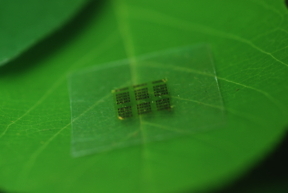 |
| A cellulose nanofibril (CNF) computer chip rests on a leaf. Photo: Yei Hwan Jung, Wisconsin Nano Engineering Device Laboratory. |
Abstract:
Portable electronics - typically made of non-renewable, non-biodegradable and potentially toxic materials - are discarded at an alarming rate in consumers' pursuit of the next best electronic gadget.
Collaboration could lead to biodegradable computer chips
Madison, WI | Posted on May 28th, 2015The research team, led by UW-Madison electrical and computer engineering professor Zhenqiang "Jack" Ma, described the new device in a paper published today (May 26, 2015) by the journal Nature Communications. The paper demonstrates the feasibility of replacing the substrate, or support layer, of a computer chip, with cellulose nanofibril (CNF), a flexible, biodegradable material made from wood.
"The majority of material in a chip is support. We only use less than a couple of micrometers for everything else," Ma says. "Now the chips are so safe you can put them in the forest and fungus will degrade it. They become as safe as fertilizer."
Zhiyong Cai, project leader for an engineering composite science research group at FPL, has been developing sustainable nanomaterials since 2009.
"If you take a big tree and cut it down to the individual fiber, the most common product is paper. The dimension of the fiber is in the micron stage," Cai says. "But what if we could break it down further to the nano scale? At that scale you can make this material, very strong and transparent CNF paper."
Working with Shaoqin "Sarah" Gong, a UW-Madison professor of biomedical engineering, Cai's group addressed two key barriers to using wood-derived materials in an electronics setting: surface smoothness and thermal expansion.
"You don't want it to expand or shrink too much. Wood is a natural hydroscopic material and could attract moisture from the air and expand," Cai says. "With an epoxy coating on the surface of the CNF, we solved both the surface smoothness and the moisture barrier."
Gong and her students also have been studying bio-based polymers for more than a decade. CNF offers many benefits over current chip substrates, she says.
"The advantage of CNF over other polymers is that it's a bio-based material and most other polymers are petroleum-based polymers. Bio-based materials are sustainable, bio-compatible and biodegradable," Gong says. "And, compared to other polymers, CNF actually has a relatively low thermal expansion coefficient."
The group's work also demonstrates a more environmentally friendly process that showed performance similar to existing chips. The majority of today's wireless devices use gallium arsenide-based microwave chips due to their superior high-frequency operation and power handling capabilities. However, gallium arsenide can be environmentally toxic, particularly in the massive quantities of discarded wireless electronics.
Yei Hwan Jung, a graduate student in electrical and computer engineering and a co-author of the paper, says the new process greatly reduces the use of such expensive and potentially toxic material.
"I've made 1,500 gallium arsenide transistors in a 5-by-6 millimeter chip. Typically for a microwave chip that size, there are only eight to 40 transistors. The rest of the area is just wasted," he says. "We take our design and put it on CNF using deterministic assembly technique, then we can put it wherever we want and make a completely functional circuit with performance comparable to existing chips."
While the biodegradability of these materials will have a positive impact on the environment, Ma says the flexibility of the technology can lead to widespread adoption of these electronic chips.
"Mass-producing current semiconductor chips is so cheap, and it may take time for the industry to adapt to our design," he says. "But flexible electronics are the future, and we think we're going to be well ahead of the curve."
####
For more information, please click here
Contacts:
Zhenqiang "Jack" Ma
608-261-1095
John Steeno
608-263-5988
Copyright © University of Wisconsin-Madison
If you have a comment, please Contact us.Issuers of news releases, not 7th Wave, Inc. or Nanotechnology Now, are solely responsible for the accuracy of the content.
Bookmark:


| Related Links |
| Related News Press |
News and information
 Quantum computer improves AI predictions April 17th, 2026
Flexible sensor gains sensitivity under pressure April 17th, 2026
A reusable chip for particulate matter sensing April 17th, 2026
Detecting vibrational quantum beating in the predissociation dynamics of SF6 using time-resolved photoelectron spectroscopy April 17th, 2026
Laboratories
Researchers develop molecular qubits that communicate at telecom frequencies October 3rd, 2025
A battery’s hopping ions remember where they’ve been: Seen in atomic detail, the seemingly smooth flow of ions through a battery’s electrolyte is surprisingly complicated February 16th, 2024
Govt.-Legislation/Regulation/Funding/Policy
Quantum computer improves AI predictions April 17th, 2026
Metasurfaces smooth light to boost magnetic sensing precision January 30th, 2026
New imaging approach transforms study of bacterial biofilms August 8th, 2025
Chip Technology
A reusable chip for particulate matter sensing April 17th, 2026
Metasurfaces smooth light to boost magnetic sensing precision January 30th, 2026
Discoveries
Quantum computer improves AI predictions April 17th, 2026
Flexible sensor gains sensitivity under pressure April 17th, 2026
A reusable chip for particulate matter sensing April 17th, 2026
Detecting vibrational quantum beating in the predissociation dynamics of SF6 using time-resolved photoelectron spectroscopy April 17th, 2026
Announcements
A fundamentally new therapeutic approach to cystic fibrosis: Nanobody repairs cellular defect April 17th, 2026
UC Irvine physicists discover method to reverse ‘quantum scrambling’ : The work addresses the problem of information loss in quantum computing system April 17th, 2026
Environment
A reusable chip for particulate matter sensing April 17th, 2026
Researchers unveil a groundbreaking clay-based solution to capture carbon dioxide and combat climate change June 6th, 2025
Research partnerships
Lab to industry: InSe wafer-scale breakthrough for future electronics August 8th, 2025
HKU physicists uncover hidden order in the quantum world through deconfined quantum critical points April 25th, 2025
 |
||
 |
||
| The latest news from around the world, FREE | ||
 |
||
|
|
||
| Premium Products | ||
 |
||
|
Only the news you want to read!
Learn More |
||
 |
||
|
Full-service, expert consulting
Learn More |
||
|
|
||