Home > Press > Quantization of 'surface Dirac states' could lead to exotic applications
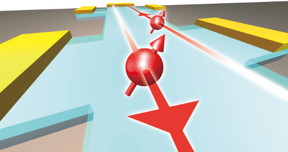 |
| Schematic showing the integer quantum Hall effect on the surface of a topological insulator The effect allows dissipationless current, without energy loss, along the edge of the material. |
Abstract:
Researchers from the RIKEN Center for Emergent Matter Science in Japan have uncovered the first evidence of an unusual quantum phenomenon--the integer quantum Hall effect--in a new type of film, called a 3D topological insulator. In doing this, they demonstrated that "surface Dirac states"--a particular form of massless electrons--are quantized in these materials, meaning that they only take on certain discrete values. These discoveries could help move science forward toward the goal of dissipationless electronics--electronic devices that can operate without producing the vast amounts of heat generated by current silicon-based semiconductors.
Quantization of 'surface Dirac states' could lead to exotic applications
Wako, Japan | Posted on April 15th, 2015Topological insulators are an unusual type of material, which do not conduct electricity in the inside but only on the surfaces. Their surfaces are populated by massless electrons and electron holes--known as Dirac fermions--which can conduct electricity in a nearly dissipationless fashion, like a superconductor. As a result, their properties are being studied in an intense way with the hope of creating low-power consumption electronic devices. However, impurities in the crystal structures of these topological conductors have, up to now, made it difficult to realize this potential.
In the current research, published in Nature Communications, the group was able to overcome these limitations through careful engineering of the material. The group fabricated a 3D topological conductor made from bismuth, antimony, and tellurium, successfully eliminating the impurities that have plagued previous efforts. By fixing the material on an indium phosphide semiconductor substrate and then placing an insulating oxide film and electrodes on top, they transformed the films into electric gating devices known as "field effect transistors," and measured the Hall resistance, a type of electric resistance, while tuning the strength of the electric field, using a constant magnetic field. By doing this, they were able to show that the resistance became constant at certain plateaus, demonstrating the presence of the quantum Hall effect in the material.
In addition, by tuning the external voltage placed on the films, they were able to show that the Dirac states could be switched between the integer quantum Hall state and insulating state by changing the electrical current.
According to Ryutaro Yoshimi of the Strong Correlation Physics Research Group, who led the research, "It was very exciting to see this exotic effect in a 3D topological insulator, and we plan to continue our work to show how materials can be finely tuned to have various electronic properties. In the future, these results could I hope be used for the creation of high-speed and low-power-consumption electronic elements."
###
The research was supported by the Japan Science and Technology Agency's FIRST Program.
Reference
R. Yoshimi, A. Tsukazaki, Y. Kozuka, J. Falson, J. G. Checkelsky, K. S. Takahashi, N. Nagaosa, M. Kawasaki and Y. Tokura., "Quantum Hall Effect on Top and Bottom Surface States of Topological Insulator (Bi1−xSbx)2Te3 Films", Nature Communications, doi: 10.1038/ncomms7627
####
For more information, please click here
Contacts:
Jens Wilkinson
81-484-621-225
Copyright © RIKEN
If you have a comment, please Contact us.Issuers of news releases, not 7th Wave, Inc. or Nanotechnology Now, are solely responsible for the accuracy of the content.
Bookmark:


| Related News Press |
News and information
 Quantum computer improves AI predictions April 17th, 2026
Flexible sensor gains sensitivity under pressure April 17th, 2026
A reusable chip for particulate matter sensing April 17th, 2026
Detecting vibrational quantum beating in the predissociation dynamics of SF6 using time-resolved photoelectron spectroscopy April 17th, 2026
Govt.-Legislation/Regulation/Funding/Policy
Quantum computer improves AI predictions April 17th, 2026
Metasurfaces smooth light to boost magnetic sensing precision January 30th, 2026
New imaging approach transforms study of bacterial biofilms August 8th, 2025
Chip Technology
A reusable chip for particulate matter sensing April 17th, 2026
Metasurfaces smooth light to boost magnetic sensing precision January 30th, 2026
Discoveries
Quantum computer improves AI predictions April 17th, 2026
Flexible sensor gains sensitivity under pressure April 17th, 2026
A reusable chip for particulate matter sensing April 17th, 2026
Detecting vibrational quantum beating in the predissociation dynamics of SF6 using time-resolved photoelectron spectroscopy April 17th, 2026
Announcements
A fundamentally new therapeutic approach to cystic fibrosis: Nanobody repairs cellular defect April 17th, 2026
UC Irvine physicists discover method to reverse ‘quantum scrambling’ : The work addresses the problem of information loss in quantum computing system April 17th, 2026
Interviews/Book Reviews/Essays/Reports/Podcasts/Journals/White papers/Posters
A fundamentally new therapeutic approach to cystic fibrosis: Nanobody repairs cellular defect April 17th, 2026
UC Irvine physicists discover method to reverse ‘quantum scrambling’ : The work addresses the problem of information loss in quantum computing system April 17th, 2026
Quantum nanoscience
Beyond silicon: Electronics at the scale of a single molecule January 30th, 2026
MXene nanomaterials enter a new dimension Multilayer nanomaterial: MXene flakes created at Drexel University show new promise as 1D scrolls January 30th, 2026
ICFO researchers overcome long-standing bottleneck in single photon detection with twisted 2D materials August 8th, 2025
 |
||
 |
||
| The latest news from around the world, FREE | ||
 |
||
|
|
||
| Premium Products | ||
 |
||
|
Only the news you want to read!
Learn More |
||
 |
||
|
Full-service, expert consulting
Learn More |
||
|
|
||