Home > Press > Important step towards quantum computing: Metals at atomic scale
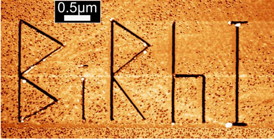 |
| Microscopic image of the topological insulator Bismuth-Rhodium-Iodine (Bi14Rh3I9). The engraved letters BiRhI act as artificially introduced steps at the crystal surface. CREDIT: M. Morgenstern, RWTH Aachen |
Abstract:
German Scientist from RWTH Aachen, Research Center Jülich, TU Dresden and of the Leibniz Institute for Solid State and Materials Research Dresden report that the current flow on the surface of a topological insulator is channeled along tiny paths, which have been theoretically calculated and experimentally observed. Their work has been published in the issue from 2 March 2015 of the journal Nature Physics. There they show for Bismuth-Rhodium-Iodine that these channels are tied to one dimensional surface features and run along steps formed by the edges of atomic layers. Scanning tunneling spectroscopy reveals the electron channels to be continuous in both energy and space and less than one nanometer wide.
Important step towards quantum computing: Metals at atomic scale
Dresden, Germany | Posted on March 2nd, 2015Due to the properties of topological insulators, electric current flows unimpeded within these channels while charge can barely move from one channel to another. In this way, the surface acts as a set of electric wires that is defined by the atomic steps at the crystals surface. The scientists demonstrated that the surface can be engraved in any arrangement, allowing channel networks to be patterned with nanometer precision. The channeled current flow enables the transport of electrons while preventing the "scattering" typically associated with power consumption, in which electrons deviate from their trajectory. Thus, the resulting energy losses and heat generation are substantially diminished. These properties make topological insulators interesting for application in electronics. Furthermore, they are expected to enable novel types of information processing such as spintronics or quantum computation. However, the prerequisite for the development of new devices based on topological insulators is a profound understanding of these quantum phenomena. The recent publication marks a milestone in this direction.
During the last decade great effort are being made worldwide to investigate and to describe the transport in topological insulators. In 2013 the team of Professor Michael Ruck at TU Dresden has succeeded for the first time in growing single crystals of Bismuth-Rhodium-Iodine. Jointly with theoreticians from the Leibniz-Institute for Solid State and Materials Research Dresden they concluded that these crystals are topological insulators with electrical conducting channels. The recent experiments at RWTH Aachen and combined calculations in Dresden have now proved this hypothesis.
###
Publication: C. Pauly, B. Rasche, K. Koepernik, M. Liebmann, M. Pratzer, M. Richter, J. Kellner, M. Eschbach, B. Kaufmann, L. Plucinski, C. M. Schneider, M. Ruck, J. van den Brink, M. Morgenstern, Subnanometre-wide electron channels protected by topology, Nature Physics, March 2015, DOI 10.1038/nphys3264
####
For more information, please click here
Contacts:
Dr. Michael Ruck
49-351-463-33244
Copyright © TU Dresden
If you have a comment, please Contact us.Issuers of news releases, not 7th Wave, Inc. or Nanotechnology Now, are solely responsible for the accuracy of the content.
Bookmark:


| Related News Press |
News and information
 Quantum computer improves AI predictions April 17th, 2026
Flexible sensor gains sensitivity under pressure April 17th, 2026
A reusable chip for particulate matter sensing April 17th, 2026
Detecting vibrational quantum beating in the predissociation dynamics of SF6 using time-resolved photoelectron spectroscopy April 17th, 2026
Imaging
Simple algorithm paired with standard imaging tool could predict failure in lithium metal batteries August 8th, 2025
Chip Technology
A reusable chip for particulate matter sensing April 17th, 2026
Metasurfaces smooth light to boost magnetic sensing precision January 30th, 2026
Quantum Computing
Quantum computer improves AI predictions April 17th, 2026
UC Irvine physicists discover method to reverse ‘quantum scrambling’ : The work addresses the problem of information loss in quantum computing system April 17th, 2026
Researchers develop molecular qubits that communicate at telecom frequencies October 3rd, 2025
Discoveries
Quantum computer improves AI predictions April 17th, 2026
Flexible sensor gains sensitivity under pressure April 17th, 2026
A reusable chip for particulate matter sensing April 17th, 2026
Detecting vibrational quantum beating in the predissociation dynamics of SF6 using time-resolved photoelectron spectroscopy April 17th, 2026
Announcements
A fundamentally new therapeutic approach to cystic fibrosis: Nanobody repairs cellular defect April 17th, 2026
UC Irvine physicists discover method to reverse ‘quantum scrambling’ : The work addresses the problem of information loss in quantum computing system April 17th, 2026
Interviews/Book Reviews/Essays/Reports/Podcasts/Journals/White papers/Posters
A fundamentally new therapeutic approach to cystic fibrosis: Nanobody repairs cellular defect April 17th, 2026
UC Irvine physicists discover method to reverse ‘quantum scrambling’ : The work addresses the problem of information loss in quantum computing system April 17th, 2026
Tools
Metasurfaces smooth light to boost magnetic sensing precision January 30th, 2026
From sensors to smart systems: the rise of AI-driven photonic noses January 30th, 2026
Japan launches fully domestically produced quantum computer: Expo visitors to experience quantum computing firsthand August 8th, 2025
Quantum nanoscience
Beyond silicon: Electronics at the scale of a single molecule January 30th, 2026
MXene nanomaterials enter a new dimension Multilayer nanomaterial: MXene flakes created at Drexel University show new promise as 1D scrolls January 30th, 2026
ICFO researchers overcome long-standing bottleneck in single photon detection with twisted 2D materials August 8th, 2025
 |
||
 |
||
| The latest news from around the world, FREE | ||
 |
||
|
|
||
| Premium Products | ||
 |
||
|
Only the news you want to read!
Learn More |
||
 |
||
|
Full-service, expert consulting
Learn More |
||
|
|
||