Home > Press > Light propagation in solar cells made visible
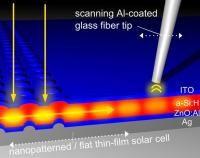 |
| Through use of a glass fibre tip, the researchers were able to measure the amount of light that had actually been captured in the solar cell using a method called near-field optical microscopy.
Credit: Forschungszentrum Jülich |
Abstract:
How can light which has been captured in a solar cell be examined in experiments? Jülich scientists have succeeded in looking directly at light propagation within a solar cell by using a trick. The photovoltaics researchers are working on periodic nanostructures that efficiently capture a portion of sunlight which is normally only poorly absorbed.
Light propagation in solar cells made visible
Juelich, Germany | Posted on December 5th, 2014Until recently, light trapping within periodically nanostructured solar cells could only be analysed using indirect methods, as captured light is not visible from outside of the solar cell. However, the quantum mechanical tunnelling effect of light allows it to be tracked if a light-conducting component is brought extremely close to the cell's surface. Through use of a glass fibre tip, the researchers were able to measure the amount of light that had actually been captured in the solar cell using a method called near-field optical microscopy.
Light trapping plays a particular important role in optimizing thin-film solar cells. These solar cells are easier to manufacture and require less material than conventional crystalline solar cells, but they are not yet as efficient. The layer in which energy conversion takes place is only about one thousandth of a millimetre thick. Therefore, longer wavelengths in the infrared region are only poorly absorbed when the cell is exposed to direct sunlight.
Periodically nanopatterned interface layers allow for better absorption of the incident light. These interfaces couple incident light into the thin silicon layer. Based on the new experimental approach, scientists from the Institute of Energy and Climate Research at Forschungszentrum Jülich showed that there is a direct link between the nature of the nanostructure, the absorption of specific wavelengths of light, and in particular the efficiency of the solar cell. The approach, presented in the specialist journal Nano Letters (DOI: 10.1021/nl503249n), also opens a range of new possibilities for investigating applied nano-optical components.
####
For more information, please click here
Contacts:
Tobias Schloesser
49-246-161-4771
Copyright © Forschungszentrum Juelich
If you have a comment, please Contact us.Issuers of news releases, not 7th Wave, Inc. or Nanotechnology Now, are solely responsible for the accuracy of the content.
Bookmark:


| Related News Press |
News and information
 Quantum computer improves AI predictions April 17th, 2026
Flexible sensor gains sensitivity under pressure April 17th, 2026
A reusable chip for particulate matter sensing April 17th, 2026
Detecting vibrational quantum beating in the predissociation dynamics of SF6 using time-resolved photoelectron spectroscopy April 17th, 2026
Imaging
Simple algorithm paired with standard imaging tool could predict failure in lithium metal batteries August 8th, 2025
Physics
UC Irvine physicists discover method to reverse ‘quantum scrambling’ : The work addresses the problem of information loss in quantum computing system April 17th, 2026
Discoveries
Quantum computer improves AI predictions April 17th, 2026
Flexible sensor gains sensitivity under pressure April 17th, 2026
A reusable chip for particulate matter sensing April 17th, 2026
Detecting vibrational quantum beating in the predissociation dynamics of SF6 using time-resolved photoelectron spectroscopy April 17th, 2026
Announcements
A fundamentally new therapeutic approach to cystic fibrosis: Nanobody repairs cellular defect April 17th, 2026
UC Irvine physicists discover method to reverse ‘quantum scrambling’ : The work addresses the problem of information loss in quantum computing system April 17th, 2026
Interviews/Book Reviews/Essays/Reports/Podcasts/Journals/White papers/Posters
A fundamentally new therapeutic approach to cystic fibrosis: Nanobody repairs cellular defect April 17th, 2026
UC Irvine physicists discover method to reverse ‘quantum scrambling’ : The work addresses the problem of information loss in quantum computing system April 17th, 2026
Energy
Sensors innovations for smart lithium-based batteries: advancements, opportunities, and potential challenges August 8th, 2025
Simple algorithm paired with standard imaging tool could predict failure in lithium metal batteries August 8th, 2025
Solar/Photovoltaic
Spinel-type sulfide semiconductors to operate the next-generation LEDs and solar cells For solar-cell absorbers and green-LED source October 3rd, 2025
KAIST researchers introduce new and improved, next-generation perovskite solar cell November 8th, 2024
Groundbreaking precision in single-molecule optoelectronics August 16th, 2024
Development of zinc oxide nanopagoda array photoelectrode: photoelectrochemical water-splitting hydrogen production January 12th, 2024
 |
||
 |
||
| The latest news from around the world, FREE | ||
 |
||
|
|
||
| Premium Products | ||
 |
||
|
Only the news you want to read!
Learn More |
||
 |
||
|
Full-service, expert consulting
Learn More |
||
|
|
||