Home > Press > QUT leading the charge for panel-powered car
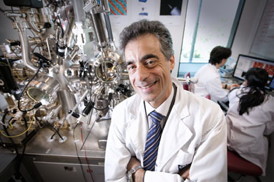 |
| QUT's Professor Nunzio Motta with one of the university's powerful nanotechnology microscopes. |
Abstract:
A car powered by its own body panels could soon be driving on our roads after a breakthrough in nanotechnology research by a QUT team.
QUT leading the charge for panel-powered car
Brisbane, Australia | Posted on November 6th, 2014Researchers have developed lightweight "supercapacitors" that can be combined with regular batteries to dramatically boost the power of an electric car.
The discovery was made by Postdoctoral Research Fellow Dr Jinzhang Liu, Professor Nunzio Motta and PhD researcher Marco Notarianni, from QUT's Science and Engineering Faculty - Institute for Future Environments, and PhD researcher Francesca Mirri and Professor Matteo Pasquali, from Rice University in Houston, in the United States.
The supercapacitors - a "sandwich" of electrolyte between two all-carbon electrodes - were made into a thin and extremely strong film with a high power density.
The film could be embedded in a car's body panels, roof, doors, bonnet and floor - storing enough energy to turbocharge an electric car's battery in just a few minutes.
The findings, published in the Journal of Power Sources and the Nanotechnology journal, mean a car partly powered by its own body panels could be a reality within five years, Mr Notarianni said.
"Vehicles need an extra energy spurt for acceleration, and this is where supercapacitors come in. They hold a limited amount of charge, but they are able to deliver it very quickly, making them the perfect complement to mass-storage batteries," he said.
"Supercapacitors offer a high power output in a short time, meaning a faster acceleration rate of the car and a charging time of just a few minutes, compared to several hours for a standard electric car battery."
Dr Liu said currently the "energy density" of a supercapacitor is lower than a standard lithium ion (Li-Ion) battery, but its "high power density", or ability to release power in a short time, is "far beyond" a conventional battery.
"Supercapacitors are presently combined with standard Li-Ion batteries to power electric cars, with a substantial weight reduction and increase in performance," he said.
"In the future, it is hoped the supercapacitor will be developed to store more energy than a Li-Ion battery while retaining the ability to release its energy up to 10 times faster - meaning the car could be entirely powered by the supercapacitors in its body panels.
"After one full charge this car should be able to run up to 500km - similar to a petrol-powered car and more than double the current limit of an electric car."
Dr Liu said the technology would also potentially be used for rapid charges of other battery-powered devices.
"For example, by putting the film on the back of a smart phone to charge it extremely quickly," he said.
The discovery may be a game-changer for the automotive industry, with significant impacts on financial, as well as environmental, factors.
"We are using cheap carbon materials to make supercapacitors and the price of industry scale production will be low," Professor Motta said.
"The price of Li-Ion batteries cannot decrease a lot because the price of Lithium remains high. This technique does not rely on metals and other toxic materials either, so it is environmentally friendly if it needs to be disposed of."
The researchers are part of QUT's Battery Interest Group, a cross-faculty group that aims to engage industry with battery-related research.
####
For more information, please click here
Contacts:
Rob Kidd
61-731-381-841
After hours
Rose Trapnell
61-0407 585 901
Copyright © Queensland University of Technology
If you have a comment, please Contact us.Issuers of news releases, not 7th Wave, Inc. or Nanotechnology Now, are solely responsible for the accuracy of the content.
Bookmark:


| Related Links |
| Related News Press |
News and information
 Quantum computer improves AI predictions April 17th, 2026
Flexible sensor gains sensitivity under pressure April 17th, 2026
A reusable chip for particulate matter sensing April 17th, 2026
Detecting vibrational quantum beating in the predissociation dynamics of SF6 using time-resolved photoelectron spectroscopy April 17th, 2026
Discoveries
Quantum computer improves AI predictions April 17th, 2026
Flexible sensor gains sensitivity under pressure April 17th, 2026
A reusable chip for particulate matter sensing April 17th, 2026
Detecting vibrational quantum beating in the predissociation dynamics of SF6 using time-resolved photoelectron spectroscopy April 17th, 2026
Materials/Metamaterials/Magnetoresistance
First real-time observation of two-dimensional melting process: Researchers at Mainz University unveil new insights into magnetic vortex structures August 8th, 2025
Researchers unveil a groundbreaking clay-based solution to capture carbon dioxide and combat climate change June 6th, 2025
A 1960s idea inspires NBI researchers to study hitherto inaccessible quantum states June 6th, 2025
Institute for Nanoscience hosts annual proposal planning meeting May 16th, 2025
Announcements
A fundamentally new therapeutic approach to cystic fibrosis: Nanobody repairs cellular defect April 17th, 2026
UC Irvine physicists discover method to reverse ‘quantum scrambling’ : The work addresses the problem of information loss in quantum computing system April 17th, 2026
Energy
Sensors innovations for smart lithium-based batteries: advancements, opportunities, and potential challenges August 8th, 2025
Simple algorithm paired with standard imaging tool could predict failure in lithium metal batteries August 8th, 2025
Automotive/Transportation
Decoding hydrogen‑bond network of electrolyte for cryogenic durable aqueous zinc‑ion batteries January 30th, 2026
Sensors innovations for smart lithium-based batteries: advancements, opportunities, and potential challenges August 8th, 2025
Simple algorithm paired with standard imaging tool could predict failure in lithium metal batteries August 8th, 2025
Solar/Photovoltaic
Spinel-type sulfide semiconductors to operate the next-generation LEDs and solar cells For solar-cell absorbers and green-LED source October 3rd, 2025
KAIST researchers introduce new and improved, next-generation perovskite solar cell November 8th, 2024
Groundbreaking precision in single-molecule optoelectronics August 16th, 2024
Development of zinc oxide nanopagoda array photoelectrode: photoelectrochemical water-splitting hydrogen production January 12th, 2024
 |
||
 |
||
| The latest news from around the world, FREE | ||
 |
||
|
|
||
| Premium Products | ||
 |
||
|
Only the news you want to read!
Learn More |
||
 |
||
|
Full-service, expert consulting
Learn More |
||
|
|
||