Home > Press > Physicists build reversible laser tractor beam
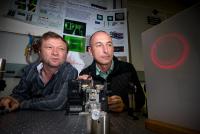 |
| Dr. Vladlen Shvedov (L) and Dr. Cyril Hnatovsky adjust the hollow laser beam in their lab at the Australian National University.
Credit: Stuart Hay, ANU |
Abstract:
Laser physicists have built a tractor beam that can repel and attract objects, using a hollow laser beam that is bright around the edges and dark in its centre.
Physicists build reversible laser tractor beam
Canberra, Australia | Posted on October 20th, 2014It is the first long-distance optical tractor beam and moved particles one fifth of a millimetre in diameter a distance of up to 20 centimetres, around 100 times further than previous experiments.
"Demonstration of a large scale laser beam like this is a kind of holy grail for laser physicists," said Professor Wieslaw Krolikowski, from the Research School of Physics and Engineering at The Australian National University.
The new technique is versatile because it requires only a single laser beam. It could be used, for example, in controlling atmospheric pollution or for the retrieval of tiny, delicate or dangerous particles for sampling.
The researchers can also imagine the effect being scaled up.
"Because lasers retain their beam quality for such long distances, this could work over metres. Our lab just was not big enough to show it," said co-author Dr Vladlen Shvedov, a driving force behind the ANU project, along with Dr Cyril Hnatovsky.
Unlike previous techniques, which used photon momentum to impart motion, the ANU tractor beam relies on the energy of the laser heating up the particles and the air around them. The ANU team demonstrated the effect on gold-coated hollow glass particles.
The particles are trapped in the dark centre of the beam. Energy from the laser hits the particle and travels across its surface, where it is absorbed creating hotspots on the surface. Air particles colliding with the hotspots heat up and shoot away from the surface, which causes the particle to recoil, in the opposite direction.
To manipulate the particle, the team move the position of the hotspot by carefully controlling the polarisation of the laser beam.
"We have devised a technique that can create unusual states of polarisation in the doughnut shaped laser beam, such as star-shaped (axial) or ring polarised (azimuthal)," Dr Hnatovsky said.
"We can move smoothly from one polarisation to another and thereby stop the particle or reverse its direction at will."
####
For more information, please click here
Contacts:
Dr. Cyril Hnatovsky
61-420-526-032
Copyright © Australian National University
If you have a comment, please Contact us.Issuers of news releases, not 7th Wave, Inc. or Nanotechnology Now, are solely responsible for the accuracy of the content.
Bookmark:


| Related News Press |
News and information
 Quantum computer improves AI predictions April 17th, 2026
Flexible sensor gains sensitivity under pressure April 17th, 2026
A reusable chip for particulate matter sensing April 17th, 2026
Detecting vibrational quantum beating in the predissociation dynamics of SF6 using time-resolved photoelectron spectroscopy April 17th, 2026
Discoveries
Quantum computer improves AI predictions April 17th, 2026
Flexible sensor gains sensitivity under pressure April 17th, 2026
A reusable chip for particulate matter sensing April 17th, 2026
Detecting vibrational quantum beating in the predissociation dynamics of SF6 using time-resolved photoelectron spectroscopy April 17th, 2026
Announcements
A fundamentally new therapeutic approach to cystic fibrosis: Nanobody repairs cellular defect April 17th, 2026
UC Irvine physicists discover method to reverse ‘quantum scrambling’ : The work addresses the problem of information loss in quantum computing system April 17th, 2026
Interviews/Book Reviews/Essays/Reports/Podcasts/Journals/White papers/Posters
A fundamentally new therapeutic approach to cystic fibrosis: Nanobody repairs cellular defect April 17th, 2026
UC Irvine physicists discover method to reverse ‘quantum scrambling’ : The work addresses the problem of information loss in quantum computing system April 17th, 2026
Environment
A reusable chip for particulate matter sensing April 17th, 2026
Researchers unveil a groundbreaking clay-based solution to capture carbon dioxide and combat climate change June 6th, 2025
Photonics/Optics/Lasers
Metasurfaces smooth light to boost magnetic sensing precision January 30th, 2026
From sensors to smart systems: the rise of AI-driven photonic noses January 30th, 2026
 |
||
 |
||
| The latest news from around the world, FREE | ||
 |
||
|
|
||
| Premium Products | ||
 |
||
|
Only the news you want to read!
Learn More |
||
 |
||
|
Full-service, expert consulting
Learn More |
||
|
|
||