Home > Press > Drug-infused nanoparticle is right for sore eyes
 |
Abstract:
For the millions of sufferers of dry eye syndrome, their only recourse to easing the painful condition is to use drug-laced eye drops three times a day. Now, researchers from the University of Waterloo have developed a topical solution containing nanoparticles that will combat dry eye syndrome with only one application a week.
Drug-infused nanoparticle is right for sore eyes
Waterloo, Canada | Posted on October 8th, 2014The eye drops progressively deliver the right amount of drug-infused nanoparticles to the surface of the eyeball over a period of five days before the body absorbs them. One weekly dose replaces 15 or more to treat the pain and irritation of dry eyes.
The nanoparticles, about 1/1000th the width of a human hair, stick harmlessly to the eye's surface and use only five per cent of the drug normally required.
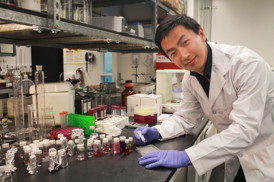
"You can't tell the difference between these nanoparticle eye drops and water," said Shengyan (Sandy) Liu, a PhD candidate at Waterloo's Faculty of Engineering, who led the team of researchers from the Department of Chemical Engineering and the Centre for Contact Lens Research. "There's no irritation to the eye."
Dry eye syndrome is a more common ailment for people over the age of 50 and may eventually lead to eye damage. More than six per cent of people in the U.S. have it. Currently, patients must frequently apply the medicine three times a day because of the eye's ability to self-cleanse—a process that washes away 95 per cent of the drug.
"I knew that if we focused on infusing biocompatible nanoparticles with Cyclosporine A, the drug in the eye drops, and make them stick to the eyeball without irritation for longer periods of time, it would also save patients time and reduce the possibility of toxic exposure due to excessive use of eye drops," said Liu.
The research team is now focusing on preparing the nanoparticle eye drops for clinical trials with the hope that this nanoparticle therapy could reach the shelves of drugstores within five years.
Liu's research article, co-authored by eight others including Professors Frank Gu and Lyndon Jones from Waterloo, recently appeared in Nano Research, the leading publication on nanotechnology and nanoscience. The Natural Sciences and Engineering Research Council of Canada (NSERC) and 20/20: Ophthalmic Materials Network supported the research.
####
About University of Waterloo
In just half a century, the University of Waterloo, located at the heart of Canada's technology hub, has become one of Canada's leading comprehensive universities with 35,000 full- and part-time students in undergraduate and graduate programs. Waterloo, as home to the world's largest post-secondary co-operative education program, embraces its connections to the world and encourages enterprising partnerships in learning, research and discovery. In the next decade, the university is committed to building a better future for Canada and the world by championing innovation and collaboration to create solutions relevant to the needs of today and tomorrow. For more information about Waterloo, please visit www.uwaterloo.ca.
For more information, please click here
Contacts:
Pamela Smyth
519-888-4777
Copyright © University of Waterloo
If you have a comment, please Contact us.Issuers of news releases, not 7th Wave, Inc. or Nanotechnology Now, are solely responsible for the accuracy of the content.
Bookmark:


| Related Links |
| Related News Press |
News and information
 Quantum computer improves AI predictions April 17th, 2026
Flexible sensor gains sensitivity under pressure April 17th, 2026
A reusable chip for particulate matter sensing April 17th, 2026
Detecting vibrational quantum beating in the predissociation dynamics of SF6 using time-resolved photoelectron spectroscopy April 17th, 2026
Nanomedicine
A fundamentally new therapeutic approach to cystic fibrosis: Nanobody repairs cellular defect April 17th, 2026
New molecular technology targets tumors and simultaneously silences two ‘undruggable’ cancer genes August 8th, 2025
New imaging approach transforms study of bacterial biofilms August 8th, 2025
Electrifying results shed light on graphene foam as a potential material for lab grown cartilage June 6th, 2025
Discoveries
Quantum computer improves AI predictions April 17th, 2026
Flexible sensor gains sensitivity under pressure April 17th, 2026
A reusable chip for particulate matter sensing April 17th, 2026
Detecting vibrational quantum beating in the predissociation dynamics of SF6 using time-resolved photoelectron spectroscopy April 17th, 2026
Announcements
A fundamentally new therapeutic approach to cystic fibrosis: Nanobody repairs cellular defect April 17th, 2026
UC Irvine physicists discover method to reverse ‘quantum scrambling’ : The work addresses the problem of information loss in quantum computing system April 17th, 2026
Interviews/Book Reviews/Essays/Reports/Podcasts/Journals/White papers/Posters
A fundamentally new therapeutic approach to cystic fibrosis: Nanobody repairs cellular defect April 17th, 2026
UC Irvine physicists discover method to reverse ‘quantum scrambling’ : The work addresses the problem of information loss in quantum computing system April 17th, 2026
 |
||
 |
||
| The latest news from around the world, FREE | ||
 |
||
|
|
||
| Premium Products | ||
 |
||
|
Only the news you want to read!
Learn More |
||
 |
||
|
Full-service, expert consulting
Learn More |
||
|
|
||