Home > Press > JPK report on the use of the NanoWizard® AFM system at TU Braunschweig to study the properties of DNA and DNA nanostructures
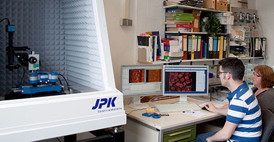 |
| PhD student, Enrico Pibiri, with technical assistant, Angela Tiefnig, with their JPK NanoWizard® system in the laboratory of Professor Philip Tinnefeld at the University of Braunschweig |
Abstract:
PK Instruments, a world-leading manufacturer of nanoanalytic instrumentation for research in life sciences and soft matter, reports on the use of their AFM system, the NanoWizard®, in the Nanobiosciences Group of the Institute of Physical & Theoretical Chemistry at the Technical University of Braunschweig. It is being used to study DNA and DNA nanostructures.
JPK report on the use of the NanoWizard® AFM system at TU Braunschweig to study the properties of DNA and DNA nanostructures
Berlin, Germany | Posted on October 7th, 2014Dr Philip Tinnefeld is Professor of Biophysical Chemistry at the Technische Universität Braunschweig where he runs a laboratory which specialises in the field of NanoBioScience. His group has pioneered the integration of DNA origami with optical single-molecule spectroscopy over the last few years. In this context, they have demonstrated some of the early applications where the breakthroughs of DNA nanotechnology achieved by others could actually lead to practically useful products and assays. DNA nanostructures (which they commonly refer to as DNA origamis) are applied for calibration standards known as "nanorulers;" as breadboards for energy transfer cascades and switches; as scaffolds for the production of nanoantennas; as biocompatible surfaces, etcetera. Currently, the group is working on new amplification mechanisms for diagnostic applications.
Asked about his motivation to use atomic force microscopy, AFM, in his work, Dr Tinnefeld said "In all our work with DNA as a material, AFM is one of the prime tools to characterize the DNA nanostructures. A first indication about the quality of DNA nanostructures comes from gel electrophoresis. The second tool is AFM. Other groups also use TEM but we don't directly have this in the institute and only get images through cooperations. Finally, we often use fluorescence microscopy (super-resolution microscopy or FRET) for further characterization. Our group comes from an optics background. We are specialists in single-molecule fluorescence microscopy and super-resolution microscopy. We also do time-resolved spectroscopy."
On choosing a JPK system for this work, Dr Tinnefeld said "We were not familiar with other SPM techniques. Through our initial cooperations when starting to work with DNA origami, we heard that the JPK NanoWizard works well when studying DNA origami. We tested it and it indeed delivered on this promise. Being inexperienced with scanning probe techniques, it was especially beneficial to have the support from the JPK team. They supported us through several visits until we got the hang of using the system"
For more details about JPK's NanoWizard® AFM systems and applications for the bio & nano sciences, please contact JPK on +49 30533112070, visit the web site: www.jpk.com or see more on Facebook: www.jpk.com/facebook and on You Tube: www.youtube.com/jpkinstruments.
####
About JPK Instruments
JPK Instruments AG is a world-leading manufacturer of nanoanalytic instruments - particularly atomic force microscope (AFM) systems and optical tweezers - for a broad range of applications reaching from soft matter physics to nano-optics, from surface chemistry to cell and molecular biology. From its earliest days applying atomic force microscope (AFM) technology, JPK has recognized the opportunities provided by nanotechnology for transforming life sciences and soft matter research. This focus has driven JPK’s success in uniting the worlds of nanotechnology tools and life science applications by offering cutting-edge technology and unique applications expertise. Headquartered in Berlin and with direct operations in Dresden, Cambridge (UK), Singapore, Tokyo, Shanghai (China) and Paris (France), JPK maintains a global network of distributors and support centers and provides on the spot applications and service support to an ever-growing community of researchers.
For more information, please click here
Contacts:
JPK Instruments AG
Bouchéstrasse 12
Haus 2, Aufgang C
Berlin 12435
Germany
T +49 30533112070
F +49 30 5331 22555
www.jpk.com/
Talking Science Limited
39 de Bohun Court
Saffron Walden
Essex CB10 2BA
United Kingdom
T +44(0)1799 521881
M +44(0)7843 012997
www.talking-science.com/
Copyright © JPK Instruments
If you have a comment, please Contact us.Issuers of news releases, not 7th Wave, Inc. or Nanotechnology Now, are solely responsible for the accuracy of the content.
Bookmark:


| Related News Press |
News and information
 Quantum computer improves AI predictions April 17th, 2026
Flexible sensor gains sensitivity under pressure April 17th, 2026
A reusable chip for particulate matter sensing April 17th, 2026
Detecting vibrational quantum beating in the predissociation dynamics of SF6 using time-resolved photoelectron spectroscopy April 17th, 2026
Imaging
Simple algorithm paired with standard imaging tool could predict failure in lithium metal batteries August 8th, 2025
Nanomedicine
A fundamentally new therapeutic approach to cystic fibrosis: Nanobody repairs cellular defect April 17th, 2026
New molecular technology targets tumors and simultaneously silences two ‘undruggable’ cancer genes August 8th, 2025
New imaging approach transforms study of bacterial biofilms August 8th, 2025
Electrifying results shed light on graphene foam as a potential material for lab grown cartilage June 6th, 2025
Announcements
A fundamentally new therapeutic approach to cystic fibrosis: Nanobody repairs cellular defect April 17th, 2026
UC Irvine physicists discover method to reverse ‘quantum scrambling’ : The work addresses the problem of information loss in quantum computing system April 17th, 2026
Tools
Metasurfaces smooth light to boost magnetic sensing precision January 30th, 2026
From sensors to smart systems: the rise of AI-driven photonic noses January 30th, 2026
Japan launches fully domestically produced quantum computer: Expo visitors to experience quantum computing firsthand August 8th, 2025
Nanobiotechnology
A fundamentally new therapeutic approach to cystic fibrosis: Nanobody repairs cellular defect April 17th, 2026
New molecular technology targets tumors and simultaneously silences two ‘undruggable’ cancer genes August 8th, 2025
New imaging approach transforms study of bacterial biofilms August 8th, 2025
Electrifying results shed light on graphene foam as a potential material for lab grown cartilage June 6th, 2025
 |
||
 |
||
| The latest news from around the world, FREE | ||
 |
||
|
|
||
| Premium Products | ||
 |
||
|
Only the news you want to read!
Learn More |
||
 |
||
|
Full-service, expert consulting
Learn More |
||
|
|
||