Home > Press > CiQUS researchers design an artificial nose to detect DNA differentiation with single nucleotide resolution
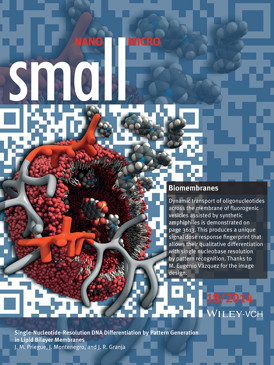 |
| This work has been highlighted at the Frontispiece section of the journal Small credits: E. Vazquez, CIQUS |
Abstract:
As they have published in the prestigious journal Small, this is a method of identification of nucleic acids based on the generation pattern (bar code) inspired by our olfactory system. The differences in trans-membrane transport can be used to generate fluorescence patterns. That allows the differentiation of molecules as DNA or RNA by means of pattern generation and/or recognition protocols.
CiQUS researchers design an artificial nose to detect DNA differentiation with single nucleotide resolution
Santiago de Compostela, Spain | Posted on September 18th, 2014Pattern recognition is the mechanism that operates in mammal's olfactory reception. In effect, humans can detect thousands (or millions) of odorants with only hundreds of olfactory receptors. Incompatible with one to one recognition, the olfactory sensing system generates response patterns that configure a unique aroma sensation in the brain. In other words, in response to the detection of an odorant molecule the olfactory receptors "generate" a pattern that is recognized in the brain. This is called a pattern generation/recognition sensor.
Thus, this methodology has an enormous power for the amplification of the differences in very similar molecules. So it has inspired researchers to develop their own sensing system based for example in host/guest chemistry.
However, in this work researchers have employed the transport of DNA molecules across lipid membranes (as the cell membranes) to generate different transport patterns. They hypothesized that if a long DNA is transported fast and at low concentration, and a short DNA is transported slowly and at high concentration, we could use these different transport behaviours to detect and differentiate DNAs molecules.
The results of this study have shown that the differences amplification observed during transport events allowed the differentiation of DNAs with an outstanding single nucleotide resolution. These findings are of interest because they might serve as a blueprint for the fabrication of many other pattern-based sensing systems in any other polymer of biological relevance (DNA, RNA...), a field that continues to be a major challenge in biochemistry.
This work has been fully developed at CIQUS by the PhD student Juan M. Priegue in collaboration with the postdoctoral researcher Javier Montenegro, under the direction of Professor Juan R. Granja. The journal Small has highlighted this work at its Frontispiece section.
Technical note
The detection and identification of polymers of biological interest -such as DNA or RNA- continues to be a major challenge in biochemistry. The transport of polyanions (i.e. DNA) across the membrane of fluorophore-loaded liposomes can be activated by small cationic amphiphilic molecules (activators). The corresponding fluorescent signals obtained in this type of transport experiments are different, depending on the molecules employed to activate DNA transport.
Therefore, these differences in transport can be used to generate fluorescence patterns that turn out to be distinctive for similar small non-ionic activators. Thus, this protocol allows the differentiation of similar analytes by means of pattern generation/recognition protocols.
In this new work researchers report that the same methodology can be also applied to generate unique dose-response patterns for different anionic polymers (DNA, RNA) of biological relevance. For that purpose, they have "de novo" designed and developed a synthetic strategy for the preparation of dynamic oximes-amphiphiles for the DNA transport activation across lipid bilayers.
The fluorescent fingerprints (dose-response plots) generated in vesicle transport experiments allowed the differentiation of a collection of biopolymers with excellent reproducibility and precision, up to single nucleotide resolution of short single stranded oligonuclotides.
####
For more information, please click here
Contacts:
Juan Granja
+34 8818 15746
Copyright © CiQUS
If you have a comment, please Contact us.Issuers of news releases, not 7th Wave, Inc. or Nanotechnology Now, are solely responsible for the accuracy of the content.
Bookmark:


| Related Links |
 Research group: Peptide Nanotubes
| Related News Press |
News and information
Quantum computer improves AI predictions April 17th, 2026
Flexible sensor gains sensitivity under pressure April 17th, 2026
A reusable chip for particulate matter sensing April 17th, 2026
Detecting vibrational quantum beating in the predissociation dynamics of SF6 using time-resolved photoelectron spectroscopy April 17th, 2026
Discoveries
Quantum computer improves AI predictions April 17th, 2026
Flexible sensor gains sensitivity under pressure April 17th, 2026
A reusable chip for particulate matter sensing April 17th, 2026
Detecting vibrational quantum beating in the predissociation dynamics of SF6 using time-resolved photoelectron spectroscopy April 17th, 2026
Announcements
A fundamentally new therapeutic approach to cystic fibrosis: Nanobody repairs cellular defect April 17th, 2026
UC Irvine physicists discover method to reverse ‘quantum scrambling’ : The work addresses the problem of information loss in quantum computing system April 17th, 2026
Interviews/Book Reviews/Essays/Reports/Podcasts/Journals/White papers/Posters
A fundamentally new therapeutic approach to cystic fibrosis: Nanobody repairs cellular defect April 17th, 2026
UC Irvine physicists discover method to reverse ‘quantum scrambling’ : The work addresses the problem of information loss in quantum computing system April 17th, 2026
Nanobiotechnology
A fundamentally new therapeutic approach to cystic fibrosis: Nanobody repairs cellular defect April 17th, 2026
New molecular technology targets tumors and simultaneously silences two ‘undruggable’ cancer genes August 8th, 2025
New imaging approach transforms study of bacterial biofilms August 8th, 2025
Electrifying results shed light on graphene foam as a potential material for lab grown cartilage June 6th, 2025
 |
||
 |
||
| The latest news from around the world, FREE | ||
 |
||
|
|
||
| Premium Products | ||
 |
||
|
Only the news you want to read!
Learn More |
||
 |
||
|
Full-service, expert consulting
Learn More |
||
|
|
||