Home > Press > Banked blood grows stiffer with age, study finds
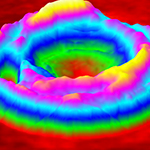 |
| Map of membrane fluctuations in a normal red blood cell, on average up to 50 nanometers. Measuring these fluctuations over time, researchers found that the membranes stiffen as they age, which impedes the cell’s function. Photo courtesy of Gabriel Popescu |
Abstract:
It may look like fresh blood and flow like fresh blood, but the longer blood is stored, the less it can carry oxygen into the tiny microcapillaries of the body, says a new study from University of Illinois researchers.
Banked blood grows stiffer with age, study finds
Champaign, IL | Posted on September 5th, 2014Using advanced optical techniques, the researchers measured the stiffness of the membrane surrounding red blood cells over time. They found that, even though the cells retain their shape and hemoglobin content, the membranes get stiffer, which steadily decreases the cells' functionality.
Led by electrical and computer engineering professor Gabriel Popescu, the team published its results in the journal Scientific Reports.
"Our results show some surprising facts: Even though the blood looks good on the surface, its functionality is degrading steadily with time," said Popescu, who is also part of the Beckman Institute for Advanced Science and Technology at the U. of I.
Nearly 14 million units of blood are banked annually in the U.S. The established "shelf life" for blood in blood banks is 42 days. During that time, a lot of changes can happen to the blood cells - they can become damaged or rupture. But much of the blood keeps its shape and, by all appearances, looks like it did the day it was donated.
Popescu and his colleagues wanted to quantitatively measure blood cells over time to see what changed and what stayed the same, to help determine what effect older blood could have on a patient. They used a special optical technique called spatial light interference microscopy (SLIM), a method developed in Popescu's lab at Illinois in 2011. It uses light to noninvasively measure cell mass and topology with nanoscale accuracy. Through software and hardware advances, the SLIM system today acquires images almost 100 times faster than three years ago.
The researchers took time-lapse images of the cells, measuring and charting the cell's properties. In particular, they were able to measure nanometer scale motions of the cell membrane, which are indicative of the cell's stiffness and function. The fainter the membrane motion, the less functional the cell, much like how a fainter pulse indicates problems with a patient.
The measurements revealed that a lot of characteristics stay the same over time: The cells retain their shape, mass and hemoglobin content, for example. However, the membranes become stiffer and less elastic as time goes by. This is important because the blood cells need to be flexible enough to travel through tiny capillaries and permeable enough for oxygen to pass through.
"In microcirculation such as that in the brain, cells need to squeeze though very narrow capillaries to carry oxygen," said postdoctoral researcher Basanta Bhaduri, the lead author of the paper. "If they are not deformable enough, the oxygen transport is impeded to that particular organ and major clinical problems may arise. This is the reason why new red blood cells are produced continuously by the bone marrow, such that no cells older than 100 days or so exist in our circulation. "
The researchers hope that the SLIM imaging method will be used clinically to monitor stored blood before it is given to patients, since conventional white-light microscopes can be easily adapted for SLIM with a few extra components.
"These results can have a wide variety of clinical applications," said co-author Krishna Tangella, U. of I professor of pathology who is also affiliated with the Christie Clinic in Urbana, Illinois. "Functional data from red blood cells would help physicians determine when to give red-cell transfusions for patients with anemia. This study may help better utilization of red-cell transfusions, which will not only decrease healthcare costs but also increase the quality of care."
The National Science Foundation and Agilent Laboratories supported this work. Additional co-authors included U. of I. graduate student Mikhail Kandel and Carlo Brugnara, a professor of pathology at Boston Children's Hospital.
####
For more information, please click here
Contacts:
Liz Ahlberg
Physical Sciences Editor
217-244-1073
Gabriel Popescu
(217) 333-4840
Copyright © University of Illinois at Urbana-Champaign
If you have a comment, please Contact us.Issuers of news releases, not 7th Wave, Inc. or Nanotechnology Now, are solely responsible for the accuracy of the content.
Bookmark:


| Related Links |
 The paper, “Optical Assay of Erythrocyte Function in Banked Blood,” is available online:
| Related News Press |
News and information
Quantum computer improves AI predictions April 17th, 2026
Flexible sensor gains sensitivity under pressure April 17th, 2026
A reusable chip for particulate matter sensing April 17th, 2026
Detecting vibrational quantum beating in the predissociation dynamics of SF6 using time-resolved photoelectron spectroscopy April 17th, 2026
Imaging
Simple algorithm paired with standard imaging tool could predict failure in lithium metal batteries August 8th, 2025
Govt.-Legislation/Regulation/Funding/Policy
Quantum computer improves AI predictions April 17th, 2026
Metasurfaces smooth light to boost magnetic sensing precision January 30th, 2026
New imaging approach transforms study of bacterial biofilms August 8th, 2025
Nanomedicine
A fundamentally new therapeutic approach to cystic fibrosis: Nanobody repairs cellular defect April 17th, 2026
New molecular technology targets tumors and simultaneously silences two ‘undruggable’ cancer genes August 8th, 2025
New imaging approach transforms study of bacterial biofilms August 8th, 2025
Electrifying results shed light on graphene foam as a potential material for lab grown cartilage June 6th, 2025
Discoveries
Quantum computer improves AI predictions April 17th, 2026
Flexible sensor gains sensitivity under pressure April 17th, 2026
A reusable chip for particulate matter sensing April 17th, 2026
Detecting vibrational quantum beating in the predissociation dynamics of SF6 using time-resolved photoelectron spectroscopy April 17th, 2026
Announcements
A fundamentally new therapeutic approach to cystic fibrosis: Nanobody repairs cellular defect April 17th, 2026
UC Irvine physicists discover method to reverse ‘quantum scrambling’ : The work addresses the problem of information loss in quantum computing system April 17th, 2026
Interviews/Book Reviews/Essays/Reports/Podcasts/Journals/White papers/Posters
A fundamentally new therapeutic approach to cystic fibrosis: Nanobody repairs cellular defect April 17th, 2026
UC Irvine physicists discover method to reverse ‘quantum scrambling’ : The work addresses the problem of information loss in quantum computing system April 17th, 2026
Tools
Metasurfaces smooth light to boost magnetic sensing precision January 30th, 2026
From sensors to smart systems: the rise of AI-driven photonic noses January 30th, 2026
Japan launches fully domestically produced quantum computer: Expo visitors to experience quantum computing firsthand August 8th, 2025
Research partnerships
Lab to industry: InSe wafer-scale breakthrough for future electronics August 8th, 2025
HKU physicists uncover hidden order in the quantum world through deconfined quantum critical points April 25th, 2025
 |
||
 |
||
| The latest news from around the world, FREE | ||
 |
||
|
|
||
| Premium Products | ||
 |
||
|
Only the news you want to read!
Learn More |
||
 |
||
|
Full-service, expert consulting
Learn More |
||
|
|
||