Home > Press > Nano-forests to reveal secrets of cells
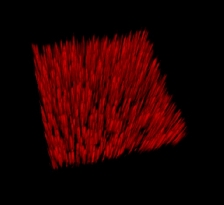 |
| Nano-forest Photo: Aleksandra Dabkowska |
Abstract:
Vertical nanowires could be used for detailed studies of what happens on the surface of cells. The findings are important for pharmaceuticals research, among other applications. A group of researchers from Lund University in Sweden have managed to make artificial cell membranes form across a large number of vertical nanowires, known as a ‘nano-forest'.
Nano-forests to reveal secrets of cells
Lund, Sweden | Posted on September 2nd, 2014All communication between the interior of a cell and its surroundings takes place through the cell membrane. The membrane is a surface layer that holds the cell together and that largely comprises lipids, built of fatty acids. Inside the cell there are also various types of membrane, all with their own specific role.
Studies of cell membranes using nanotechnology have up to now mainly involved studying artificial membranes on flat surfaces, but because many membranes in the body have a curved shape, a different type of nano-surface is needed. In a new scientific study, researchers from Lund University have used vertical nanowires to create more varied surfaces on which artificial membranes can form. The Lund researchers have built an entire forest of upright nanowires on a one millimetre squared surface, on which they have succeeded in forming artificial membranes that are curved in the same way as many natural cell membranes.
"Our research demonstrates that artificial membranes can follow the curved surface formed by the nanowires, which creates unique opportunities to study membranes in a curved state", said Aleksandra Dabkowska from the Department of Chemistry at Lund University.
The nanowires also act as fine feelers that can measure how the membrane works. For instance, the vertical nanowires can be used to study different proteins that are active in the body's cell membranes. Because of their barrier function on the surface of the cell, these proteins are the target of a range of different drugs. The nano-forest could therefore be of great importance for pharmaceutical research, as well as for basic cell research, partly because the nano-surfaces are very precisely controlled as regards the length, thickness and spacing of the nanowires, and partly because the nano-forest multiplies the total study surface compared with a flat nano-landscape.
The present study is a close collaboration between researchers within the Nanometre Structure Consortium at Lund University who come from the Divisions of Physical Chemistry and Solid State Physics at the faculties of Science and Engineering.
####
For more information, please click here
Contacts:
Aleksandra Dabkowska
46-462-228-148
Copyright © Lund University
If you have a comment, please Contact us.Issuers of news releases, not 7th Wave, Inc. or Nanotechnology Now, are solely responsible for the accuracy of the content.
Bookmark:


| Related Links |
| Related News Press |
News and information
 Quantum computer improves AI predictions April 17th, 2026
Flexible sensor gains sensitivity under pressure April 17th, 2026
A reusable chip for particulate matter sensing April 17th, 2026
Detecting vibrational quantum beating in the predissociation dynamics of SF6 using time-resolved photoelectron spectroscopy April 17th, 2026
Nanomedicine
A fundamentally new therapeutic approach to cystic fibrosis: Nanobody repairs cellular defect April 17th, 2026
New molecular technology targets tumors and simultaneously silences two ‘undruggable’ cancer genes August 8th, 2025
New imaging approach transforms study of bacterial biofilms August 8th, 2025
Electrifying results shed light on graphene foam as a potential material for lab grown cartilage June 6th, 2025
Discoveries
Quantum computer improves AI predictions April 17th, 2026
Flexible sensor gains sensitivity under pressure April 17th, 2026
A reusable chip for particulate matter sensing April 17th, 2026
Detecting vibrational quantum beating in the predissociation dynamics of SF6 using time-resolved photoelectron spectroscopy April 17th, 2026
Announcements
A fundamentally new therapeutic approach to cystic fibrosis: Nanobody repairs cellular defect April 17th, 2026
UC Irvine physicists discover method to reverse ‘quantum scrambling’ : The work addresses the problem of information loss in quantum computing system April 17th, 2026
Interviews/Book Reviews/Essays/Reports/Podcasts/Journals/White papers/Posters
A fundamentally new therapeutic approach to cystic fibrosis: Nanobody repairs cellular defect April 17th, 2026
UC Irvine physicists discover method to reverse ‘quantum scrambling’ : The work addresses the problem of information loss in quantum computing system April 17th, 2026
Nanobiotechnology
A fundamentally new therapeutic approach to cystic fibrosis: Nanobody repairs cellular defect April 17th, 2026
New molecular technology targets tumors and simultaneously silences two ‘undruggable’ cancer genes August 8th, 2025
New imaging approach transforms study of bacterial biofilms August 8th, 2025
Electrifying results shed light on graphene foam as a potential material for lab grown cartilage June 6th, 2025
 |
||
 |
||
| The latest news from around the world, FREE | ||
 |
||
|
|
||
| Premium Products | ||
 |
||
|
Only the news you want to read!
Learn More |
||
 |
||
|
Full-service, expert consulting
Learn More |
||
|
|
||