Home > Press > Deeper insights into protein folding: Study presents a new theoretical foundation explaining the mechanism of protein folding and unfolding in water
 |
| “Structure of staphylococcal nuclease" © Yakubovich et al. |
Abstract:
Investigating the structure and dynamics of so-called Meso-Bio-Nano (MBN) systems—micron-sized biological or nanotechnology entities—is a rapidly expanding field of science. Now, scientists Alexander Yakubovich and Andrey Solov'yov from MBN Research Centre in Frankfurt, Germany, have produced a new theoretical study of a protein macromolecule changing from a coil structural conformation to a globular one. Their statistic mechanics model, just published in EPJ D, describes the thermodynamic properties of real proteins in an aqueous environment, using a minimal number of free physical parameters.
Deeper insights into protein folding: Study presents a new theoretical foundation explaining the mechanism of protein folding and unfolding in water
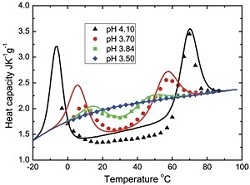
Heidelberg, Germany | Posted on June 26th, 2014In this work, the authors confirmed the validity of their theoretical calculation of dependencies of the protein heat capacities on temperature by comparing it with the corresponding experimental measurements for two proteins, namely an enzyme called staphylococcal nuclease and an oxygen and iron carrier protein called metmyoglobin. Sudden changes in temperature could result in the loss of a protein's three-dimensional structure and function. Thus, these findings could contribute to our understanding of high-energy ions therapy on biological cells.
In this work, the authors focus on the folding and unfolding of globular proteins at various levels of temperature in an aqueous environment. Their statistical mechanics model is inspired by a pre-existing model of solvation of hydrophobic hydrocarbons. This leads to establishing the so-called partition function of this globular protein in water environment. In turn, this helps to determine all of the protein's thermodynamic characteristics at equilibrium. These include its heat capacity and the average number of amino acids in an unfolded conformation.
The study validates the use of an approximation of three stages of macromolecular complexes undergoing folding and unfolding transformations, instead of using fitting parameters as previously done. These results also significantly expand the possibilities of quantitative description of the structure conformation processes for other proteins obeying simple folding kinetics and complex multi-domain proteins with peculiar folding profiles.
####
For more information, please click here
Contacts:
Saskia Rohmer
49-622-148-78414
Copyright © Springer
If you have a comment, please Contact us.Issuers of news releases, not 7th Wave, Inc. or Nanotechnology Now, are solely responsible for the accuracy of the content.
Bookmark:


| Related Links |
| Related News Press |
News and information
 Quantum computer improves AI predictions April 17th, 2026
Flexible sensor gains sensitivity under pressure April 17th, 2026
A reusable chip for particulate matter sensing April 17th, 2026
Detecting vibrational quantum beating in the predissociation dynamics of SF6 using time-resolved photoelectron spectroscopy April 17th, 2026
Nanomedicine
A fundamentally new therapeutic approach to cystic fibrosis: Nanobody repairs cellular defect April 17th, 2026
New molecular technology targets tumors and simultaneously silences two ‘undruggable’ cancer genes August 8th, 2025
New imaging approach transforms study of bacterial biofilms August 8th, 2025
Electrifying results shed light on graphene foam as a potential material for lab grown cartilage June 6th, 2025
Discoveries
Quantum computer improves AI predictions April 17th, 2026
Flexible sensor gains sensitivity under pressure April 17th, 2026
A reusable chip for particulate matter sensing April 17th, 2026
Detecting vibrational quantum beating in the predissociation dynamics of SF6 using time-resolved photoelectron spectroscopy April 17th, 2026
Announcements
A fundamentally new therapeutic approach to cystic fibrosis: Nanobody repairs cellular defect April 17th, 2026
UC Irvine physicists discover method to reverse ‘quantum scrambling’ : The work addresses the problem of information loss in quantum computing system April 17th, 2026
Interviews/Book Reviews/Essays/Reports/Podcasts/Journals/White papers/Posters
A fundamentally new therapeutic approach to cystic fibrosis: Nanobody repairs cellular defect April 17th, 2026
UC Irvine physicists discover method to reverse ‘quantum scrambling’ : The work addresses the problem of information loss in quantum computing system April 17th, 2026
Nanobiotechnology
A fundamentally new therapeutic approach to cystic fibrosis: Nanobody repairs cellular defect April 17th, 2026
New molecular technology targets tumors and simultaneously silences two ‘undruggable’ cancer genes August 8th, 2025
New imaging approach transforms study of bacterial biofilms August 8th, 2025
Electrifying results shed light on graphene foam as a potential material for lab grown cartilage June 6th, 2025
 |
||
 |
||
| The latest news from around the world, FREE | ||
 |
||
|
|
||
| Premium Products | ||
 |
||
|
Only the news you want to read!
Learn More |
||
 |
||
|
Full-service, expert consulting
Learn More |
||
|
|
||