Home > Press > Stem cells are a soft touch for nano-engineered biomaterials
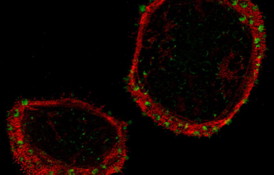 |
| This photo shows cells adhering to large nanopatterns. The green dots indicate the sites of adhesions, and the red area shows where molecules responsible for contracting the cells are located. |
Abstract:
Scientists from Queen Mary University of London have shown that stem cell behaviour can be modified by manipulating the nanoscale properties of the material they are grown on - improving the potential of regenerative medicine and tissue engineering as a result.
Stem cells are a soft touch for nano-engineered biomaterials
London, UK | Posted on June 9th, 2014Stem cells are special because they are essential to the normal function of our organs and tissues. Previous research shows stem cells grown on hard substrates go on to multiply but do not differentiate: a process by which the cells specialise to perform specific functions in the body. In contrast, stem cells grown on softer surfaces do go on to differentiate.
In this new study, published in the journal Nano Letters, the researchers used tiny material patches known as nanopatches to alter the surface of the substrate and mimic the properties of a softer material.
"By changing the surface properties like the shape of the substrate at the nanoscale level, we tricked the stem cells to behave differently," explains co-author Dr Julien Gautrot, from QMUL's School of Engineering and Materials Science and the Institute of Bioengineering.
The team tested different sizes of nanopatches - from 3 microns to 100 nanometres (about one thousandth of the diameter of a hair). The stem cells behaved as if they were on a soft surface when in contact with the smallest patches because they can't firmly grip them.
Dr Gautrot added: "This development will be useful when there's a need to create a rigid implant to be inserted into the body. Potentially, such nanopatches could provide a soft touch to the surface of the implant so that cells from the neighbouring tissues are not perturbed by such a hard material."
####
For more information, please click here
Contacts:
Neha Okhandiar
020-788-27927
Copyright © Queen Mary, University of London
If you have a comment, please Contact us.Issuers of news releases, not 7th Wave, Inc. or Nanotechnology Now, are solely responsible for the accuracy of the content.
Bookmark:


| Related News Press |
News and information
 Quantum computer improves AI predictions April 17th, 2026
Flexible sensor gains sensitivity under pressure April 17th, 2026
A reusable chip for particulate matter sensing April 17th, 2026
Detecting vibrational quantum beating in the predissociation dynamics of SF6 using time-resolved photoelectron spectroscopy April 17th, 2026
Nanomedicine
A fundamentally new therapeutic approach to cystic fibrosis: Nanobody repairs cellular defect April 17th, 2026
New molecular technology targets tumors and simultaneously silences two ‘undruggable’ cancer genes August 8th, 2025
New imaging approach transforms study of bacterial biofilms August 8th, 2025
Electrifying results shed light on graphene foam as a potential material for lab grown cartilage June 6th, 2025
Discoveries
Quantum computer improves AI predictions April 17th, 2026
Flexible sensor gains sensitivity under pressure April 17th, 2026
A reusable chip for particulate matter sensing April 17th, 2026
Detecting vibrational quantum beating in the predissociation dynamics of SF6 using time-resolved photoelectron spectroscopy April 17th, 2026
Announcements
A fundamentally new therapeutic approach to cystic fibrosis: Nanobody repairs cellular defect April 17th, 2026
UC Irvine physicists discover method to reverse ‘quantum scrambling’ : The work addresses the problem of information loss in quantum computing system April 17th, 2026
Interviews/Book Reviews/Essays/Reports/Podcasts/Journals/White papers/Posters
A fundamentally new therapeutic approach to cystic fibrosis: Nanobody repairs cellular defect April 17th, 2026
UC Irvine physicists discover method to reverse ‘quantum scrambling’ : The work addresses the problem of information loss in quantum computing system April 17th, 2026
 |
||
 |
||
| The latest news from around the world, FREE | ||
 |
||
|
|
||
| Premium Products | ||
 |
||
|
Only the news you want to read!
Learn More |
||
 |
||
|
Full-service, expert consulting
Learn More |
||
|
|
||