Home > Press > Scientists develop new hybrid energy transfer system
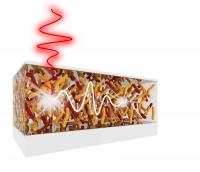 |
| This is the device trapping photons between two mirrors in which two different organic molecules reside.
Credit: University of Southampton |
Abstract:
Scientists from the University of Southampton, in collaboration with the Universities of Sheffield and Crete, have developed a new hybrid energy transfer system, which mimics the processes responsible for photosynthesis.
Scientists develop new hybrid energy transfer system
Southampton, UK | Posted on May 27th, 2014From photosynthesis to respiration, the processes of light absorption and its transfer into energy represent elementary and essential reactions that occur in any biological living system.
This energy transfer is known as Forster Resonance Energy Transfer (FRET), a radiationless transmission of energy that occurs on the nanometer scale from a donor molecule to an acceptor molecule. The donor molecule is the dye or chromophore that initially absorbs the energy and the acceptor is the chromophore to which the energy is subsequently transferred without any molecular collision. However, FRET is a strongly distance dependent process which occurs over a scale of typically 1 to 10 nm.
In a new study, published in the journal Nature Materials, the researchers demonstrate an alternate non-radiative, intermolecular energy transfer that exploits the intermediating role of light confined in an optical cavity. The advantage of this new technique which exploits the formation of quantum states admixture of light and matter, is the length over which the interaction takes places, that is in fact, considerably longer than conventional FRET-type processes.
Co-author Dr Niccolo Somaschi, from the University of Southampton's Hybrid Photonics group (which is led by Professor Pavlos Lagoudakis, co-author of the paper), says: "The possibility to transfer energy over distances comparable to the wavelength of light has the potential to be of both fundamental and applied interest. Our deep understanding of energy transfer elucidates the basic mechanisms behind the process of photosynthesis in biological systems and therefore gets us closer to the reproduction of fully synthetic systems which mimic biological functionalities. At the fundamental level, the present work suggests that the coherent coupling of molecules may be directly involved in the energy transfer process which occurs in the photosynthesis.
"On the applied perspective instead, organic semiconductors continue to receive significant interest for application in optoelectronic devices, for example light-emitting or photovoltaic devices, in which performance is dependent on our ability to control the formation and transport of carriers in molecular systems."
The new device consists of an optical cavity made by two metallic mirrors which trap the photons in a confined environment where two different organic molecules reside in. By engineering the spacing between the mirrors based on the optical properties of the organic materials, it is possible to create a new quantum state that is a combination of the trapped photons and the excited states in the molecules. The photon essentially "glues" together these quantum mechanical states, forming a new half-light half-matter particle, called polariton, which is responsible for the efficient transfer of energy from one material to the other.
####
For more information, please click here
Contacts:
Glenn Harris
44-023-805-93212
Copyright © University of Southampton
If you have a comment, please Contact us.Issuers of news releases, not 7th Wave, Inc. or Nanotechnology Now, are solely responsible for the accuracy of the content.
Bookmark:


| Related News Press |
News and information
 Quantum computer improves AI predictions April 17th, 2026
Flexible sensor gains sensitivity under pressure April 17th, 2026
A reusable chip for particulate matter sensing April 17th, 2026
Detecting vibrational quantum beating in the predissociation dynamics of SF6 using time-resolved photoelectron spectroscopy April 17th, 2026
Discoveries
Quantum computer improves AI predictions April 17th, 2026
Flexible sensor gains sensitivity under pressure April 17th, 2026
A reusable chip for particulate matter sensing April 17th, 2026
Detecting vibrational quantum beating in the predissociation dynamics of SF6 using time-resolved photoelectron spectroscopy April 17th, 2026
Announcements
A fundamentally new therapeutic approach to cystic fibrosis: Nanobody repairs cellular defect April 17th, 2026
UC Irvine physicists discover method to reverse ‘quantum scrambling’ : The work addresses the problem of information loss in quantum computing system April 17th, 2026
Interviews/Book Reviews/Essays/Reports/Podcasts/Journals/White papers/Posters
A fundamentally new therapeutic approach to cystic fibrosis: Nanobody repairs cellular defect April 17th, 2026
UC Irvine physicists discover method to reverse ‘quantum scrambling’ : The work addresses the problem of information loss in quantum computing system April 17th, 2026
Battery Technology/Capacitors/Generators/Piezoelectrics/Thermoelectrics/Energy storage
Decoding hydrogen‑bond network of electrolyte for cryogenic durable aqueous zinc‑ion batteries January 30th, 2026
COF scaffold membrane with gate‑lane nanostructure for efficient Li+/Mg2+ separation January 30th, 2026
MXene nanomaterials enter a new dimension Multilayer nanomaterial: MXene flakes created at Drexel University show new promise as 1D scrolls January 30th, 2026
Research partnerships
Lab to industry: InSe wafer-scale breakthrough for future electronics August 8th, 2025
HKU physicists uncover hidden order in the quantum world through deconfined quantum critical points April 25th, 2025
Solar/Photovoltaic
Spinel-type sulfide semiconductors to operate the next-generation LEDs and solar cells For solar-cell absorbers and green-LED source October 3rd, 2025
KAIST researchers introduce new and improved, next-generation perovskite solar cell November 8th, 2024
Groundbreaking precision in single-molecule optoelectronics August 16th, 2024
Development of zinc oxide nanopagoda array photoelectrode: photoelectrochemical water-splitting hydrogen production January 12th, 2024
Quantum nanoscience
Beyond silicon: Electronics at the scale of a single molecule January 30th, 2026
MXene nanomaterials enter a new dimension Multilayer nanomaterial: MXene flakes created at Drexel University show new promise as 1D scrolls January 30th, 2026
ICFO researchers overcome long-standing bottleneck in single photon detection with twisted 2D materials August 8th, 2025
 |
||
 |
||
| The latest news from around the world, FREE | ||
 |
||
|
|
||
| Premium Products | ||
 |
||
|
Only the news you want to read!
Learn More |
||
 |
||
|
Full-service, expert consulting
Learn More |
||
|
|
||