Home > Press > Nanocrystalline cellulose modified into an efficient viral inhibitor
 |
| Ari Hinkkanen and Janne Ruotsalainen, University of Eastern Finland, and Aalto University |
Abstract:
Researchers have succeeded in creating a surface on nano-sized cellulose crystals that imitates a biological structure. The surface adsorbs viruses and disables them. The results can prove useful in the development of antiviral ointments and surfaces, for instance.
Nanocrystalline cellulose modified into an efficient viral inhibitor
Helsinki, Finland | Posted on April 15th, 2014There are many viral diseases in the world for which no pharmaceutical treatment exists. These include, among others, dengue fever, which is spread by mosquitoes in the tropics, as well as a type of diarrhea, which is more familiar in Finland and is easily spread by the hands and can be dangerous especially for small children and the elderly.
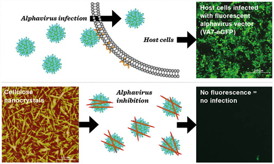
Researchers at Aalto University and the University of Eastern Finland have now succeeded in preliminary tests to prevent the spread of one type of virus into cells with the help of a new type of nanocrystalline cellulose. Nano-sized cellulose crystals were manufactured out of cotton fibre or filter paper with the help of sulphuric acid, causing sulphate ions with negative charges to attach to their surfaces. The ions then attached to alphaviruses used in the test and neutralised them. When the researchers replaced the sulphate ions with cellulose derivatives that imitate tyrosine sulphates, the activity of the viruses was further reduced. The experiments succeeded in preventing viral infection in 88-100 percent of the time with no noticeable effect on the viability of the cells by the nanoparticles. The research findings were published in the journal Biomacromolecules.
Small size is a great advantage
The coordinator of the research, Jukka Seppälä, Professor of Polymer Technology at Aalto University, sees the results as a good example of the possibilities that could be advanced with nanotechnology.
'Certain cellulose derivatives had been seen to have an impact on viruses before. The nano scale increases the proportion of the surface area to that of the number of grams to a very high level, which is an advantage, because viruses specifically attach themselves to surfaces. Making the cellulose crystals biomimetic, which means that they mimic biological structures, was an important step, as we know that in nature viruses often interact specifically with tyrosine structures,' he says.
Both Jukka Seppälä and Ari Hinkkanen, Professor of Gene Transfer Technology at the University of Eastern Finland, emphasise that the research is still in the early stages.
‘Now we know that the attachment of a certain alphavirus can be effectively prevented when we use large amounts of nanocrystalline cellulose. Next we need to experiment with other alpha viruses and learn to better understand the mechanisms that prevent viral infection. In addition, it is necessary to ascertain if cellulose can also block other viruses and in what conditions, and to investigate whether or not the sulphates have a deleterious effects on an organism,' Ari Hinkkanen explains.
According to Kristiina Järvinen, Professor of Pharmaceutical Technology at the University of Eastern Finland, there are many routes that can be taken in the commercialisation of the results. The development of an antiviral medicine is the most distant of these; the idea could be sooner applied in disinfectant ointments and coatings, for instance.
‘It would be possible to provide protection against viruses, spread by mosquitoes, by applying ointment containing nanocrystalline cellulose onto the skin. Nanocrystalline cellulose applied on hospital door handles could kill viruses and prevent them from spreading. However, we first need to ascertain if the compounds will remain effective in a non-liquid form and how they work in animal tests,' she ponders.
####
For more information, please click here
Contacts:
Minna Hölttä
358-505-396-229
Copyright © Aalto University
If you have a comment, please Contact us.Issuers of news releases, not 7th Wave, Inc. or Nanotechnology Now, are solely responsible for the accuracy of the content.
Bookmark:


| Related Links |
| Related News Press |
News and information
 Quantum computer improves AI predictions April 17th, 2026
Flexible sensor gains sensitivity under pressure April 17th, 2026
A reusable chip for particulate matter sensing April 17th, 2026
Detecting vibrational quantum beating in the predissociation dynamics of SF6 using time-resolved photoelectron spectroscopy April 17th, 2026
Nanomedicine
A fundamentally new therapeutic approach to cystic fibrosis: Nanobody repairs cellular defect April 17th, 2026
New molecular technology targets tumors and simultaneously silences two ‘undruggable’ cancer genes August 8th, 2025
New imaging approach transforms study of bacterial biofilms August 8th, 2025
Electrifying results shed light on graphene foam as a potential material for lab grown cartilage June 6th, 2025
Discoveries
Quantum computer improves AI predictions April 17th, 2026
Flexible sensor gains sensitivity under pressure April 17th, 2026
A reusable chip for particulate matter sensing April 17th, 2026
Detecting vibrational quantum beating in the predissociation dynamics of SF6 using time-resolved photoelectron spectroscopy April 17th, 2026
Announcements
A fundamentally new therapeutic approach to cystic fibrosis: Nanobody repairs cellular defect April 17th, 2026
UC Irvine physicists discover method to reverse ‘quantum scrambling’ : The work addresses the problem of information loss in quantum computing system April 17th, 2026
Interviews/Book Reviews/Essays/Reports/Podcasts/Journals/White papers/Posters
A fundamentally new therapeutic approach to cystic fibrosis: Nanobody repairs cellular defect April 17th, 2026
UC Irvine physicists discover method to reverse ‘quantum scrambling’ : The work addresses the problem of information loss in quantum computing system April 17th, 2026
 |
||
 |
||
| The latest news from around the world, FREE | ||
 |
||
|
|
||
| Premium Products | ||
 |
||
|
Only the news you want to read!
Learn More |
||
 |
||
|
Full-service, expert consulting
Learn More |
||
|
|
||