Home > Press > Clever NIST/JPL technology decodes more information from single photons
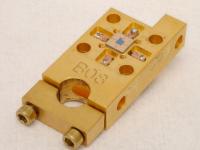 |
| This NIST device, 1.5 by 3 centimeters in outer dimensions, is a prototype receiver for laser communications enabling much higher data rates than conventional systems. Superconducting detectors in the center of the small square chip register the timing and position of single particles of light.
Credit: Verma and Tomlin/NIST |
Abstract:
It's not quite Star Trek communications—yet. But long-distance communications in space may be easier now that researchers at the National Institute of Standards and Technology (NIST) and Jet Propulsion Laboratory (JPL) have designed a clever detector array that can extract more information than usual from single particles of light.
Clever NIST/JPL technology decodes more information from single photons
Boulder, CO | Posted on February 12th, 2014Described in a new paper,* the NIST/JPL array-on-a-chip easily identifies the position of the exact detector in a multi-detector system that absorbs an incoming infrared light particle, or photon. That's the norm for digital photography cameras, of course, but a significant improvement in these astonishingly sensitive detectors that can register a single photon. The new device also records the signal timing, as these particular single-photon detectors have always done.
The technology could be useful in optical communications in space. Lasers can transmit only very low light levels across vast distances, so signals need to contain as much information as possible.
One solution is "pulse position modulation" in which a photon is transmitted at different times and positions to encode more than the usual one bit of information. If a light source transmitted photons slightly to the left/right and up/down, for instance, then the new NIST/JPL detector array circuit could decipher the two bits of information encoded in the spatial position of the photon. Additional bits of information could be encoded by using the arrival time of the photon.
The same NIST/JPL collaboration recently produced detector arrays for the first demonstration of two-way laser communications outside Earth's orbit using the timing version of pulse position modulation.** The new NIST/JPL paper shows how to make an even larger array of detectors for future communications systems.
The new technology uses superconducting nanowire single-photon detectors. The current design can count tens of millions of photons per second but the researchers say it could be scaled up to a system capable of counting of nearly a billion photons per second with low dark (false) counts. The key innovation enabling the latest device was NIST's 2011 introduction of a new detector material, tungsten-silicide, which boosted efficiency, the ability to generate an electrical signal for each arriving photon.*** Detector efficiency now exceeds 90 percent. Other materials are less efficient and would be more difficult to incorporate into complex circuits.
The detectors superconduct at cryogenic temperatures (about minus 270 °C or minus 454 °F), and cooling needs set a limit on wiring complexity. The NIST/JPL scheme requires only twice as many wires (2N) as the number of detectors on one side of a square array (N x N), greatly reducing cooling loads compared to a one-wire-per-detector approach while maintaining high timing accuracy. NIST researchers demonstrated the scheme for a four-detector array with four wires and are now working on a 64-detector array with 16 wires.
In the circuit, each detector is located in a specific column and row of the square array. Each detector acts like an electrical switch. When the detector is in the superconducting state, the switch is closed and the current is equally distributed among all detectors in that column. When a detector absorbs a photon, the switch opens, temporarily diverting the current to an amplifier for the affected column while reducing the signal through the affected row. As a result, the circuit generates a voltage spike in the column readout and a voltage dip in the row readout. The active detector is at the intersection of the active column and row.
###
The research was supported by the Defense Advanced Research Projects Agency.
*V.B. Verma, R. Horansky, F. Marsili, J.A. Stern, M.D. Shaw, A.E. Lita, R.P. Mirin and S.W. Nam. A four-pixel single-photon pulse position camera fabricated from WSi superconducting nanowire single photon detectors. Applied Physics Letters 104, 051115. DOI: 10.1063/1.4864075. Posted online Feb. 4, 2014.
####
About National Institute of Standards and Technology (NIST)
The National Institute of Standards and Technology (NIST) is an agency of the U.S. Department of Commerce.
For more information, please click here
Contacts:
Laura Ost
303-497-4880
Copyright © National Institute of Standards and Technology (NIST)
If you have a comment, please Contact us.Issuers of news releases, not 7th Wave, Inc. or Nanotechnology Now, are solely responsible for the accuracy of the content.
Bookmark:


| Related Links |
| Related News Press |
News and information
 Quantum computer improves AI predictions April 17th, 2026
Flexible sensor gains sensitivity under pressure April 17th, 2026
A reusable chip for particulate matter sensing April 17th, 2026
Detecting vibrational quantum beating in the predissociation dynamics of SF6 using time-resolved photoelectron spectroscopy April 17th, 2026
Superconductivity
MXene nanomaterials enter a new dimension Multilayer nanomaterial: MXene flakes created at Drexel University show new promise as 1D scrolls January 30th, 2026
Lattice-driven charge density wave fluctuations far above the transition temperature in Kagome superconductor April 25th, 2025
Laboratories
Researchers develop molecular qubits that communicate at telecom frequencies October 3rd, 2025
Wireless/telecommunications/RF/Antennas/Microwaves
Researchers develop molecular qubits that communicate at telecom frequencies October 3rd, 2025
Govt.-Legislation/Regulation/Funding/Policy
Quantum computer improves AI predictions April 17th, 2026
Metasurfaces smooth light to boost magnetic sensing precision January 30th, 2026
New imaging approach transforms study of bacterial biofilms August 8th, 2025
Discoveries
Quantum computer improves AI predictions April 17th, 2026
Flexible sensor gains sensitivity under pressure April 17th, 2026
A reusable chip for particulate matter sensing April 17th, 2026
Detecting vibrational quantum beating in the predissociation dynamics of SF6 using time-resolved photoelectron spectroscopy April 17th, 2026
Announcements
A fundamentally new therapeutic approach to cystic fibrosis: Nanobody repairs cellular defect April 17th, 2026
UC Irvine physicists discover method to reverse ‘quantum scrambling’ : The work addresses the problem of information loss in quantum computing system April 17th, 2026
Interviews/Book Reviews/Essays/Reports/Podcasts/Journals/White papers/Posters
A fundamentally new therapeutic approach to cystic fibrosis: Nanobody repairs cellular defect April 17th, 2026
UC Irvine physicists discover method to reverse ‘quantum scrambling’ : The work addresses the problem of information loss in quantum computing system April 17th, 2026
Military
Quantum engineers ‘squeeze’ laser frequency combs to make more sensitive gas sensors January 17th, 2025
Chainmail-like material could be the future of armor: First 2D mechanically interlocked polymer exhibits exceptional flexibility and strength January 17th, 2025
Single atoms show their true color July 5th, 2024
NRL charters Navy’s quantum inertial navigation path to reduce drift April 5th, 2024
Aerospace/Space
Decoding hydrogen‑bond network of electrolyte for cryogenic durable aqueous zinc‑ion batteries January 30th, 2026
ICFO researchers overcome long-standing bottleneck in single photon detection with twisted 2D materials August 8th, 2025
Onion-like nanoparticles found in aircraft exhaust May 14th, 2025
Photonics/Optics/Lasers
Metasurfaces smooth light to boost magnetic sensing precision January 30th, 2026
From sensors to smart systems: the rise of AI-driven photonic noses January 30th, 2026
 |
||
 |
||
| The latest news from around the world, FREE | ||
 |
||
|
|
||
| Premium Products | ||
 |
||
|
Only the news you want to read!
Learn More |
||
 |
||
|
Full-service, expert consulting
Learn More |
||
|
|
||