Home > Press > A magnetic nanoparticles-based method for DNA extraction from the saliva after stroke
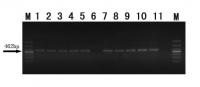 |
| PCR products of methylenetetrahydrofolate reductase C677T DNA samples extracted with magnetic nanoparticles using saliva samples (lanes 1) and with traditional methods using blood samples (lanes 7).
Credit: Neural Regeneration Research |
Abstract:
C677T polymorphism in the methylenetetrahydrofolate reductase (MTHFR) gene is a risk factor for stroke. Studies have report a higher C677T homozygosity frequency in Chinese than in Europeans.
A magnetic nanoparticles-based method for DNA extraction from the saliva after stroke
Shenyang, PR China | Posted on December 24th, 2013Usually, the detection of genetic diseases is rather complicated on a large scale owing to the invasive sampling and a cumbersome DNA extraction process. In a study by Dr. Li Yi and team from Peking University Shenzhen Hospital in China, DNA from stroke patients and healthy controls was extracted from the saliva using a magnetic nanoparticles-based method and from the blood using conventional methods. Real-time PCR results revealed that the C677T polymorphism was genotyped by PCR using DNA extracted from both saliva and blood samples. The genotype results were confirmed by gene sequencing, and results for saliva and blood samples were consistent. Therefore, this noninvasive magnetic nanoparticles-based method using saliva samples could be used to screen for the MTHFR C677T polymorphism in target populations. This study was published in the Neural Regeneration Research (Vol. 8, No. 32, 2013).
####
For more information, please click here
Contacts:
Meng Zhao
86-138-049-98773
Neural Regeneration Research
Copyright © Neural Regeneration Research
If you have a comment, please Contact us.Issuers of news releases, not 7th Wave, Inc. or Nanotechnology Now, are solely responsible for the accuracy of the content.
Bookmark:


| Related Links |
| Related News Press |
News and information
 Quantum computer improves AI predictions April 17th, 2026
Flexible sensor gains sensitivity under pressure April 17th, 2026
A reusable chip for particulate matter sensing April 17th, 2026
Detecting vibrational quantum beating in the predissociation dynamics of SF6 using time-resolved photoelectron spectroscopy April 17th, 2026
Nanomedicine
A fundamentally new therapeutic approach to cystic fibrosis: Nanobody repairs cellular defect April 17th, 2026
New molecular technology targets tumors and simultaneously silences two ‘undruggable’ cancer genes August 8th, 2025
New imaging approach transforms study of bacterial biofilms August 8th, 2025
Electrifying results shed light on graphene foam as a potential material for lab grown cartilage June 6th, 2025
Discoveries
Quantum computer improves AI predictions April 17th, 2026
Flexible sensor gains sensitivity under pressure April 17th, 2026
A reusable chip for particulate matter sensing April 17th, 2026
Detecting vibrational quantum beating in the predissociation dynamics of SF6 using time-resolved photoelectron spectroscopy April 17th, 2026
Announcements
A fundamentally new therapeutic approach to cystic fibrosis: Nanobody repairs cellular defect April 17th, 2026
UC Irvine physicists discover method to reverse ‘quantum scrambling’ : The work addresses the problem of information loss in quantum computing system April 17th, 2026
Interviews/Book Reviews/Essays/Reports/Podcasts/Journals/White papers/Posters
A fundamentally new therapeutic approach to cystic fibrosis: Nanobody repairs cellular defect April 17th, 2026
UC Irvine physicists discover method to reverse ‘quantum scrambling’ : The work addresses the problem of information loss in quantum computing system April 17th, 2026
 |
||
 |
||
| The latest news from around the world, FREE | ||
 |
||
|
|
||
| Premium Products | ||
 |
||
|
Only the news you want to read!
Learn More |
||
 |
||
|
Full-service, expert consulting
Learn More |
||
|
|
||